

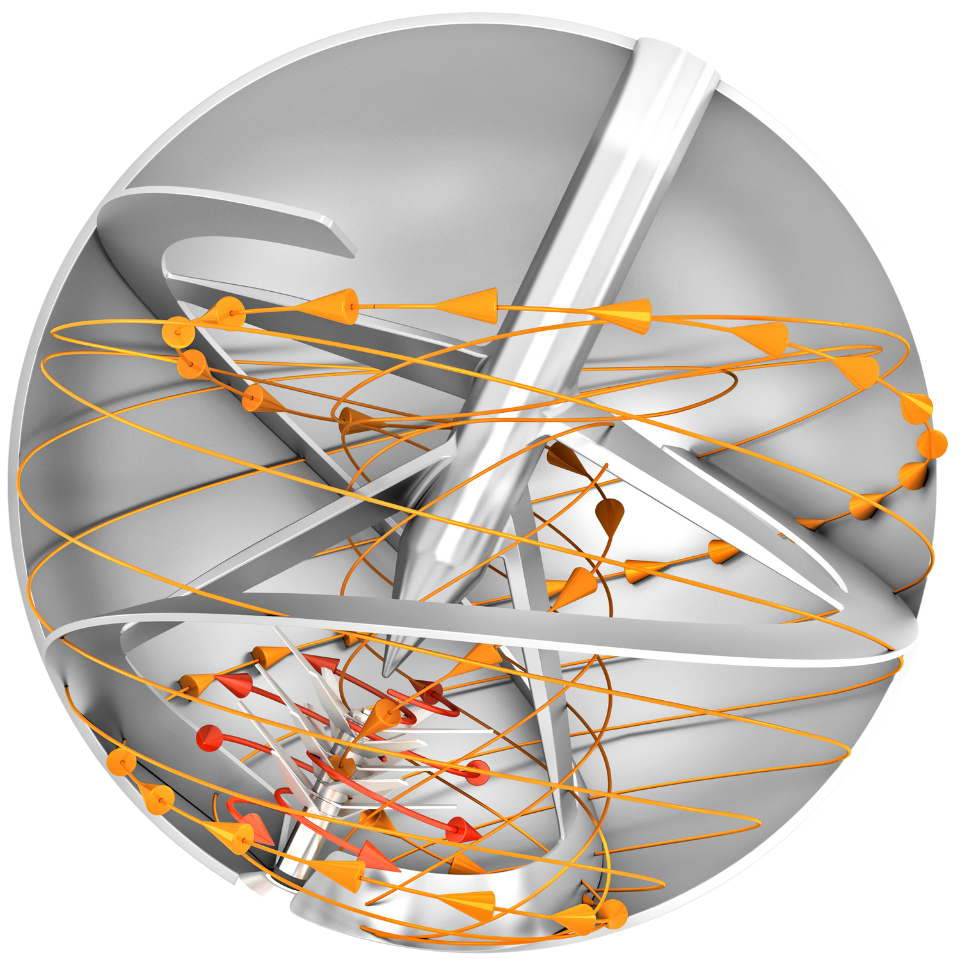

SpherHelics® Hollow spherical mixer Type SH
amixon® manufactures various types of hollow sphere mixers. There are currently 23 different sizes available. Batch volumes range from 50 litres to 14,000 litres. The spiral-shaped mixing blades rotate within the hollow sphere around an inclined axis. This axis is inclined at an angle of 20° to 30°. An inclination of, for example, 23.4° (the Earth’s axial tilt) is also possible. Detailed information on ball mixers can be found here.
Even though the mixing shaft is mounted at an angle, this type of mixer belongs to the category of vertical mixers. This is the case with the amixon® spherical mixer. Its mixing performance is positively influenced by the inclined position of the mixing shaft.
The highest mixing quality in the shortest possible time
All amixon® mixers achieve ideal mixing quality – regardless of whether coarse or very fine particles are being mixed. In practice, an ideal distribution is achieved when the coefficient of variation of the mixing quality is less than 5 per cent. This is already the case with sample quantities* of just 20 g and for component ratios of up to 1:100,000 – regardless of whether the ball mill is fully or only partially filled. The ball mill achieves this mixing quality after just a few minutes of mixing: all components of the formulation are then perfectly distributed.
*) The finer the powders to be mixed, the smaller the sample size can be.
Calculation of the turnover frequency
The turnover frequency describes how often the helical mixing tool must rotate in order to completely redistribute the entire batch within the mixing chamber once. When the formula is used to compare ball mills of different sizes, it provides very reliable approximations. The more comparable the sizes being compared are, the more accurate these approximations will be:
The mixing tool’s throughput, also known as the volumetric flow rate, can be calculated using the following formula:
IV = (π / 4) · (D² − d²) · Φ · S · n · ζ
- IV: Displacement or volumetric flow rate
- D/d: Outer diameter/inner diameter of the helix
- Φ: Filling ratio (relative to the effective volume)
- S: Pitch of the helix
- n: Rotational frequency (revolutions per second)
- ζ: velocity coefficient (tool-specific)
Mixing trials provide clarity
This formula enables the sound design of mixing machines of various sizes. In particular, when extrapolating to large-volume ball mills, it helps to minimise drive power or reduce mixing time.
Our decades of experience across a wide range of industries can be complemented by your own practical trials. We therefore recommend carrying out test mixes at the amixon® Technical Centre. There, the processing variants for your process can be identified and evaluated. This forms the basis for the process engineering design of your mixer. This ensures there are no surprises later on under real operating conditions.
Mixing quality alone is rarely sufficient
Whilst a high level of mixing quality is a prerequisite for reproducible results, it is generally not sufficient on its own.
In addition to the homogeneity of a powder mixture, further quality criteria must be met. Depending on the design and operating mode of the mixer, the following powder properties can be improved:
- Particle size distribution (granulometry)
- Dust-free nature
- Flow behaviour and dosability
- Stability against segregation
- Appearance when mixing liquids with powders
- Porosity
- Agglomeration or deagglomeration
- Compressibility and tableting ability
- Dispersion and solubility behaviour in the end application
- Absence of lumps and free-flowing properties after storage
- Storage stability over extended periods
- Visual appearance after prolonged storage
There are often conflicting objectives between these properties. It is frequently the interplay of all these characteristics that determines the suitability of the mixture for the end customer. The mixing trial in the pilot plant is therefore a crucial step in selecting the most suitable mixing system or process.
From a wealth of experience to a recommendation – using in-house AI –
On request, amixon® analyses your mixing task using in-house AI. This combines the process and application know-how of amixon GmbH – documented over four decades – with the customer’s specific process requirements.
The result is a well-founded recommendation on three levels:
- the most suitable mixing system from the amixon® range,
- the most suitable mixer configuration,
- the optimal operating mode for the mixer.
Every powder mixer has a minimum and maximum filling level.
Every powder mixer has a minimum and maximum filling level that depends on its design and the process. Outside this range, the mixing effect may be insufficient. The gross volume of a hollow sphere mixer for powdered materials should be approximately one-third greater than the required batch volume. This corresponds to a filling level of approximately 75 per cent. The remaining free space allows for the bulk material movement required for the mixing process.
The filling height (z) of a hollow sphere mixer is determined by the volume of bulk material loaded (V). The calculation is based on the volume formula for a spherical cap.
V(z) = π ⋅ z² ⋅ (3 ⋅ r – z)/3
- V: volume of water
- z: fill level measured from the lowest point of the sphere
- r: inner radius of the hollow sphere
The permissible range of values is \(0\leq z\leq 2r\). Expanding for z, the formula becomes:
z=r-2r*cos((π+arccos(1-3V/(2πr^3)))/3)
As the volume of the mixing tool is not taken into account, the formula provides only an approximate value; the actual fill level is slightly higher.
amixon® has over 40 years’ experience across virtually all industries in which bulk materials are processed or refined. At the same time, the company conducts ongoing research, including in collaboration with scientists from various universities. Some of these research findings have been so significant that they have led to new products and further developments.
That is why we are always happy to invite our customers – both new and existing – to carry out mixing trials at the amixon® technical centre. There, customer-specific challenges become apparent, and amixon®’s user expertise is directly passed on to the customer.
Many of the mixers we have supplied are now over thirty years old. amixon® can adapt and upgrade even these to meet current customer requirements through a retrofit.
amixon® can manufacture FDA-compliant hollow-sphere mixers as sterile mixers. These are then designed as pressure-resistant, double-jacketed reactors. They also meet the requirements of EHEDG and 3-A Sanitary Standards.
What benefits does the user gain from an amixon® hollow-sphere mixer?
- Ideal mixing quality with very short mixing times.
- It can be used for dry, moist and paste-like materials as well as liquids.
- A pressure-resistant, double-jacketed sterile mixer (FDA-compliant) is available on request.
- Compliance with EHEDG and 3-A Sanitary Standards.
- Gentle or aggressive deagglomerating mixing – with one and the same mixer
- Rapid and precise distribution of liquid additions during mixing
- Excellent residual discharge, using ComDisc® tools on request.
- Simple and efficient cleaning: dry, damp or wet, fully automatic with WaterDragon® on request – the targeted jet nozzles are freely programmable.
- Low energy consumption and low drive power – a particularly efficient mixing process
amixon® operates more than 30 modern test mixers in Paderborn alone. This ensures that you always achieve the best results in your mixing trials.
| SpherHelics® hollow sphere mixer Type SH The type designation corresponds to the maximum batch size in liters. Highest mixing qualities can be achieved even at low filling levels. |
Approximate gross volume of the mixer | Approximate hollow sphere diameter | Approximate dimensions of different amixon® hollow sphere mixers. For exact planning, please request detailed dimension sheets from us! We will be happy to provide CAD data on request. |
The required drive power can vary greatly depending on bulk density, flow properties, rotational frequency, processing task such as e.g. deagglomeration. | |||||
|---|---|---|---|---|---|---|---|---|---|
| A | B | C | D | E | from | to | |||
| net usable capacity [Liter] | Liter | mm | mm | kW | |||||
| 400 | 524 | 1000 | 910 | 1030 | 1750 | 230 | 180 | 3 | 6 |
| 600 | 697 | 1100 | 950 | 1130 | 1830 | 230 | 180 | 5 | 11 |
| 800 | 1023 | 1250 | 1090 | 1280 | 2030 | 230 | 180 | 7 | 15 |
| 1000 | 1288 | 1350 | 1130 | 1380 | 2140 | 340 | 180 | 9 | 21 |
| 1250 | 1500 | 1420 | 1150 | 1450 | 2210 | 340 | 180 | 12 | 25 |
| 1500 | 1767 | 1500 | 1170 | 1530 | 2290 | 355 | 270 | 14 | 30 |
| 2000 | 2572 | 1700 | 1180 | 1730 | 2400 | 355 | 270 | 19 | 39 |
| 2500 | 3157 | 1820 | 1210 | 1850 | 2610 | 355 | 270 | 23 | 50 |
| 3000 | 3882 | 1950 | 1200 | 1980 | 2680 | 410 | 270 | 28 | 60 |
| 4000 | 5204 | 2150 | 1200 | 2180 | 2820 | 410 | 270 | 37 | 80 |
| 5000 | 6371 | 2300 | 1265 | 2330 | 3026 | 410 | 270 | 45 | 100 |