

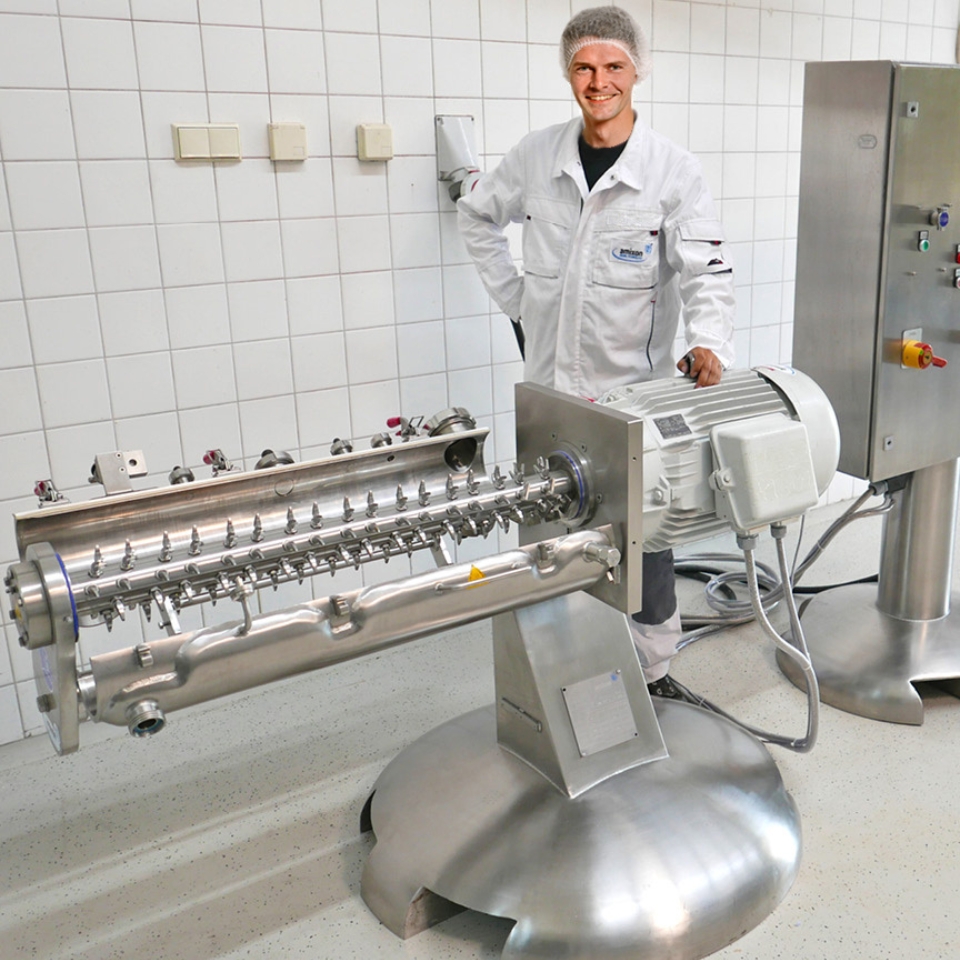


Continuous Granulator / Ring-layer mix-pelletizer (RMG)
The mixing tools of the continuous mixer are tiller or paddles. They cover the entire cylindrical mixing chamber. Dry powders can be moistened. Powders, slurries, liquids and highly viscous products can be homogenised effectively. They can be agglomerated very frequently. In this case, the ring-pan mixer works as a ring-pan granulator.
Further features of the mixer and agglomerator:
- Pins and paddles cover the entire mixing chamber at the same distance (equidistant)
- Continuous pipe flow
- several treatment zones: a) intensive mixing and deagglomeration, b) intensive wetting, c) agglomeration by build-up granulation, d) continuous discharge
- The mixing chamber is made of thick-walled sheet metal
- It is particularly round (as it is machined).
- Cleaning and inspection are facilitated by large inspection doors OmgaSeal seals the inspection doors particularly gap-free
- Test machines with dosing station available for tests
amixon can manufacture the appliances hygienically
- EHEDG
- 3-A hygiene standards
- FDA
- GMP
Extensive equipment
- Customised design adaptation to the task
- Various materials
- Wear-resistant design
- Double jacket for temperature control
- Washing-in-place equipment
Product Video


| Ring-layer mixing granulator Type RMG |
Extended residence time if the liquid distribution is difficult and/or high energy inputs are required for granulation | Short residence time if the liquid distribution is simple and the materials are particularly easy to compact | |||||||
|---|---|---|---|---|---|---|---|---|---|
| Approximate diameter of the mixing chamber | Approximate length of the mixing chamber | Estimated residence time; depending on flowability, volume flow, rotational frequency | Volume flow must be confirmed by means of tests. Obtained data are extrapolated on the basis of empirical values. | Estimated residence time; depending on flowability, volume flow, rotational frequency | Volume flow must be confirmed by means of tests. Obtained data are extrapolated on the basis of empirical values. | Data can vary greatly depending on the size of the drive and the type of execution. Please request detailed dimension sheets! Approximate dimensions |
|||
| Ø | L | A | B | D | |||||
| Type | mm | [second] | [m³/h] | [second] | [m³/h] | [mm] | |||
| 10 | 140 | 909 | 21 | 0,4 | 9 | 1,7 | 1800 | 150 | 200 |
| 30 | 203 | 1282 | 29 | 0,7 | 12 | 3,4 | 2400 | 220 | 290 |
| 50 | 242 | 1458 | 33 | 1,0 | 14 | 4,5 | 2700 | 260 | 330 |
| 400 | 491 | 2420 | 55 | 3,2 | 23 | 15,3 | 4300 | 500 | 630 |
| 600 | 563 | 2665 | 61 | 4,1 | 25 | 19,4 | 4800 | 580 | 710 |
| 3000 | 974 | 3884 | 88 | 10,1 | 37 | 49,5 | 6400 | 1100 | 1500 |