
Powder Mixers:
Operating Principle, Homogeneity and Mixing Quality
Summary
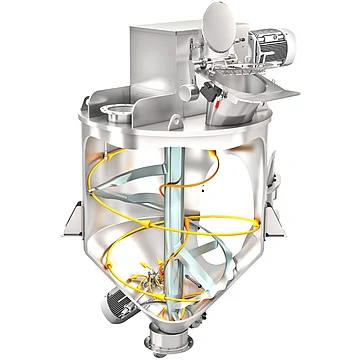
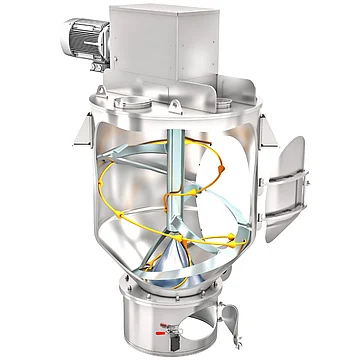
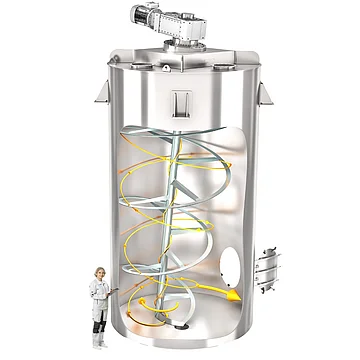
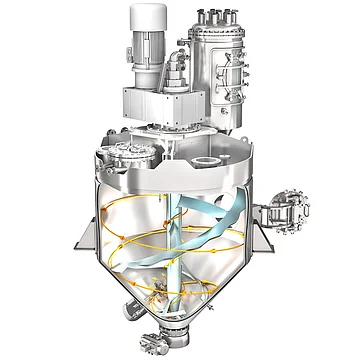
Powder mixers process dry bulk materials into a homogeneous mixture. Whether the required mixing quality can be achieved depends on the particle size, bulk density and cohesion of the raw materials, as well as the sampling strategy.
Key Facts About Powder Mixers: Operating Principle, Homogeneity and Mixing Quality
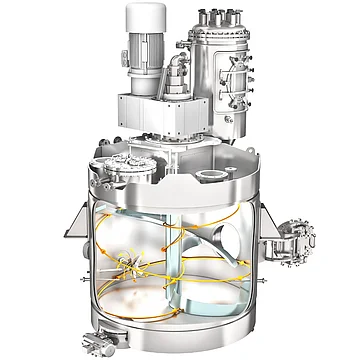
A powder mixer produces a uniform mixture from dry bulk materials by repeatedly rearranging the particles and distributing them through convective mixing and diffusion. Homogeneity describes the desired state, while mixing quality indicates how closely the mixture approaches that state. Mixing quality analysis determines this from samples taken at several points within the mixing chamber and assesses the results against defined mixing quality criteria.
Whether the required level of homogeneity can be achieved depends primarily on the raw materials. Differences in particle size, particle size distribution and bulk density, as well as other bulk material properties such as cohesion or the tendency to agglomerate, determine how quickly and uniformly the components are distributed. When components account for only a few parts per thousand of the formulation, the sampling strategy also determines how meaningful the results are.
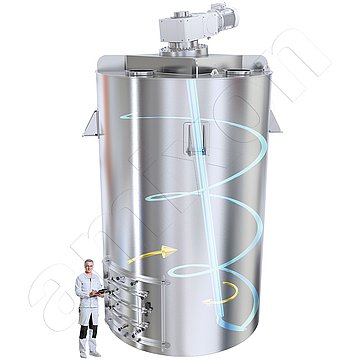
A longer mixing time does not necessarily improve the result. In fact, it can reduce mixing quality through demixing (segregation). However, this type of segregation has not been observed in vertical mixers equipped with a helical ribbon mixing tool. The optimum mixing time is therefore determined through measurement. In addition to mixing, other powder processing steps—such as liquid addition, temperature control and residual discharge—are often relevant to the quality of the end product.
Selection Matrix
| Criterion | Key Question | Implications for Mixer Selection |
|---|---|---|
| Target mixing quality | What coefficient of variation is required, and against which specification? | The mixer cannot be designed without a defined target value. This value determines the mixing time, number of samples and testing effort. |
| Smallest formulation component | How small is the smallest component in relation to the total batch? | Trace quantities require premixing or staged addition. Direct addition to the full batch is not reproducible. |
| Differences in density and particle size | How significantly do the components differ? | Large differences increase the risk of segregation after mixing—during discharge, conveying and filling. |
| Sampling | Where and how often are samples taken, and what is the sample volume? | The sample volume must correspond to the individual unit of consumption. Oversized samples conceal inhomogeneity rather than reveal it. |
| Mixing-time window | At what point does additional mixing cease to improve the result? | The optimum is determined through measurement. Beyond this point, particle attrition and an increase in temperature may occur. |
| Filling range | Within what range of the nominal volume will the mixer operate? | This determines whether partial batches achieve the same mixing quality as full batches. Otherwise, a second mixer may be required. |
| Sensitivity to attrition | Do the particles change during mixing? | This limits the mixing-tool speed and mixing time. Attrition alters the particle size distribution and may therefore affect compliance with the specification. |
| Downstream process steps | What happens to the product after mixing? | Discharging, conveying and filling can compromise the mixing quality already achieved. These steps must therefore be included in the mixer assessment. |
| Validation requirements | Does the process need to be validated or merely monitored? | Validation requires reproducible parameters, documented sampling and defined residual discharge performance. |
| Batch or continuous operation | Are multiple formulations processed, or is the mass flow constant? | Batch operation is suitable for frequent formulation changes. Continuous operation requires a stable formulation and sufficient dosing accuracy at the inlet. |

FAQ
For pharmaceutical batches of 500 to 1,000 litres, around 10 to 20 minutes for V, double-cone and other free-fall mixers is a realistic first benchmark. Actively convective mixers can achieve significantly shorter times depending on the product, while cohesive, low-dose or agglomeration-prone recipes may require additional premixing or intensive mixing steps. The relevant metric is not time alone, but a validated process window of fill level, speed or revolution count, charging sequence, mixing time and discharge conditions. This window must be secured with the original material through a mixing kinetics study, a representative sampling strategy and, where applicable, PAT across the entire process chain up to dosing or filling.
amixon® achieves short mixing times for large pharmaceutical batches through actively generated, three-dimensional product flow-through with SinConvex® mixing tools. The twin-shaft mixer HM can support particularly short mixing times through superimposed product streams, while the KoneSlid® KS fully repositions the batch volume once after around four tool revolutions and can reach the desired mixing quality after about 20 to 40 revolutions depending on the recipe. For very large, product-gentle batches, the Gyraton® GM is available. ComDisc® and DosiFlap® complement the mixing technology with controlled residual discharge and dosed filling. However, the robust mixing time is always determined through original-product trials and must be qualified for pharmaceutical applications together with homogeneity, discharge stability, cleanability and documented process control.
Yes, vertical mixers can achieve very good blending even with large density differences, provided that geometry and process parameters are designed accordingly. What matters above all is a forced redistribution, suitable mixing tools, an appropriate speed and a matched fill level.
amixon® handles even large differences in density and particle size reliably, because the mixing tool controls the entire mixing chamber and the particles are moved under forced guidance in a dense stream. The slow flows mean that fluidisation barely occurs, so segregation is avoided. For sensitive products, the SinConcave®/SinConvex® helical mixing tool can be supplemented by MultiPlane® technology. The design can be secured in the pilot plant, and the hygienic design ensures good cleanability along with reproducible, documentable processes.
Very high mixing quality can be achieved above all through suitable premixing, appropriate mixing technology and controlled process control. For trace components in baking mixes, the central goal is to achieve a fast, statistically stable distribution while avoiding segregation.
amixon® precision mixers generate the technically ideal random mixture – in practice not further improvable, independent of fill level from 10 to 100%. Component ratios up to 1:100,000 are homogenised; gentle circumferential speeds from 0.8 m/s avoid heat input. Target RSD values are verified in advance in the pilot plant with the original product and a sampling plan.
Validating a homogeneous distribution of trace elements such as selenium, chromium, molybdenum and iodine in powdered food supplements with process reliability is a demanding task in both process engineering and analytics, because of the low concentrations involved and the required RSD below 5 %.
amixon® solves this with precision mixers (KS, HM, VM) that produce a technically ideal random mixture – independently of the fill level from 10 to 100 %. Low circumferential speeds of approximately 0.8 m/s keep the mixture cool. The GMP-compliant hygienic design from amixon® allows residual discharge of 99.997 % and better. The coefficient of variation of the mixing quality is below 5 %; even values around 1 % are achievable.
In summary, a batch mixer for pet food is usually the more advantageous solution when high recipe diversity, frequent product changes, small to medium lots, critical micro-components and simple batch-related traceability are the priority. It enables very high, clearly validatable homogeneity and creates clear boundaries between individual recipes. A continuous mixer is especially attractive when large quantities of a few standard recipes are produced over long, stable production campaigns. It can deliver very good homogeneity but requires consistently precise dosing, a stable raw-material supply, and consistent management of residence time, transition material and product changes.
Both continuous and batch mixing can achieve excellent and reproducible homogeneity for pet food. The amixon® cone mixer AMK combines both modes of operation: it can operate continuously for high throughputs and long campaigns, but can equally be used as a batch mixer for premixes, smaller quantities or differing fill levels where needed.
In continuous operation, throughput, fill level, residence time and mixing intensity are specifically controlled. This allows adaptation to simple or complex recipes with solids, fats, vitamins, liquids and functional additives. By starting with the discharge component closed, jointly adjusting the gravimetric feeders, and only opening the discharge after a stable fill level is reached, the AMK can deliver specification-compliant product quality from the first regular discharge onward. On shutdown, the mixer empties continuously and largely completely, so that classic start-up and shutdown losses can be significantly reduced or avoided.
With many recipe changes, smaller lot sizes and high requirements for batch-specific documentation, batch operation remains particularly advantageous. For long production campaigns with high throughputs, the continuous AMK plays out its economic strengths. For critical changeovers between products with pharmaceutical additives, coccidiostats, allergens or other sensitive ingredients, cleaning, rinsing and analytical verification must always be designed and validated for the entire process line.
The final design is ideally based on trials with the original product. These assess homogeneity, residence time, liquid distribution, residual discharge, cleanability, changeover times, product gentleness and reproducibility under realistic process conditions.
With large density differences, mixability is most reliably assessed at laboratory scale with a combination of material characterisation, representative mixing kinetics, stratified sampling and a complete discharge and conveying test. For dry bulk materials, particle size, shape, bulk density, cohesiveness and flow behaviour are more important than metrics from liquid agitation technology. For suspensions and emulsions, rheology, sedimentation or creaming trials, and quantities such as the Reynolds, Archimedes and Richardson numbers supplement the assessment; for solid-liquid systems, the just-suspended speed according to Zwietering is central. Scale-up should be based on several metrics and product trials, not on an unchanged speed or a single laboratory result.
Large differences in bulk density and particle size cannot be assessed on the basis of theoretical parameters alone. amixon® tests mixability with the original product and under realistic mixing, discharge and conveying conditions. SinConvex®/SinConcave® helical tools generate controlled three-dimensional forced restratification and can support the homogenisation of heterogeneous recipes. The Gyraton® silo mixer GM is especially suitable for large batches at the beginning of long process routes. Targeted, finely distributed liquid addition can bind dust-like fractions to coarser particles and thereby reduce the tendency to segregate. However, mixing kinetics, representative sampling, CoV evaluation and time-staggered analyses across discharge, conveying and filling remain decisive.
A reproducible mixing-quality assessment for pharma validations rests on a pre-approved, risk-based sampling and analysis concept. What matters is not low RSD values alone, but an analytical method validated for the powder mix, control of critical process parameters, and GMP-compliant, traceable documentation. Only the interplay of these elements makes mixing quality robustly reproducible.
Mixing quality for pharma validations is not demonstrated by a low RSD value alone. Robust proof results from the interplay of representative, risk-based sampling, matrix-appropriate and validated analytics, stable process control, complete residual discharge, validated cleaning, and GMP-compliant data integrity.
amixon® supports these tasks with mixer designs that enable controlled three-dimensional product circulation, defined sampling, low-dead-space discharge and hygienic accessibility. The PLC recipe monitors the validated setpoints for mixing time, speed, fill level, dosing sequence and other critical process parameters. Barcode, RFID and ERP connections can support the seamless linking of raw materials, recipe, process data, cleaning and batch release.
Verification takes place in the pilot plant with the original product and realistic process conditions. There, mixing quality, mixing kinetics, fill-level window, product gentleness, residual discharge, cleanability, sampling, discharge stability and reproducibility can be examined. The documented data from this forms the basis for designing the production mixer, the qualification documentation, and later Continued Process Verification in GMP-regulated operation.
For batches above 2,000 litres, typical mixing times for dry food ingredients are usually between 1 and 15 minutes, with many standard applications already reaching a homogeneity of CV ≤ 5 % in 5 to 8 minutes. The exact mixing time depends above all on the mixing principle, the product properties and any liquid additions, and should always be validated in a trial with the original product.
amixon® achieves short mixing times by design: the SinConvex® mixing tool restratifies the entire volume by force, and with the KoneSlid® KS ideal mixing quality is reached after just 20 to 40 revolutions. Mixing quality is independent of the fill level from 10 to 100 %, and segregation during discharge is prevented by ComDisc® or by the seconds-long discharge of the KS. Specific times for each recipe are demonstrated in a pilot-plant trial.
Metallic abrasion in cathode active masses can be limited to very low values in industrial practice, but a universal ppb value cannot be promised across the board. For important elemental impurities such as Cr, Fe, Cu, Zn and Pb, specifications below 1 ppm are often applied to cathode materials. What matters, however, is not only the total chemical metal content, but also the occurrence of individual critical metal particles by size, shape and number. Success comes from a multi-stage concept of abrasion-minimised hygienic and wear design, suitable materials or coatings, low effective speeds, closed material transfers, magnetic separation and screening, preventive maintenance, and combined ICP and particle analytics. Only validation with the original material and under real operating, cleaning and maintenance conditions shows which contamination level is permanently achievable in the specific process chain.
amixon® minimises potential metal abrasion with abrasive battery active masses through controlled, low-speed SinConvex® total flow-through, wear-optimised materials and coatings, and a design that is inherently low in contamination, without product-contacted lower bearing points or screw connections in the mixing chamber. Hardox®, hardened or carbide-tipped mixing tools, duplex stainless steels and ceramic plasma coatings can be used depending on the purity target. Blanket limit values are not robust; the actually achievable purity is determined with the original material, product-related material selection and suitable trace and particle analytics. For a safe design, charging, discharge, conveying, separation and maintenance must also be considered as potential contamination sources alongside the mixer.
In the micro-dosing of vitamins, enzymes and other highly active micro-components in the food, animal feed and pharmaceutical industries, dosing accuracies of ±0.5 % or better are achievable on an industrial scale – provided that gravimetric systems are used.
amixon® precision mixers produce the technically ideal random mixture – not further improvable in practice, and independent of the fill level from 10 to 100 %. Component ratios of up to 1:100,000 are homogenised, and gentle circumferential speeds from 0.8 m/s avoid heat input. Target RSD values are verified in advance in the pilot plant with the original product and a sampling plan.
Adaptable mixing tools allow an industrial mixer to be adapted to different products and recipes. They support a targeted balance of convective circulation, de-agglomeration and product gentleness, can shorten mixing times, and help limit build-up and product residues. Modular wear elements improve maintainability and service life with abrasive mixes. In combination with variable speed, additional units, liquid dosing, temperature control and suitable sensors, a plant can cover several mixing and process tasks. However, every significant change in product, tool, fill level or recipe requires a product-related review and, where applicable, renewed validation of mixing quality, discharge and cleaning.
The main advantage of adaptable mixing tools at amixon® lies not in the mechanical exchange of tools, but in the universally applicable SinConvex® mixing tool and the flexibly programmable mode of operation. From coarse and sensitive particles to fine or nanostructured powders, the mixing tools essentially remain unchanged. Mixing time, circumferential speed, fill level, addition sequence, liquid dosing, temperature control and, where needed, time-limited cutting-rotor or HighShearBlade phases are individually set in the control system. This allows the same mixer to process different products with little changeover effort. New or significantly changed recipes must nevertheless be checked on a risk basis with the original product for mixing quality, product gentleness, discharge, cleaning and stability across the entire process chain.
Insufficient mixing quality shows up as concentration fluctuations, visible inhomogeneities, agglomerates, uneven moisture, unstable flow behaviour or quality problems in downstream process steps. Torque, power consumption, temperature, pressure and flow rate are valuable early indicators, but do not alone prove homogeneity. NIR and Raman spectroscopy, combined with chemometric evaluation, are especially suitable for direct inline assessment. The mixing endpoint is reached when the measurement signals are stable and a validated model simultaneously confirms the correct target concentration of the critical components. For sensitive or low-dose recipes, this inline concept must be backed up by spatially and temporally staggered reference samples, including samples during discharge.
amixon® makes mixing quality monitorable through the combination of representative, stratified sampling, validated mixing parameters, automated recipe management and, where needed, direct PAT analytics. Clever-Cut® access points and low-dead-space discharge components support defined sampling points. The control system, ERP integration and barcode or RFID capture document the recipe, batch and process parameters traceably. NIR and Raman spectroscopy can monitor actual homogeneity and the mixing endpoint in real time, while torque, power and temperature serve as complementary early indicators. If warning signs such as fluctuating analytical values or segregation during discharge occur, the mixer, sampling and the entire downstream process chain should be examined with the original product.
OEE stands for Overall Equipment Effectiveness and is composed of availability, performance and quality. Shorter mixing times increase performance if the mixer is actually the line bottleneck. Faster, validated cleaning increases availability through shorter product changeovers and can simultaneously improve quality through less cross-contamination, rejects and rework. The OEE effect must always be derived from the complete batch time and a real loss analysis. What matters is not the individual saving in minutes, but the permanently gained time for producing specification-compliant products with stable mixing quality and demonstrated cleaning success.
amixon® improves the OEE of powder mixing plants via the three factors availability, performance and quality. Availability benefits from top-mounted mixing tools, a low number of product-critical wear points, preventive maintenance and extensive residual discharge through SinConvex®, SinConcave® and ComDisc®. Performance increases when short mixing times, fast discharge, DosiFlap®-supported dosed filling and short, reproducible cleaning changeovers shorten the batch time. MultiPlane® supports particularly gentle mixing processes, while cutting rotors de-agglomerate locally where needed. OptiClean®, Clever-Cut® and OmgaSeal® promote accessibility as well as cleaning-friendly, low-dead-space construction. WaterDragon® standardises wet cleaning and, with programmable target-jet nozzles and warm-air drying, accelerates return to operation. The specific OEE improvement must be demonstrated with the original product and a complete loss analysis of the respective production line.
For the continuous production of detergent powders with high throughput and very close homogeneity, mixer designs with a mechanically fluidised bed are used above all.
The amixon® continuous mixer AMK is suitable for producing detergent powder with high throughput and constant homogeneity, because throughput and residence time can be set independently of each other and mixing quality remains reproducible through the SinConcave®/SinConvex® tool. It is particularly suited to long campaigns with fixed process windows and microfine liquid incorporation, while amixon® secures the design and process reliability in the pilot plant with the original product.
For short mixing times and high mixing quality with large batches, a low-dead-space vessel geometry, a mixing tool that covers the entire volume, a product-specifically validated fill level, and matched speed, circumferential speed and power density are decisive. Particle size, bulk density, cohesiveness, moisture and agglomerate behaviour determine the permissible stress and the segregation risk. Minor components must be dosed into active mixing zones and, where needed, premixed. Discharge must be designed as part of the mixing task, preferably with mass flow, low drop heights and matched conveying technology. For scale-up, several metrics should be combined and the design confirmed through simulation as well as mixing, discharge and conveying trials with the original product.
amixon® achieves short mixing times with large batches through three-dimensional SinConvex® forced restratification, in which the entire product volume is continuously exchanged. The HM uses two superimposed product streams for short mixing times, the KoneSlid® KS can fully reposition a batch once after around four tool revolutions, and the Gyraton® GM covers large batches up to about 100 m³. However, the decisive design parameters remain recipe, fill level, bulk density, cohesiveness, particle structure, dosing strategy, speed and discharge. ComDisc® and DosiFlap® support residual discharge and dosed filling, while a low-speed mode of operation and, where needed, engageable cutting rotors combine product gentleness with targeted de-agglomeration. The actually achievable mixing time and homogeneity are documented in the pilot plant with the original product and checked across the entire process chain up to filling.
CoV and RSD are the central, mathematically identical metrics for assessing mixing quality in food blends. Both are calculated as standard deviation divided by mean value, multiplied by 100 percent. Low values indicate low scatter and thus good uniform distribution of the marker component examined. As a technical guideline, values up to about 5 percent are often considered very good and values up to 10 percent acceptable in many applications; however, the product-specific specification and the risk profile of the recipe are always binding. The reliability depends critically on representative sampling, sufficient sample quantity, a suitable marker component and precise analytics. Besides CoV and RSD, target-value accuracy, individual values, discharge trend and, for continuous processes, the concentration distribution over time should be assessed.
CoV and RSD are the central and mathematically identical metrics for assessing mixing quality in food applications. Both are calculated as standard deviation divided by mean value and expressed as a percentage. Values up to about 5 percent are often considered very good, values up to around 10 percent acceptable in many applications; however, the product-specific specification and the critical importance of the respective ingredient remain decisive. amixon® supports the assessment through representative, stratified sampling, integrated or accessible sampling points, PLC-based parameter monitoring and seamless batch documentation. Mixing quality must be assessed across the entire process path, including discharge. Hygienic, easily cleanable and product-gently operated mixing systems support reliable homogeneity, fast product changeovers and effective allergen control.
To counter segregation of muesli and cereals in the packaging, a gentle base mixing process, targeted premixing of minor components, where applicable binding of fines through a suitable coating, and short, low-vibration, low-drop-height product paths are especially effective. Mass-flow bins and suitable discharge components reduce segregation in buffers and hoppers. The most robust solution for very different or high-value components is often separate, packaging-near dosing via a multihead weigher, because the mix is only formed immediately before the bag. Whether the mix remains stable up to the final container must be checked through samples across discharge, conveying and the packaging run with the original product.
The amixon® KoneSlid® mixer KS combines gentle, three-dimensional forced repositioning with short mixing and discharge times. Special wetting devices can specifically bind fine dusts, spice powders or breakage fractions to larger muesli components. This reduces the percolation of freely mobile fines, and the mix can remain more stable on the way to packaging. The optimal effect depends on the binder, dosing quantity, droplet size, dosing location, recipe and downstream product handling. In addition to the mix itself, discharge, conveying paths, drop heights, buffers and packaging must be designed to minimise segregation and checked with the original product across the entire process path.
For metallic powders, a slow-running, convective and fully closed batch mixer with large, flow-favourable tools, matched wall clearances and low relative speed is usually suitable. Decisive are a contamination-compatible choice of materials, low-wear geometries, avoidance of product-contacted bearing points and gaps, controlled charging and discharge, and closed, where needed inerted, material transfers. For highly critical powders, the entire system, including the mixer, conveying, screening, filters, seals, maintenance and cleaning, must be considered. Suitability is demonstrated through trials with the original powder and a combined analysis of particle-size distribution, foreign particles and relevant element contents before and after processing.
amixon® reduces abrasion for metallic powders through low-speed SinConvex® forced restratification and a consistently wear- and contamination-minimised apparatus design. For particularly critical products, amixon® can coat all product-contacted components with suitable high-performance oxide ceramic. This separates the mixing chamber, tools, shaft, outlet and internals from metal contact with the mix; metallic abrasion during mixing, reacting and drying is excluded. In addition, joint-free surfaces, mixing tools mounted only at the top, dust-tight OmgaSeal® systems and a controlled periphery limit further sources of foreign particles. The specific coating, mode of operation and purity performance are validated with the original product and suitable element and particle analytics before the investment.
In the production of pre-mixes for pharmaceutical, food and chemical applications, the homogeneous distribution of micro-dosages – typically active ingredients, vitamins, trace elements, enzymes, colourants, flavourings or catalytically active additives – is one of the most demanding process engineering tasks. Micro-dosages are usually present in mass fractions below 1 % down to the ppm or ppb range.
amixon® precision mixers produce the technically ideal random mixture – not further improvable in practice, and independent of the fill level from 10 to 100 %. Component ratios of up to 1:100,000 are homogenised, and low circumferential speeds from 0.8 m/s avoid heat input. Target RSD values are verified in advance in the pilot plant with the original product and a sampling plan.
For dry cathode and anode powders, intensive mixers, ploughshare mixers with a targeted chopper function, and gentle vertical and cone mixers are suitable – often as a combination of premixing, de-agglomeration and final homogenisation. For battery slurries, planetary mixers, double planetary mixers and planetary dissolvers are key technologies; an upstream high-shear dispersion may be required for conductive carbon black and CNTs. Continuous twin-screw processes are relevant for high throughputs with precise dosing. The best solution does not result from a single mixer design, but from the material system, the addition sequence, the required de-agglomeration, the permissible energy input, contamination protection and the entire process path up to coating.
amixon® mixers can gently homogenise cathode and anode powders through low-speed SinConvex® total flow-through and protect them from metallic abrasion via a matched material strategy. Wear-resistant materials, hardened tools, carbide or ceramic plasma coatings can be used; for particularly critical purity requirements, product-contacted parts can be protected with oxide ceramic. For cohesive conductive carbon blacks, CNTs or firm agglomerates, an additional local de-agglomeration stage may be required. Gas-tight, inertable apparatus designable up to ATEX Zone 20 support the handling of moisture- or oxidation-sensitive as well as dust-explosion-capable materials. The final selection of mixer, materials, mode of operation, discharge concept and cleaning strategy is validated with the original product and mixing-quality, particle and contamination analytics.
Heterogeneous bulk materials with different bulk densities are most reliably homogenised with actively convective mixing systems and process control matched to the product. Suitable options are paddle, blade, ploughshare, helical and multi-shaft mixers; the choice depends on cohesiveness, particle sensitivity and required de-agglomeration. Choppers, variable speed, targeted liquid addition and gravimetric dosing can support the mix, but must be used in a targeted manner. Also decisive for mix stability are mass-flow-oriented discharge, short drop distances, low-vibration conveying and a controlled addition sequence. The Froude number and power density support the design but do not replace validation with the original product across mixing, discharge and the entire further process chain.
For heterogeneous bulk materials with different bulk densities, amixon® especially recommends the twin-shaft mixer HM for intensive, fast three-dimensional homogenisation and the KoneSlid® KS for particularly gentle mixing tasks with sensitive or coarsely structured components. SinConvex® mixing tools form the controlled base flow; cutting rotors or HighShearBlades allow, where needed, a time-limited de-agglomeration. Liquid addition via lances or two-fluid nozzles can bind fines to coarser carriers and thereby reduce segregation. The plant configuration is matched to the product spectrum and checked with the most critical original products in the pilot plant. Mixing quality, product gentleness and segregation stability must be validated not only in the mixer, but across discharge, conveying and subsequent processing.
Reproducibility of mixing processes in food ingredients manufacturing describes the ability to achieve comparable mixing quality and product quality across many batches under identical setting parameters.
amixon® supports the monitoring of mixing quality in three ways: integrated samplers allow representative in-process samples, mixing programmes stored in the control system with connection to higher-level production and management systems, and barcode-based real-time documentation for complete batch traceability. Pilot-plant trials are particularly important for systematically uncovering any sources of error.
Dispersing agglomerates in ceramic suspensions is a key step for slip homogeneity, green body density, sintering activity and the mechanical reliability of the components.
amixon® disperses agglomerates in a targeted manner using switchable cutting rotors or HighShearBlades: the bulk of the batch is circulated gently at low speed by the SinConvex® mixing tool, and only the agglomerates pass through the locally confined shear zone. Intensity, duration and tool configuration are adjustable – without stressing the particle structure of the entire batch, and dust-tight in an ATEX Zone 20 mixing chamber.
A relative standard deviation (RSD) below 5 % is regarded in spice blends as a practically relevant target value for a technically homogeneous distribution of all components.
amixon® precision mixers produce a technically ideal random mixture, so that coefficients of variation below 5 % are reliably achievable even with micro-dosages. Mixing quality remains largely independent of the fill level, while the gentle operating mode, an optional cutting rotor and hygienic design support product integrity, cleaning and validation.
Slow-running convective single- or twin-shaft mixers are the most universal solution for homogeneous spice powders and mixed bulk goods with low particle stress. Coating drums are especially gentle for fragile snacks, nuts, extrudates and herbs when oil, slurry or dry seasoning is to be applied. Container solutions offer advantages with frequent recipe changes, closed handling and allergen management, but require an active mixing system for cohesive or complex recipes. For continuous snack lines, coating drums, belt coaters and on-machine seasoning systems are suitable. The final selection should be secured with the original product based on mixing quality, breakage rate, coating distribution, residual discharge and validated changeover or cleaning time.
amixon® mixers enable particularly gentle homogenisation of spices, herbs, tea, coffee and sensitive instant products through a low-speed, three-dimensional SinConvex® forced restratification. The mixing action is created by controlled product circulation rather than by strong throwing, impact or crushing zones. Cutting rotors can be engaged locally for de-agglomeration where needed. For very fragile products, SpherHelics® SH and KoneSlid® KS offer specialised mixing concepts; the Gyraton® GM is suitable for large-volume, particularly gentle batches up to about 100 m³. Fast product changeovers are supported by extensive residual discharge, good accessibility and validatable dry or wet cleaning. The actual mixing quality, particle integrity, discharge stability and changeover time are documented and verified in the pilot plant with the original product.
For validating mixing quality, a combination of stratified sampling, CoV or RSD evaluation and analytics suitable for the critical component is recommended. For dry mixes, tracer methods, chemical analytics and, where applicable, NIR or Raman are especially suitable. Image analysis and particle-size measurement supplement the assessment for visible components, breakage or segregation. For pastes and liquids, rheology, conductivity, density, turbidity or pH can additionally be considered. What matters is not the number of methods used, but representative sampling, separation of analytical and process variance, and testing across the entire process chain including discharge, conveying and filling.
amixon® mixers are established as fundamentally mixing-performance-validated systems through numerous documented mixing-quality tests. Additional product trials mainly serve to determine, for a specific recipe, the shortest safe mixing time and a robust process window. Validation combines stratified sampling across the mixing chamber and discharge, CoV or RSD evaluation, and analytics suited to the critical component, such as tracer analysis, HPLC, GC, ICP, NIR, Raman or image analysis. The Gyraton® silo mixer GM can provide a homogeneous and stable starting batch already at the beginning of long process routes, thereby reducing downstream control and fine-adjustment effort. Control-system programs, process-parameter monitoring, and ERP, barcode or RFID connectivity ensure reproducible and seamlessly documented batch management. The final mixing quality is verified not only in the mixer, but across discharge, conveying and filling with the original product.