
Skip to main navigation Skip to main content Skip to page footer

Summary

In reaction mixing, mechanical mixing, heat transfer and chemical reactions take place in the same vessel. Applying a vacuum lowers the boiling point, allowing water and solvents to evaporate at a low product temperature. This makes the process suitable for temperature- and oxidation-sensitive materials, ranging from active pharmaceutical ingredient synthesis and metal, ceramic and battery materials to inorganic salts.

Insights, FAQs and Topics Related to Reaction Mixing, Drying, Vacuum Processing and Temperature Control

In reaction mixing, mechanical mixing, heat transfer and chemical reactions take place in the same vessel. A vacuum lowers the boiling point, allowing water and solvents to evaporate at a low product temperature. Vacuum contact drying is therefore also suitable for temperature- and oxidation-sensitive materials. Applications range from active pharmaceutical ingredient synthesis and the processing of metal, ceramic and battery materials to starch modification, fermentation processes, tobacco and cocoa processing, plastics processing, pharmaceutical active ingredients and intermediates, sterilization by direct steam injection, precious-metal and pigment processing, solvent recovery, and inorganic salts such as calcium carbonate, sodium bicarbonate, citric acid, percarbonate and zeolites.

A key factor is the ratio of heat-transfer surface area to batch volume, as this limits the achievable drying performance. Other important parameters include the jacket temperature and heat-transfer medium, the vacuum level, the recondensation of vapours, and a vapour filter that prevents product losses. During temperature control, the product temperature responds gradually to changes in the setpoint. Heating and cooling profiles are therefore an integral part of the recipe. Whether the main focus is drying, crystallization or a synthesis reaction can ultimately be determined only through drying trials using the original product.

Below, you will find answers to the most frequently asked questions about reaction mixing and vacuum drying, an overview of suitable machine concepts—from the conical mixer dryer to the temperature-controlled conical mixer—as well as detailed explanations of the key technical terms.

FAQ - Reaction Mixing, Drying, Vacuum and Temperature Control

Modern powder mixers can capture torque, temperature, moisture, fill level and other process data and document it via Industry 4.0 interfaces. Monitoring becomes particularly informative when this data is combined with validated spectroscopic inline moisture measurement or Raman sensor technology for mixing quality and endpoint detection.

Yes – amixon® integrates process monitoring on a project-specific basis: torque, temperature and moisture measurement for endpoint determination, mixing and drying programmes stored in the control system, ERP integration and real-time barcode documentation. Since every unit is a one-off built to the URS, the sensor technology and interfaces (control system/MES) are implemented to the customer's specification.

Read more

A well-founded mixer suitability recommendation needs more than bulk density, particle size and moisture. Flow behaviour, cohesion, abrasiveness, segregation tendency, shear sensitivity and the specific process task are also decisive. Bulk density influences fill quantity and drive sizing. Differences in particle size, density and shape can cause segregation. Moisture changes flow behaviour, lump formation and adhesion. High shear is not always beneficial, as it can damage sensitive particles or generate heat and abrasion.

amixon® draws up a well-founded mixer recommendation based on product data, process objectives and plant requirements. In addition to bulk density, particle size and moisture, flow behaviour, shear sensitivity, cleanability, explosion protection, batch size and desired additional functions are also assessed.

A value-benefit analysis compares the customer-specific requirements with the properties of suitable apparatus. This allows mixing quality, product gentleness, residual discharge, drying performance, automation and cost-effectiveness to be compared transparently.

The preselection is then verified in the pilot plant with the original product. The trial data secures the selection of apparatus size, mixing tool, speed, fill level and process parameters.

Read more

Response and on-site times depend on the service contract, fault criticality, location, and technician and spare-part availability. An SLA should clearly define initial response, remote diagnosis, on-site arrival and restoration time.

For critical plants, 24-hour service, fixed escalation paths and spare-part concepts are advisable. Remote support, preventive maintenance and condition monitoring help to shorten or avoid downtime.

amixon® manufactures exclusively in Paderborn. amixon® machines are robust and long-lived; many plants have been running for over 30 years, some for more than 40 years. Low speeds and the vertical design reduce wear and susceptibility to faults.

Regular maintenance remains advisable. For large vacuum mixing dryers and synthesis reactors, predictive maintenance can help to monitor critical components early and avoid downtime.

Even without a maintenance contract, amixon® supports customers with faults as quickly as possible. The aim is to secure plant availability and keep the operator economically productive.

Read more

For inline moisture measurement and automated endpoint determination when drying in the mixer, several, sometimes combined, measurement methods are now available, which are installed directly in the mixing chamber or its periphery and integrated into the process control system.

amixon® integrates process monitoring on a project-specific basis: torque, temperature and moisture measurement for endpoint determination, mixing and drying programmes stored in the control system, ERP integration and real-time barcode documentation. Since every unit is a one-off built to the URS, the sensor technology and interfaces (control system/MES) are implemented to the customer's specification.

Read more

Targeted inline sensor technology is central to running mixing processes reproducibly, reliably detecting endpoints, and optimising quality, energy use and cycle times.

amixon® integrates process monitoring on a project-specific basis: torque, temperature and moisture measurement for endpoint determination, mixing and drying programmes stored in the control system, ERP integration and real-time barcode documentation. Since every unit is a one-off built to the URS, the sensor technology and interfaces (control system/MES) are implemented to the customer's specification.

Read more

In the pharmaceutical industry, contact-heated, mechanically agitated multifunctional apparatus are used above all to combine vacuum drying with chemical reaction processes. These enable a one-pot process, in which synthesis, crystallisation, filtration and drying are carried out without product transfer in a single, closed plant.

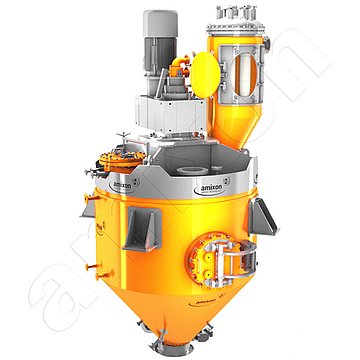
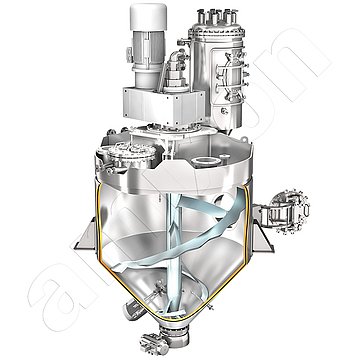
amixon® manufactures precisely for this purpose the mixing dryer reactors VMT (vertical) and AMT (conical): pressure- and vacuum-tight down to 5 mbar absolute, fully temperature-controlled with water, steam or thermal oil including the mixing tool. Mixing, reacting, crystallising and vacuum drying take place in the same dead-space-free apparatus – from 100 litres to 50 m³, on request as an FDA-compliant sterile reactor.

Read more

When pharmaceutical excipients are to be both dry-mixed and dried in a closed, GMP-compliant process, combined mixing-drying plants ("single-pot systems", single-pot process) are mainly used. These combine mechanical mixing functions with thermal energy transfer (usually with a heating jacket and optional vacuum) in a single apparatus.

amixon® manufactures precisely for this purpose the mixing dryer reactors VMT (vertical) and AMT (conical): pressure- and vacuum-tight down to 5 mbar absolute, fully temperature-controlled with water, steam or thermal oil including the mixing tool. Mixing, reacting, crystallising and vacuum drying take place in the same dead-space-free apparatus – from 100 litres to 50 m³, on request as an FDA-compliant sterile reactor.

Read more

Mixing, granulating and drying systems for crop protection products are integrated plants in which the three process steps take place in a common apparatus or in closely coupled functional units. In practice, this is often referred to as one-pot processing, where product mixing, granulate formation and drying occur without transfer in a single system.

amixon® VMT and AMT are not build-up granulators, but particularly high-performance vacuum mixing dryers for crop protection formulations. They mix precisely, bind dust through targeted wetting, dry quickly under vacuum and enable very good residue-free discharge. Large, temperature-controlled contact surfaces and continuous product movement ensure efficient, gentle drying at low rotational speeds.

Read more

Additional sensor technology can be retrofitted well if spare connections, blank flanges and free I/O capacity are already provided for. A heating or cooling jacket, on the other hand, is not a simple modular retrofit, because the pressure rating, vacuum stability and material of the vessel must be re-examined, and pressure equipment may require a renewed technical assessment.

amixon® plants can be well prepared for later sensor technology through spare connections, additional measurement ports and free automation capacity. Temperature, pressure, moisture, fill level or other measured variables can then be added on a project-specific basis. Heating and cooling jackets, on the other hand, are not a simple standard retrofit. They alter the apparatus structurally and must be examined with regard to pressure rating, vacuum stability, thermal expansion, material, welding technique and control. Liquid addition, nozzles, cutting rotors, washing lances or discharge components can also be added depending on the condition of the machine. However, every retrofit should be technically and process-engineering assessed and, for regulated applications, documented and, where applicable, re-qualified.

Read more

When mixing ingredients into already tempered chocolate masses, precise thermal and mechanical process control is essential to preserve the desired crystal modification of the cocoa butter (preferably Form V / β crystals) and to avoid unwanted fat melting, fat bloom and inhomogeneous texture.

amixon® mixers can be fully temperature-controlled on request: double-jacketed mixing chambers for heating and cooling with water, steam or thermal oil, and for the VMT and AMT reactor series, an additionally temperature-controlled mixing tool (shaft, arms, helix) for particularly large heat-exchange surfaces. Temperature profiles are run reproducibly as a control-system program.

Read more

For the reproducibility of mixing processes, combined process sensor technology is useful, because the mixing state usually cannot be measured directly, but only reliably captured via indirect physical variables. Particularly important are torque, temperature, moisture and precise recipe and batch tracking.

amixon® integrates process monitoring on a project-specific basis: torque, temperature and moisture measurement for endpoint determination, mixing and drying programmes stored in the control system, ERP integration and real-time barcode documentation. Since every unit is a one-off built to the URS, the sensor technology and interfaces (control system/MES) are implemented to the customer's specification.

Read more

Blog

Production of Pesticides (Part 1)
For reasons of longer shelf life and lower transport volume, plant protection products are often offered in powder form. amixon® has developed vacuum mix dryers that dry particularly quickly and gently. The powdered active ingredient concentrate is usually free-flowing, crystalline and low in dust.

Read more

amixon® helps with the dimensioning of large vacuum mixer dryer systems
Successful tests in the pilot plant are the basic prerequisite for a well-functioning vacuum drying process. Thermodynamic calculations enable a safe scale-up of drying plants that are many times larger than the test plant. amixon® has 4 test plants (200 liters) in Paderborn. amixon® can safely…

Read more

Mixing-drying reactor for the synthesis of plant protection active ingredients
amixon® manufactures high-performance vacuum mixing dryers and synthesis reactors. These can process/dry chemicals of different consistencies. (POWDERY, SOLID, LIQUID, PASTY).

Read more

FAQ – Vacuum drying with amixon® mixing technology
Pressure and vacuum resistant reactors are required when vacuum drying is to be carried out. Then the wet or moist product must also be heated. This is usually done by giving the mixer a double jacket. A heat transfer medium circulates in the double jacket. This is steam, water, thermal oil or a…

Read more

Plant protection products (Part 2)
Today's crop protection products are highly effective and environmentally friendly. Synthesis reactors from amixon GmbH have valuable features in terms of increased efficiency and operational reliability. This makes them very valuable for the plant.

Read more