

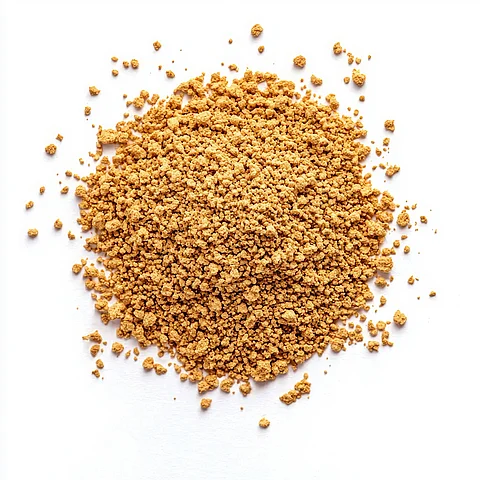
tendency to agglomerate
Agglomeration tendency refers to the property of powders or bulk materials to clump together under certain conditions. In this process, individual particles stick together and form larger clusters. This effect can be either desirable (e.g. in granulation) or undesirable (e.g. caking in silos or mixers).
The tendency to agglomerate is determined by various physical and chemical factors. These include particle size and the proportion of fine particles, surface properties, moisture content, temperature and electrostatic charge. Intermolecular forces such as van der Waals forces, capillary bridges and hydrogen bonds can significantly enhance the adhesive effect.
Powders with a high specific surface area and very fine particles often exhibit a marked tendency to agglomerate. Even small amounts of moisture are often sufficient to form additional liquid bridges and create stable agglomerates.
In process engineering, the tendency to agglomerate influences, amongst other things, flow behaviour, dust formation, dosing accuracy and the achievable mixing quality. It is relevant during the storage, conveyance, mixing, drying and processing of bulk materials. Depending on the process objective, a high tendency to agglomerate can be utilised specifically, for example in agglomeration and granulation processes to improve flowability or solubility. In other applications, it must be reduced through appropriate equipment design, process control or the use of additives (e.g. flow regulators, anti-caking agents) to ensure stable and reproducible processing.
This formula describes the proportion A of agglomerated particles following a process step
A = Agglomerates / Total
The larger A is, the more the material tends to agglomerate under the specified conditions.