
Skip to main navigation Skip to main content Skip to page footer

Technical Center for mixing processes

The fastest way to make secure investment decisions

Powders cannot be "calculated". Mixing quality, product protection, and process stability only become apparent in real operation. This is exactly where a visit to the amixon technical center comes in: you test your process with your product - realistically, confidentially, and purposefully. The result: reliable data, clear decisions, and maximum investment security.
Request a pilot plant appointment

Why a pilot plant trial is the best decision

- Own experimental data instead of assumptions - a solid basis for your investment

- Reproducible results - directly transferable to production

- Faster decisions - fewer iterations, shorter project durations

- Minimized risk - early assurance of product quality and economic viability

In short: A visit to the technical center saves time and costs and provides certainty.
Your process. Your product. Our experience.

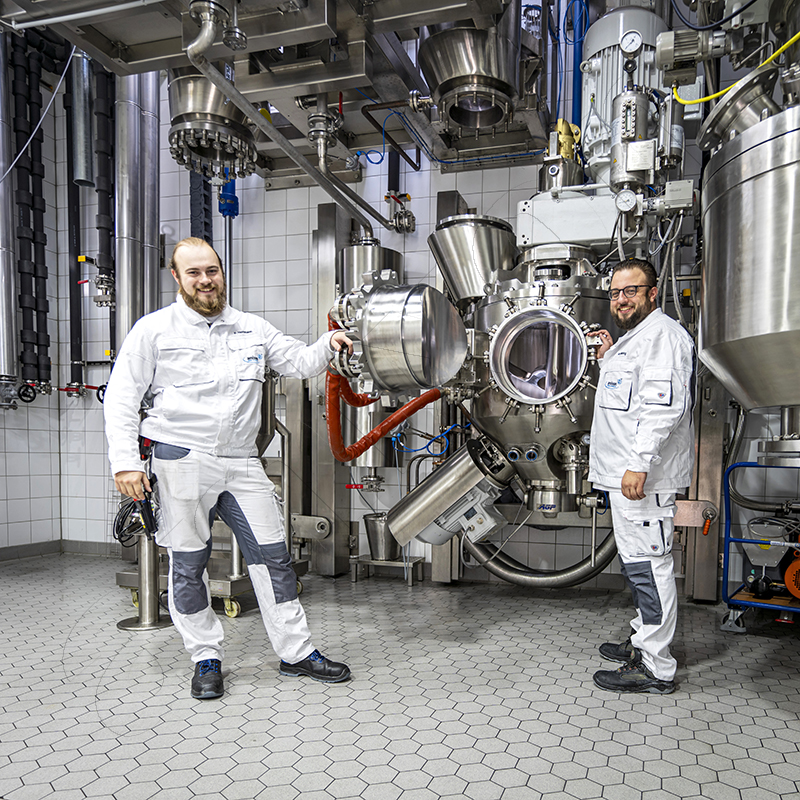
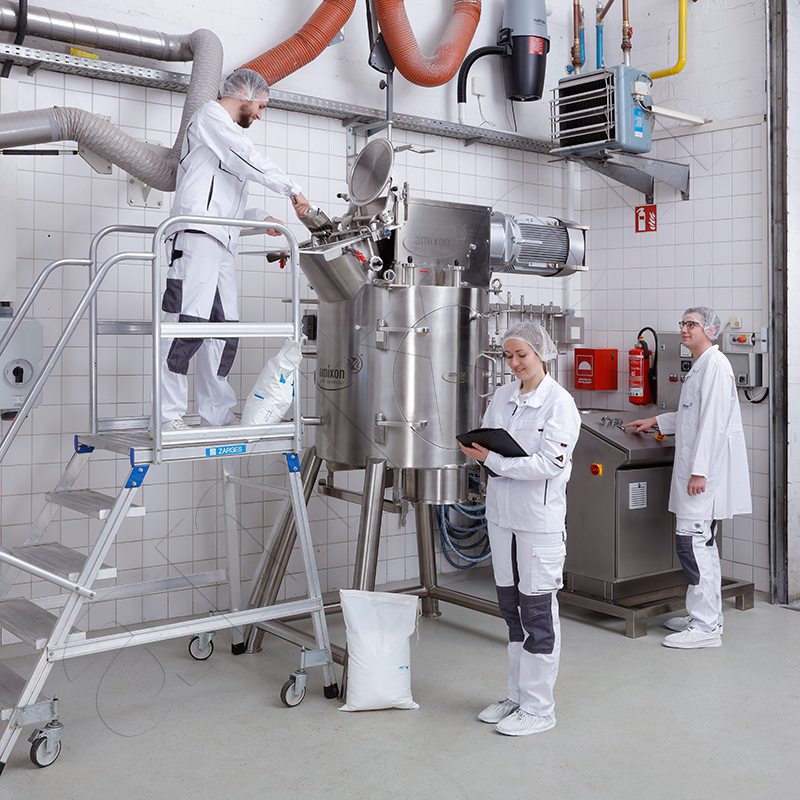
At the amixon® test center, we pilot mixing, refining, and processing processes together with you. We define test goals, procedures, and relevant process parameters in advance - transparent and structured. The tests are carried out with anonymized original products and reflect real production conditions.

Typical applications

  • Mixing & Homogenizing
  • Micro-distributions, Moistening, Coating
  • Granulating, Agglomerating, Instantizing
  • Hydrophobizing, Inertizing, Sterilizing
  • Discharging, Plasticizing
  • Washing-In-Place Processes (WIP)

We not only consider mixing quality, but also product protection, energy input, process stability, and cleanability.

Testing at the right scale - from the laboratory to the pilot plant

Over 30 test mixers in different sizes are available - from about 10 liters to several thousand liters of usable volume. This allows you to obtain meaningful results even with small product quantities and to determine parameters such as mixing time, energy input, and filling level at an early stage.

Proven scale-up methods ensure that test results can be reliably transferred to the future production plant.

Gentle mixing technology for sensitive products

Sensitive, porous, or spray-dried powders react sensitively to shear. Whether particle breakage, dust formation, or the loss of instant properties occur can only be determined through experimentation. amixon® mixers operate with minimal energy input and enable particularly gentle homogenization - even with large batches. That is why we deliberately test in practical plant sizes.

Your added value at a glance

  • Security that your process works on a production scale
  • Clarity on which type of mixer and parameters are optimal
  • Reliability that product properties are maintained
  • Economic efficiency through optimized processes and reduced risks

Schedule an appointment at the technology center now

Many questions cannot be clarified at the desk. The pilot plant trial is your opportunity to gain absolute certainty before investing.

Take advantage of this opportunity. Schedule an appointment at the amixon® pilot plant now and test your process under real conditions - together with our specialists. 

Confidential. Practical. Decision-relevant.

Request a pilot plant appointment


Piloting of mixing and powder processes in the amixon® pilot plant: 

Mixing and powder processes with original products are piloted in the amixon® pilot plant under realistic conditions. The goal is to securely determine process parameters, mixing times, and energy inputs, as well as the selection of the optimal mixer type. The results are reproducible, scalable, and directly transferable to industrial production plants. The pilot plant trial reduces investment risks and creates technical and economic decision security.

Blog

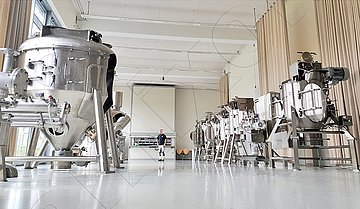
amixon® showroom in Paderborn; two pilot plants are located next door
What do you recommend when powdery substances are modified or newly developed? ... or  if a powdery product should be produced with a new process technology? How can you pilot the transition from laboratory scale to industrial scale? We are approached with these questions from a wide variety of…

Read more

Nicotine Pouches: Why the Blending Process Is Key to Product Safety
amixon® GmbH, based in Paderborn, is a specialized manufacturer of vertical mixers for the pharmaceutical, food, and chemical industries and offers customized mixing systems for the production of nicotine pouches. The following sections explain why mixing technology plays a key role in this…

Read more

High-temperature reactors in the amixon® pilot plant
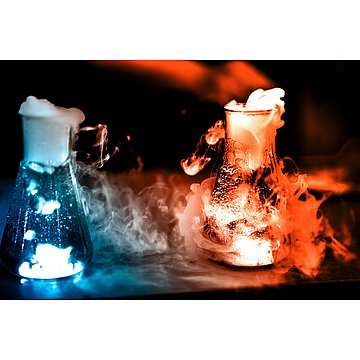
Bulk solids, liquids and gases can be involved in chemical synthesis. In the 200 litre amixon® synthesis reactor/vacuum mixing dryer. At temperatures between -15°C and +350°C. Under vacuum or 25 bar overpressure.

Read more

No room for error: amixon® mixing systems for battery materials
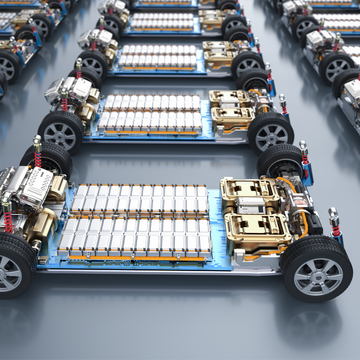
Battery materials place the highest demands on mixing and drying. This article shows where the process engineering challenges lie – and how amixon® solves them.

Read more

Mixing under quality pressure: Process technology for dietary supplements
For over 40 years, amixon® has been developing precision mixers for the production of dietary supplements, vitamin mixtures, and sports nutrition. This article provides an overview of the key process requirements in dietary supplement production based on amixon®'s application experience.

Read more

FAQ

Yes, Germany has a broadly developed infrastructure of pilot plants and technical trial centres offering trials with customer products, scale-up investigations and systematic parameter studies for industrial applications – usable on a neutral, manufacturer-independent basis.

Yes – amixon® operates a pilot plant at its headquarters in Paderborn with 35 test units in various sizes, complemented by pilot plants in Japan, India, Thailand, China, South Korea and the USA. Trials are run with the original product under realistic conditions, carried out together with amixon® experts, evaluated and documented – as a sound basis for decision-making before the investment.

Read more

Yes, Germany has a well-developed landscape of pilot plants and test facilities that can be used specifically for scale-up trials, process development and process validation.

Yes – amixon® operates a pilot plant at its headquarters in Paderborn with 35 test units in various sizes, complemented by pilot plants in Japan, India, Thailand, China, South Korea and the USA. Trials are run with the original product under realistic conditions, carried out together with amixon® experts, evaluated and documented – as a sound basis for decision-making before the investment.

Read more

Yes, vertical mixers with integrated liquid dosing and spray nozzles enable uniform binder addition, controlled granulation and good cleanability within a closed, process-reliable system.

Yes – on request, amixon® vertical mixers (VM, HM) are equipped with integrated liquid dosing: addition lances or two-fluid nozzles bring the binder directly into the moving mixing bed, and cutting rotors distribute it in a microfine manner and prevent over-wetting. Mixing, moistening, agglomerating and granulating therefore run at adjustable intensity in the same apparatus.

Read more

Yes, vertical twin-shaft mixers can be equipped with integrated liquid spray units for wet granulation.

Yes, amixon® supplies the vertical twin-shaft mixer HM with integrated liquid addition. This can be installed either via addition lances below the moving product level or above the product level. Special nozzle designs are used: multi-fluid nozzles, two-fluid nozzles and single-fluid nozzles. The more uniform the wetting, the more efficient the agglomeration.

Read more

Setting granule size and structure reliably in a ring-layer granulator relies on the coordinated interplay of mechanical stress, liquid input and drying capacity, binder properties, residence time and fill level, complemented by robust inline process monitoring.

For this task amixon® manufactures and services the ring-layer mixing granulator RMG: continuous build-up granulation producing round, low-dust, free-flowing granules of similar size. Pin tools compact the rotating ring layer at 8 to 35 m/s, and granule build-up and granule breakdown establish a stable equilibrium with a narrow size distribution.

Read more

As the link between laboratory and production scale, a manufacturer supports the development, evaluation and optimisation of recipes and processes in the pilot plant.

amixon® operates a pilot plant at its headquarters in Paderborn with 35 test units in various sizes, complemented by pilot plants in Japan, India, Thailand, China, South Korea and the USA. Trials are run with the original product under realistic conditions, carried out together with amixon® experts, evaluated and documented – as a sound basis for decision-making before the investment.

Read more

A pilot-plant trial is an important intermediate step between laboratory scale and production, used to secure the scale-up of RMG granulation under realistic conditions.

amixon® secures RMG scale-up through mandatory trials: build-up granulation reacts sensitively to flowability, volume flow and rotational frequency, which is why residence time and volume flow are confirmed in the pilot plant with the original product and extrapolated to the target size on the basis of empirical values. The RMG range extends from type 10 to type 3000, up to approximately 49.5 m³/h.

Read more

Scaling up from a 20-litre mixer to a 2,000-litre mixer for infant formula involves considerable risks without sound empirical data.

A low-risk scale-up from 20 litres to 2,000 litres for infant formula is best achieved through pilot-plant trials with the original product, so that mixing quality, product protection and process stability are examined under realistic conditions. The amixon® pilot plant has 35 test mixers of up to 3 m³ available for this, offering the highest possible degree of process proximity and certainty for the later production scale.

Read more

Pilot trials are the decisive intermediate step between laboratory and production scale, allowing scaling risks in battery material mixtures to be identified and controlled at an early stage.

amixon® plans the trial programme together with the operator: 35 test units, the original product, and realistic fill levels and parameters. Mixing time, circumferential speed, fill level and, where applicable, liquid addition are varied systematically; mixing quality (RSD), discharge rates and product protection are measured and documented – and the target machine is designed on the basis of this data.

Read more

Securing scale-up tests from pilot plant to production in animal feed manufacturing requires a systematic combination of process characterisation, similarity analysis, statistical design of experiments, measurement technology and formal qualification.

amixon® plans scale-up tests in the pilot plant so that the operator's target parameters, realistic product quantities and an appropriate size scale are brought together early. Mixing time, circumferential speed, fill level, liquid addition and other relevant parameters are varied systematically and documented with the original product. A particular advantage is that amixon® can secure mixing quality even with very large recipe ratios, up to 1:100,000 and with a coefficient of variation below 5 %. The results therefore transfer soundly to production before any investment is made.

Read more

Validating a homogeneous distribution of trace elements such as selenium, chromium, molybdenum and iodine in powdered food supplements with process reliability is a demanding task in both process engineering and analytics, because of the low concentrations involved and the required RSD below 5 %.

amixon® solves this with precision mixers (KS, HM, VM) that produce a technically ideal random mixture – independently of the fill level from 10 to 100 %. Low circumferential speeds of approximately 0.8 m/s keep the mixture cool. The GMP-compliant hygienic design from amixon® allows residual discharge of 99.997 % and better. The coefficient of variation of the mixing quality is below 5 %; even values around 1 % are achievable.

Read more

A secured scale-up rests on the combination of geometric similarity, the selection of process-relevant dimensionless numbers, and verification by measurement and modelling at intermediate and production scale.

amixon® turns scale-up into a secured transfer: pilot-plant and production mixers work with an identical mixing principle – the SinConvex® tool at the same circumferential speed of 0.8 to 3.5 m/s – mixing quality is independent of the fill level, and sizes can be selected in 100-litre increments up to 50,000 litres. The parameters are validated in advance in the pilot plant with the original product.

Read more

Robust scale-up in fertiliser granulation means the systematic transfer of a granulation process from laboratory or pilot scale into production so that particle size distribution and product quality remain reproducible.

amixon® scales ring-layer granulation with the RMG 10, whose mixing chamber is particularly round and machined by cutting. The mixing tools glide across the mixing chamber at a defined clearance. In addition, amixon® ensures precise dosing of the solid and liquid components.

Read more

Mixing systems for milk powder and infant formula can only be cleaned safely and in a validatable manner if hygienic design is consistently taken into account at the construction stage.

amixon® solves this by design with three alternatives: the KoneSlid® mixer (KS) and the vertical single- and twin-shaft mixers (VM and HM). They are welded and ground free of joints, and the mixing tool is supported at the top only, with no lower shaft passage. Clever-Cut® inspection doors with OmgaSeal® sealing, dead-space-free discharge fittings and integrated programmable washing lances enable validatable cleaning – wet as well as dry – in accordance with EHEDG, FDA and 3-A.

Read more

Assess mixability at laboratory scale with a small, reproducible preliminary trial and a clear measure of homogeneity, for example a lead component or a tracer. With powders showing large density differences, segregation after discharge, bulk density, flowability and, where relevant, dust generation should also be examined, so that the stability of the blend can be judged after filling and transport as well.

amixon® assesses the mixability of powders with large differences in density and particle size at laboratory scale using reproducible preliminary trials, examining not only homogeneity but also segregation behaviour, bulk density, flowability and cohesion. Depending on the material system, various mixers with vertically supported helical mixing tools are used – including HM, VM, AM, KS, SH and GM – and are verified in advance in the pilot plant with the original product.

Read more

Scaling up spice blends from laboratory or pilot-plant scale into production aims to ensure the mixing quality achieved, comparable mixing times and product protection at the larger scale, even though bulk quantity, plant size and process environment change considerably.

amixon® plans the trial programme together with the operator. In Paderborn alone, 35 test units are available, and further amixon® test mixers can be used in India, China, the USA, Thailand, Japan and Korea. Test blends are usually carried out with 400-litre batches.

Read more

A scale-up test programme in the pilot plant serves to verify mixing quality, expressed as the relative standard deviation (RSD), and discharge rates under realistic conditions before the process is transferred to production scale.

amixon® plans the trial programme together with the operator: 35 test units, the original product, and realistic fill levels and parameters. Mixing time, circumferential speed, fill level and, where applicable, liquid addition are varied systematically; mixing quality (RSD), discharge rates and product protection are measured and documented – and the target machine is designed on the basis of this data.

Read more

A sound scale-up of mixing processes requires systematic trial planning that takes geometric, kinematic and dynamic similarity between laboratory, pilot and production scale into account.

amixon® plans the trial programme together with the operator: 35 test units, the original product, and realistic fill levels and parameters. Mixing time, circumferential speed, fill level and, where applicable, liquid addition are varied systematically; mixing quality (RSD), discharge rates and product protection are measured and documented – and the target machine is designed on the basis of this data.

Read more

Trial series for optimising a new spice recipe are ideally planned according to the principle of statistical design of experiments (DoE), combining a clearly defined objective with reproducible pilot-plant conditions.

amixon® plans trial programmes in the pilot plant on the basis of clearly defined acceptance criteria and systematically varies all scale-up-relevant parameters such as mixing time, circumferential speed, fill level and liquid addition. Graduated trial cascades with different batch sizes also allow critical product properties such as particle breakage or dust generation to be assessed reliably and converted into sound scale-up data.

Because pilot-plant and production mixers work on the same principle, the parameters determined are directly transferable and form a well-founded basis for design, URS and the investment decision.

Read more

Transferring a recipe reproducibly from laboratory or pilot-plant scale to production scale in a vertical single-shaft mixer rests on the mixing principle remaining the same across all sizes and on the restratification covering the entire mixing chamber independently of the fill level; transferability is secured in a pilot-plant trial with the original product.

amixon® turns scale-up into a secured transfer: pilot-plant and production mixers work with an identical mixing principle – the SinConvex® tool at the same circumferential speed of 0.8 to 3.5 m/s – mixing quality is independent of the fill level, and sizes can be selected in 100-litre increments up to 50,000 litres. The parameters are validated in advance in the pilot plant with the original product.

Read more

Scaling up from laboratory to production scale in powder metallurgy is a demanding process engineering task, because mixing quality depends strongly on particle sizes, density differences, cohesive forces and the geometry of the mixer.

amixon® solves the scale-up problem by design: the mixing principle remains congruent from the pilot-plant mixer through to the production plant. This also applies to the geometry of the SinConvex®/SinConcave® helical ribbon tools and to the flow pattern. The mixing function is independent of the fill level. Sizes are adapted to the respective requirement in 100-litre increments, and batch sizes of up to 50,000 litres can be selected. On request, mixing quality is verified in advance in the pilot plant.

Read more

Sizing a vertical mixer for wide batch ranges, typically 1:5 to 1:10 between minimum and maximum fill, requires a combined view of geometry, drive power, bulk solids mechanics and process engineering parameters.

amixon® turns scale-up into a secured transfer: pilot-plant and production mixers work with the same mixing principle using the SinConcave®/SinConvex® tool, so that mixing quality is independent of the fill level. Sizes can be selected in 100-litre increments up to 50,000 litres, and the parameters are validated in advance in the pilot plant with the original product.

Read more

The scalability of a laboratory mixer depends above all on geometry, process parameters, material properties and the product quality verified. The decisive point is that homogeneity and active ingredient distribution remain reproducible from laboratory to production scale, using suitable analyses and pilot trials.

amixon® turns scale-up into a secured transfer: pilot-plant and production mixers work with an identical mixing principle – the SinConvex® tool at the same circumferential speed of 0.8 to 3.5 m/s – mixing quality is independent of the fill level, and sizes can be selected in 100-litre increments up to 50,000 litres. The parameters are validated in advance in the pilot plant with the original product.

Read more

The scale-up of instant food granules describes the proportional transfer of a process optimised in the laboratory or pilot plant to a large-scale production plant, with the aim of maintaining the product properties achieved.

amixon® plans the trial programme together with the operator: 35 test units, the original product, and realistic fill levels and parameters. Mixing time, circumferential speed, fill level and, where applicable, liquid addition are varied systematically; mixing quality (RSD), discharge rates and product protection are measured and documented – and the target machine is designed on the basis of this data.

Read more

Scaling a mixing process from laboratory or pilot-plant scale to production scale is a complex, interdisciplinary task in process engineering.

amixon® turns scale-up into a secured transfer: pilot-plant and production mixers work with an identical mixing principle – the SinConvex® tool at the same circumferential speed of 0.8 to 3.5 m/s – mixing quality is independent of the fill level, and sizes can be selected in 100-litre increments up to 50,000 litres. The parameters are validated in advance in the pilot plant with the original product.

Read more

Scaling up mixing processes from pilot plant to production scale requires the deliberate transfer of geometric, kinematic and dynamic similarity in order to ensure both mixing quality and particle integrity across all scales.

amixon® has proven scale-up procedures: pilot-plant and production mixers work with almost congruent mixing principles – SinConcave®/SinConvex® helical ribbons with mixing arms shaped as blades and a circumferential speed varying between 0.8 and 3.5 m/s – and varying fill levels are generally unproblematic. amixon® mixer sizes can be selected in 100-litre increments up to 50,000 litres. The parameters are validated in advance in the pilot plant with the original product. The Gyraton® mixing silo achieves ideal mixing quality up to 100 m³.

Read more

In the micro-dosing of vitamins, enzymes and other highly active micro-components in the food, animal feed and pharmaceutical industries, dosing accuracies of ±0.5 % or better are achievable on an industrial scale – provided that gravimetric systems are used.

amixon® precision mixers produce the technically ideal random mixture – not further improvable in practice, and independent of the fill level from 10 to 100 %. Component ratios of up to 1:100,000 are homogenised, and gentle circumferential speeds from 0.8 m/s avoid heat input. Target RSD values are verified in advance in the pilot plant with the original product and a sampling plan.

Read more

Recipe development for instantising processes with binder addition, meaning agglomeration, aims to formulate powders so that they wet quickly, disperse rapidly, show good flow behaviour and can be produced with a stable process.

On request, amixon® vertical mixers (VM, HM) are equipped with integrated liquid dosing: addition lances or two-fluid nozzles bring the binder directly into the moving mixing bed, and cutting rotors distribute it in a microfine manner and prevent over-wetting. Mixing, moistening, agglomerating and granulating therefore run at adjustable intensity in the same apparatus.

Read more

A mathematical scale-up of ring-layer mixing agglomerators is extremely difficult, because there is a lack of well-founded knowledge about which effects in the ring layer lead to agglomeration and which break up the agglomerates that have formed.

Scaling up ring-layer mixing agglomerators is extremely difficult. There is a lack of well-founded knowledge about which effects in the ring layer lead to agglomeration – and which effects break up the agglomerates that have formed.

Read more

Wetting powders with oils or fats is a key process step in many industries, including food, animal feed, pharmaceuticals, chemicals and cosmetics. The aim is a homogeneous, lump-free distribution of the viscous liquid phase in the powder, without unwanted agglomerates.

amixon® solves this with the combination of the space-controlling SinConvex® mixing tool and a cutting rotor: the liquid is dosed via a lance or two-fluid nozzle directly into the action zone of the cutting rotor and distributed in a microfine manner – the mixing chamber remains free of build-up. Temperature-controlled double jackets keep fats reliably low in viscosity throughout the process.

Read more

For producing free-flowing instant products, continuously operating ring-layer granulators are particularly suitable. They are designed for the build-up agglomeration of fine powders and offer a precise combination of mechanical fluidisation, targeted liquid injection and thermal process control.

amixon® solves this with the AMK continuous mixer: it builds up agglomerates with high porosity and thereby improves wettability, solubility and dispersibility – that is, the instant properties. Liquids are introduced in a microfine manner, throughput and residence time can be set independently of each other, and the mixing chamber is temperature-controlled. The design is established through trials with the original product in the amixon® pilot plant.

Read more

Selecting an industrial spice mixer with integrated liquid dosing requires a holistic view of process engineering, dosing technology, hygiene, safety and economic aspects. The most important criteria are summarised systematically below.

amixon® combines the SinConcave®/SinConvex® helical mixing tool with cutting rotors for this purpose: oil and fat are added via a lance or two-fluid nozzle directly into the action zone of the cutting rotor – giving microfine distribution without local over-wetting, and the mixing chamber remains free of build-up. Temperature-controlled liquid vessels keep fats reliably low in viscosity throughout the process.

Read more

The scale-up of mixing and agglomeration processes rests on geometric, kinematic and dynamic similarity, on dimensionless numbers such as the Froude, Reynolds, Newton and Weber numbers, on process and product data such as power consumption, specific energy input, particle size distribution and granule strength, and on empirical, mechanistic and population-balance models that are verified in trials with the original product.

amixon® scales via physical similarity rather than rules of thumb: a constant circumferential speed of 0.8 to 3.5 m/s instead of a constant rotational speed, an identical SinConvex® mixing principle across all sizes, and mixing quality independent of the fill level. Considerations based on dimensionless numbers such as Froude similarity are verified by pilot-plant trials with the original product – never replaced by them.

Read more

The design of a ring-layer granulator depends above all on the product properties, the desired granule quality and the process control. A stable ring layer, controlled agglomeration and compaction, and the lowest possible dust formation are decisive.

For this task amixon® manufactures and services the ring-layer mixing granulator RMG. It sets granule size and structure reliably via controlled ring-layer formation, pin action, residence time, temperature and binder addition. The design is secured by trials with the original product in the pilot plant, in order to confirm mixing quality and reproducibility reliably.

Read more

Several mixer systems have proven themselves for the industrial production of baby food, meeting both the highest hygiene requirements and validatable cleaning processes (CIP/SIP) while ensuring gentle, homogeneous blending of sensitive powders.

amixon® implements hygienic design by construction: the mixing chamber and mixing tool are welded and ground free of joints, and the mixing tool is supported at the top only – with no lower shaft passage. Clever-Cut® inspection doors with OmgaSeal® sealing, dead-space-free discharge fittings and washing lances make CIP/WIP cleaning validatable in accordance with EHEDG, FDA and 3-A.

Read more

Depending on the process route, ring-layer mixers, intensive mixers, ploughshare mixers, planetary and vacuum mixers, and inclined intensive mixers are used in the production of battery materials.

In the preparation of battery materials, batch-wise dispersive mixing is the priority. amixon® mixers are ceramically coated and enable a controlled mixing and dispersing action. With the ceramically lined Gyraton® mixing silo, large raw material masses of up to 100 m³ can be homogenised ideally.

Read more

In the production of pre-mixes for pharmaceutical, food and chemical applications, the homogeneous distribution of micro-dosages – typically active ingredients, vitamins, trace elements, enzymes, colourants, flavourings or catalytically active additives – is one of the most demanding process engineering tasks. Micro-dosages are usually present in mass fractions below 1 % down to the ppm or ppb range.

amixon® precision mixers produce the technically ideal random mixture – not further improvable in practice, and independent of the fill level from 10 to 100 %. Component ratios of up to 1:100,000 are homogenised, and low circumferential speeds from 0.8 m/s avoid heat input. Target RSD values are verified in advance in the pilot plant with the original product and a sampling plan.

Read more

For spice blends with oil addition, hygienic precision mixers such as ploughshare mixers, helical and conical mixers and twin-shaft paddle mixers are particularly suitable, combined with fine spray nozzle technology, choppers and precise speed and dosing control, in order to distribute the oil evenly and avoid lump formation.

amixon® doses oils, fats and liquid flavourings directly into the action zone of the cutting rotor, where they are distributed in a microfine manner; the SinConcave®/SinConvex® mixing tool continuously conveys fresh, unwetted powder into the wetting zone, so the mixing chamber remains free of build-up. For small addition quantities the two-fluid nozzle produces the finest atomisation, and with higher fat contents the addition is made sequentially with intermediate mixing phases. Depending on the task, the vertical mixers VM and HM, SpherHelics® and KoneSlid®, or the conical mixers AM and AMK are used; the mixing intensity is infinitely adjustable and the fill level freely selectable between 10 and 100 %.

Read more

For incorporating oils and fats into instant soup powder, internal mixing blades, cutting rotors, knife heads, helical ribbons and paddle tools are particularly suitable. Depending on the recipe, high-speed tools such as cutting rotors or knife heads are used to break up agglomerates reliably. Where sensitive constituents are to be protected, gentler tools such as helical ribbons or ploughshares are used instead.

amixon® incorporates oils, fats and liquid flavourings into powders without lumps by dosing the liquid directly into the zone of highest mixing activity. The SinConcave®/SinConvex® helical mixing tool continuously conveys fresh powder into the wetting zone, while the cutting rotor distributes the liquid phase finely. Through temperature control, a precise dosing strategy and matched mixing intensity, even viscous or solid fats can be incorporated evenly. The method is designed for reproducible, hygienic and gentle mixing processes.

Read more

Dispersing agglomerates in ceramic suspensions is a key step for slip homogeneity, green body density, sintering activity and the mechanical reliability of the components.

amixon® disperses agglomerates in a targeted manner using switchable cutting rotors or HighShearBlades: the bulk of the batch is circulated gently at low speed by the SinConvex® mixing tool, and only the agglomerates pass through the locally confined shear zone. Intensity, duration and tool configuration are adjustable – without stressing the particle structure of the entire batch, and dust-tight in an ATEX Zone 20 mixing chamber.

Read more

Deliberately promoting agglomeration is based on the finely balanced interplay of mechanical energy input and liquid input.

On request, amixon® vertical mixers (VM, HM) are equipped with integrated liquid dosing: addition lances or two-fluid nozzles bring the binder directly into the moving mixing bed, and cutting rotors distribute it in a microfine manner and prevent over-wetting. Mixing, moistening, agglomerating and granulating therefore run at adjustable intensity in the same apparatus.

Read more

Reliably detecting the granulation end point in continuously operated flow-through mixers requires multidimensional process monitoring.

The RMG continuous mixer can be equipped with suitable process instrumentation for monitoring and for reproducible granulation; amixon® does not develop sensors of its own, but does handle their project-specific integration. Torque, power consumption, product temperature, moisture, solids mass flow and the quantity of granulating liquid added can all be used; imaging online measurement methods that continuously record particle size and particle shape are particularly informative. Which measured variable reliably marks the granulation end point depends on the formulation, the raw material quality and the process management, and is compared against analytically determined granulate properties. amixon® manufactures and services these apparatus and supplies spare parts for them in the long term; development work today concentrates on precision mixers with vertically or obliquely arranged mixing shafts.

Read more

For the scale-up of vertical mixing technologies such as conical screw mixers and vertical paddle or helical mixers, several geometry-based, dimensionless-number-based and power-related approaches have become established in industrial practice.

amixon® scales via physical similarity rather than rules of thumb: a constant circumferential speed of 0.8 to 3.5 m/s instead of a constant rotational speed, an identical SinConvex® mixing principle across all sizes, and mixing quality independent of the fill level. Considerations based on dimensionless numbers such as Froude similarity are verified by pilot-plant trials with the original product – never replaced by them.

Read more

Converting mixing times during scale-up is based on geometric similarity between the laboratory and production vessel and on the deliberate selection of suitable similarity criteria, such as specific power input or circumferential speed.

amixon® scales from the laboratory mixer to the large-volume production plant via a defined restratification frequency, constant geometry and pilot-plant trials, thereby ensuring ideal mixing quality down to component ratios of 1:100,000.

Read more

Manufacturers in Germany support companies along the entire development path from laboratory to series production with a broad, mostly manufacturer-neutral service portfolio.

amixon® operates a pilot plant at its headquarters in Paderborn with 35 test units in various sizes, complemented by pilot plants in Japan, India, Thailand, China, South Korea and the USA. Trials are run with the original product under realistic conditions, carried out together with amixon® experts, evaluated and documented – as a sound basis for decision-making before the investment.

Read more

An industrial pilot plant offers a wide range of solution-oriented services that support companies with recipe development and process optimisation.

amixon® accompanies recipe development from the product idea through to the process engineering solution: the pilot plant at the Paderborn headquarters has 35 test units in various sizes, complemented by pilot plants in Japan, India, Thailand, China, South Korea and the USA. Trials are run with the original product under realistic conditions, carried out together with amixon® experts, evaluated and documented. Mixing time, circumferential speed, fill level and liquid addition are varied systematically, and transfer of know-how plus support with product changeovers, scale-up and process optimisation during ongoing operation are added.

Read more

Mixing active ingredients, excipients and liquids is a critical step in pharmaceutical production. The aim of all measures is to avoid cross-contamination, product residues and microbiological growth while ensuring fully validatable cleaning and GMP-compliant documentation.

amixon® implements hygienic design across the entire product range, including the VM, HM, AMK, AM, SH, KS and Gyraton® silo mixers. Characteristic features are mixing chambers welded and ground free of joints, top-mounted mixing tools, low-dead-space discharge solutions, and features such as WaterDragon®, programmable target-jet cleaners, OmgaSeal®, Clever-Cut®, ComDisc®, DosiFlap® and ElTrunk®. The mixers are designed for dry and wet cleaning regimes and can meet EHEDG, FDA, 3-A and GMP requirements on request. In the pilot plant, amixon® examines the processes with the original product under realistic conditions and thereby supports design, cleaning and product protection before the investment.

Read more

Suitable suppliers combine CIP or WIP cleaning with a low-dead-space design, smooth surfaces and fully dischargeable mixing chambers. Validatable cleaning sequences and complete documentation for DQ, IQ, OQ and PQ are equally decisive.

amixon® implements hygienic design by construction: the mixing chamber and mixing tool are welded and ground free of joints, and the mixing tool is supported at the top only – with no lower shaft passage. Clever-Cut® inspection doors with OmgaSeal® sealing, dead-space-free discharge fittings and washing lances make CIP/WIP cleaning validatable in accordance with EHEDG, FDA and 3-A.

Read more

A broad supplier landscape is available in the industrial environment, supporting companies with preliminary trials, recipe development and process optimisation at pilot-plant scale.

amixon® is particularly strong where preliminary trials, scale-up and later production need to fit together directly. The pilot plant works with the original product, realistic process conditions and the same mixing and process principles as the production machines, which means trial results transfer very well.

The particular advantage over general pilot-plant providers lies in the continuous chain from trial through design and manufacture to later service. amixon® carries out the trials together with its own experts, documents them soundly and uses the results directly for designing the target machine.

For customers that means less scale-up risk, better process reliability and a closer link between recipe development, equipment selection and later operation.

Read more

Investments in new mixing technology – for solid-liquid dispersion, high-viscosity pastes, emulsions or powder blends – involve considerable technical and economic risks.

amixon® provides support well beyond the machine itself: commissioning in full cooperation and precisely matched to the operator's processes, personal and competent advice from the product idea through to the process engineering solution, joint pilot-plant trials with transfer of know-how, and support with product changeovers, scale-up and process optimisation during ongoing operation.

Read more