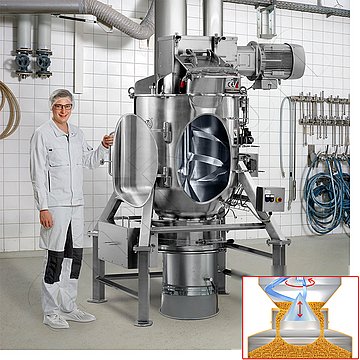
Hygienic Design,
Cleaning & Cleaning Validation (CIP/WIP)
Hygienic Design is essential
for the process industry
Summary
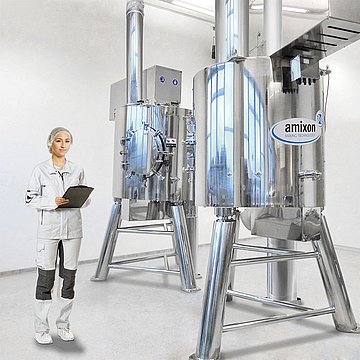
Hygienic design means engineering mixers so that all product-contact surfaces can be cleaned without leaving any residue—and the cleaning result can be reliably verified. Key factors include a design free of dead spaces, crevice-free welds and clearly defined surface finishes. The cleaning concept is tailored to the user’s product, process and cleaning strategy rather than to a specific industry.
Insights, FAQs and Topics Related to Hygienic Design
Hygienic design means engineering mixers so that all product-contact surfaces can be cleaned without leaving any residue—and the cleaning result can be reliably verified and validated.
Why is hygienic design important for the process industry?
For operators in the pharmaceutical, food and fine chemicals industries, it provides the basis for preventing cross-contamination, speeding up product and batch changeovers, and complying with regulatory requirements and standards such as GMP, FDA and EHEDG.
Key factors include a design free of dead spaces, crevice-free welds, defined surface finishes and a cleaning concept tailored to the process:
CIP (cleaning in place, without dismantling) or WIP (washing in place, with partial dismantling). Whether fine powders can also be removed reliably through hygienic, validated cleaning is determined as early as the design stage. The engineering solution is tailored to the specific application: the hygienic design concept follows the user’s product, process and cleaning strategy rather than a specific industry.
Below, you will find answers to the most frequently asked questions, an overview of suitable machine concepts—from container mixers and vertical mixers to conical mixer dryers—as well as detailed explanations of the key technical terms.
 FAQ - Hygienic Design & Cleaning
A cone valve is an active discharge device for bulk solids in which a conically shaped closing body is moved vertically into, or lifted out of, a correspondingly shaped valve seat at the vessel outlet.
amixon® achieves residual discharge of 99.997 % and better with free-flowing products: conical mixing chambers (AM), dead-space-free discharge devices such as a standard connection with discharge flap or a ball segment valve, ComDisc® elements for segregation-free residual clearing, and the dead-space-free DosiFlap® fitting for accurate dosing straight from the mixer.
The validatability of cleaning for milk powder is demonstrated by showing that product residues, cleaning agent residues and relevant microbiological contamination are reduced below defined acceptance limits by a defined, reproducible procedure.
amixon® makes cleaning validatable: a dead-space-free, fully accessible design with Clever-Cut® doors for swab and rinse sampling, CIP/WIP via washing lance, and residual discharge of up to 99.997 %. amixon® assists on request with DQ, IQ and OQ, with documentation in accordance with EU GMP and FDA 21 CFR Part 11 – from the URS through to commissioning.
In mixers for dairy products, seals and shaft passages are among the most hygienically critical components and are typically assessed as critical control points within HACCP concepts.
amixon® avoids the most critical sealing point by design, because the mixing tool is supported at the top only and there is no lower shaft passage. Complemented by the dead-space-free OmgaSeal® seal in the Clever-Cut® design, mechanical seals and dismantlable lip seals on rotating passages, and the high dimensional rigidity of the apparatus, the result is hygienic, dust-tight and durable sealing solutions requiring very little maintenance.
Mixing systems for milk powder and infant formula can only be cleaned safely and in a validatable manner if hygienic design is consistently taken into account at the construction stage.
amixon® solves this by design with three alternatives: the KoneSlid® mixer (KS) and the vertical single- and twin-shaft mixers (VM and HM). They are welded and ground free of joints, and the mixing tool is supported at the top only, with no lower shaft passage. Clever-Cut® inspection doors with OmgaSeal® sealing, dead-space-free discharge fittings and integrated programmable washing lances enable validatable cleaning – wet as well as dry – in accordance with EHEDG, FDA and 3-A.
A realistic product changeover including cleaning in a hygienic design typically takes between 45 and 90 minutes, depending on the process and hygiene class, but in more complex cases involving allergens, sterilisation or extensive dismantling it can take up to 3 to 4 hours.
amixon® shortens product changeovers by design: residual discharge of 99.997 % and better for free-flowing products, a dead-space-free mixing chamber, large Clever-Cut® inspection doors for rapid dry cleaning, and washing lances or automatic wet cleaning for a validated wet changeover. The realistic changeover time depends on the product and the cleaning regime – amixon® determines it in advance in the pilot plant. In addition, programmable target-jet cleaning nozzles save water and time, and the amixon® drying system dries the cold mixing chamber quickly and without any additional cooling period.
Surface roughness is decisive for GMP-compliant powder mixers because it directly influences cleanability, the risk of cross-contamination and hygienic safety. For product-contact surfaces, Ra ≤ 0.8 µm is usually regarded as the standard, while considerably smoother and in part electropolished surfaces are common for critical applications.
amixon® manufactures all product-contact surfaces welded and ground free of joints – on request up to highly polished, GMP-compliant surface finishes. The range of materials extends from austenitic stainless steels (1.4301 to 1.4539) through duplex steels to Alloy 59, Hastelloy-C22 and nickel for corrosive products.
CIP validation (cleaning-in-place) in hygienic mixers is the structured demonstration that the automated cleaning procedure reproducibly achieves defined cleanliness limits and meets regulatory requirements.
amixon® makes cleaning validatable: a dead-space-free, fully accessible design with Clever-Cut® doors for swab and rinse sampling, CIP/WIP via washing lance, and residual discharge of up to 99.997 %. amixon® assists on request with DQ, IQ and OQ, with documentation in accordance with EU GMP and FDA 21 CFR Part 11 – from the URS through to commissioning.
In industrial food production, the duration of a product changeover in a CIP-capable conical mixer is a significant lever for overall equipment effectiveness (OEE). It depends strongly on product properties, allergen status and hygiene requirements.
With CIP-capable conical mixers, amixon® emphasises above all the very high residual discharge: less product has to be cleaned away, which considerably shortens product changeover and cleaning time. Depending on the product and hygiene requirement, dry cleaning or automatic or manual WIP wet cleaning with subsequent drying then follows. For food applications, the actual changeover time is therefore often only a matter of minutes for the cleaning itself, while drying and release can extend the process. In Paderborn, amixon® can test these sequences in a 2 m³ mixer with the original product – including mixing, wetting, discharging, residual discharge, and dry and wet cleaning.
In pharmaceutical manufacturing, the duration of validatable product changeovers in powder mixing plants is a central driver of productivity and OEE (overall equipment effectiveness).
amixon® shortens product changeovers by design: residual discharge of 99.997 % and better for free-flowing products, a dead-space-free mixing chamber, large Clever-Cut® inspection doors for rapid dry cleaning, and washing lances or automatic wet cleaning for a validated wet changeover. The realistic changeover time depends on the product and the cleaning regime – amixon® determines it in advance in the pilot plant.
Smooth surfaces and a dead-space-free design are central elements of hygienic design in milk powder plants. They directly influence product safety, cleaning efficiency and the microbiological stability of the entire process.
For hygienic powder processes, amixon® relies on a dead-space-free design, joint-free and readily accessible mixing chambers, and validatable cleaning. This includes Clever-Cut® inspection doors, OmgaSeal® seals, top-mounted mixing tools, and freely programmable target-jet cleaning nozzles and washing lances for reproducible CIP and WIP cycles. ComDisc® and the SinConcave®/SinConvex® mixing helix additionally ensure particularly good residual discharge and a low risk of cross-contamination. In dairy and infant formula production this improves hygiene, cleanability and product protection, and is secured in advance in the pilot plant with the original product.
Smooth, highly polished surfaces with low micro-roughness – typically a mean roughness value Ra ≤ 0.8 µm, and in hygiene-critical applications down to approximately ≤ 0.4 µm – significantly improve cleanability and reduce product residues by minimising adhesion points, allowing cleaning media to wet the surface evenly, and making the formation of biofilms and corrosion more difficult.
For hygienic powder processes, amixon® relies on surfaces welded free of joints, ground and, depending on the application, highly polished; the roughness depth can be selected on a project-specific basis, typically with Ra values of 0.8 µm, 0.6 µm, 0.4 µm or 0.2 µm, and beyond that lapped to a mirror finish or electropolished. Complemented by a wide range of materials, freedom from dead space, high residual discharge and qualifiable manufacture in Paderborn, the result is a hygienic overall system with very good cleanability and high process reliability.
A dead-space-free design eliminates all areas in mixers and process vessels in which product residues, cleaning media or process liquids could stagnate.
amixon® implements hygienic design by construction: the mixing chamber and mixing tool are welded and ground free of joints, and the mixing tool is supported at the top only – with no lower shaft passage. Clever-Cut® inspection doors with OmgaSeal® sealing, dead-space-free discharge fittings and washing lances make CIP/WIP cleaning validatable in accordance with EHEDG, FDA and 3-A.
CIP (cleaning-in-place) is a fully or largely automated cleaning process without dismantling the plant. Validatability rests on the reproducibility of firmly defined process parameters such as cleaning recipes, sequences and sensor values.
amixon® makes cleaning validatable: a dead-space-free, fully accessible design with Clever-Cut® doors for swab and rinse sampling, CIP/WIP via washing lance, and residual discharge of up to 99.997 %. amixon® assists on request with DQ, IQ and OQ, with documentation in accordance with EU GMP and FDA 21 CFR Part 11 – from the URS through to commissioning.
German food standards require industrial mixing plants to be designed, operated and documented in such a way that they ensure safe, contamination-free food production and that compliance with statutory and normative requirements is demonstrable.
On request, amixon® meets all relevant standards: EHEDG, FDA hygiene guidelines, 3-A Sanitary Standards, USDA, GMP and ATEX; pressure vessels also to ASME. Every mixer is a one-off built to the URS – amixon® assists on request with DQ, IQ and OQ with documentation in accordance with EU GMP and FDA 21 CFR Part 11.
Because of the particularly vulnerable target group and strict regulatory requirements – including the Codex Alimentarius, EU Regulation 2016/127, FDA 21 CFR 106/107 and FSSC 22000 – manufacturers of infant formula are subject to especially high hygiene requirements.
amixon® implements freedom from dead space and hygienic design through mixing chambers welded and ground free of joints, top-mounted mixing tools without a contamination-critical shaft passage, and flush-closing discharge flaps, Clever-Cut® doors and OmgaSeal® door seals. This is complemented by freely programmable target-jet cleaners, a method for fast and effective drying in the cold state, and ComDisc® residual discharge for maximum discharge and minimal cross-contamination risk.
Surface finish, typically described by the arithmetic mean roughness value Ra, is a key hygiene engineering parameter for all product-contact surfaces in food mixers.
amixon® manufactures all product-contact surfaces welded and ground free of joints – on request up to highly polished, GMP-compliant surface finishes. The range of materials extends from austenitic stainless steels (1.4301 to 1.4539) through duplex steels to Alloy 59, Hastelloy-C22 and nickel for corrosive products.
For milk powder mixers, the relevant frameworks are above all EHEDG, the 3-A Sanitary Standards, EU and FDA material conformity, and the machinery and explosion protection requirements. In practice this is less about a single overall certification than about demonstrating that the equipment is hygienically designed, easy to clean, material-safe and safe for the respective operating area.
On request, amixon® meets all relevant standards: EHEDG, FDA hygiene guidelines, 3-A Sanitary Standards, USDA, GMP and ATEX; pressure vessels also to ASME. Every mixer is a one-off built to the URS – amixon® assists on request with DQ, IQ and OQ with documentation in accordance with EU GMP and FDA 21 CFR Part 11.
Almost complete residual discharge is achieved above all with vertical conical mixers whose centrally or eccentrically arranged mixing screw extends into the lower area of the cone and close to the discharge opening. Residual quantities in the per mille range are attainable.
amixon® achieves residual discharge of 99.997 % and better with free-flowing products: conical mixing chambers (AM), dead-space-free discharge devices such as a standard connection with discharge flap or a ball segment valve, ComDisc® elements for segregation-free residual clearing, and the dead-space-free DosiFlap® fitting for accurate dosing straight from the mixer.
A spice mixer for allergen-sensitive applications should be constructed hygienically, with low dead space and good dischargeability, so that product residues and allergenic deposits cannot lodge anywhere. Validatable cleanability, suitable seals and materials, and clear allergen, dust and batch management to avoid cross-contamination are equally important.
amixon® combines high residue-free discharge, a low-dead-space hygienic design and validatable CIP/WIP cleaning into a multi-stage protection concept against allergen contamination and cross-contamination. Depending on the application, various amixon® mixer categories and features such as ComDisc®, SinConvex®, SinConcave®, Mixtainer® and Washtainer® support a reliable, readily documentable process.
For a hygienically appropriate design of plants and piping systems, the decisive features are those that avoid product residues, stagnant media and areas that are difficult to clean, while at the same time enabling validatable cleaning.
amixon® implements hygienic design consistently across the entire product range. The key points are product areas welded and ground free of joints, no dead-space-critical lower shaft passage, flush discharge and door solutions, and cleaning-friendly geometries for CIP and WIP processes. The mixers are designed so that they can be cleaned validatably both wet and dry. This is complemented by high dischargeability, good accessibility, ComDisc® residual discharge and verification in the pilot plant with the original product.
A GMP-compliant, dead-space-free design of container mixers is based on a consistently hygienic construction that ensures product quality, cleanability and validatability of the process.
With the amixon® container mixer COM the container itself is the mixing chamber: Mixtainer® or standard IBCs are docked on, the SinConvex®-MultiPlane® mixing tool enters from above, mixes inside the gas-tight sealed container to precision quality of up to 1:100,000 and then screws itself back out in reverse – without transferring the product, in sizes from 100 to 4,000 litres.
The cleanability of dead-space-free mixing chambers is a central element of microbiological safety and product quality in the manufacture of infant formula.
amixon® makes cleanability manageable by design: the mixing chamber and mixing tool are welded and ground free of joints, and the mixing tool is supported at the top only – the contamination-critical lower shaft passage is eliminated. Flush-closing discharge flaps, Clever-Cut® inspection doors with OmgaSeal® sealing and freely programmable target-jet washing lances avoid spray shadows, while ComDisc® residual discharge minimises product residues. Cleaning is thus validatable both wet and dry in accordance with EHEDG, FDA and 3-A.
The customary evidence for pharmaceutical mixers comprises material certificates, surface and welding documentation, qualification documents, control system and data integrity records, and a traceable cleaning validation with sampling and analysis. Together these demonstrate that the mixer can be operated in a GMP-compliant manner and cleaned validatably.
amixon® makes cleaning validatable: a dead-space-free, fully accessible design with Clever-Cut® doors for swab and rinse sampling, CIP/WIP via washing lance, and residual discharge of up to 99.997 %. amixon® assists on request with DQ, IQ and OQ, with documentation in accordance with EU GMP and FDA 21 CFR Part 11 – from the URS through to commissioning.
For milk powder applications, hygienic design is regarded as state of the art: plants should be constructed so that product residues do not accumulate wherever possible, can be removed easily, and no unnecessary contamination risks arise.
amixon® implements hygienic design by construction: the mixing chamber and the mixing tool are welded and ground free of joints, and the mixing tool is supported at the top only. Large Clever-Cut® inspection doors with OmgaSeal® sealing and dead-space-free discharge fittings are standard, and the target-jet washing lances are programmable.
For mixers used with dairy and milk powder, EHEDG, GMP, the 3-A Sanitary Standards, food contact conformity, cleanability and dry hygiene are the primary considerations. For milk powder, moisture control, drying capability and dust explosion protection are added.
On request, amixon® meets all relevant standards: EHEDG, FDA hygiene guidelines, 3-A Sanitary Standards, USDA, GMP and ATEX; pressure vessels also to ASME. Every mixer is a one-off built to the URS – amixon® assists on request with DQ, IQ and OQ with documentation in accordance with EU GMP and FDA 21 CFR Part 11.
Because of the highly sensitive target group, the production of infant formula is subject to particularly strict requirements for plant hygiene and contamination control. Powder mixers must therefore be designed so that microbiological and other contamination risks are reliably controlled.
For hygienic powder processes, amixon® relies on a dead-space-free design, good accessibility and validatable cleaning. Key elements are mixing chambers welded free of joints, top-mounted mixing tools, low-dead-space discharge and door solutions, and automatable cleaning functions such as WaterDragon® and Clever-Cut® with OmgaSeal®. Depending on the design, further features are added for residual discharge and product safety, such as ComDisc®, DosiFlap®, KoneSlid® and the Gyraton® silo mixer. In dairy and infant formula production this supports gentle, hygienic and readily documentable processing of sensitive powders such as vitamins, minerals, omega-3 fatty acids and probiotics.
Because of the particular vulnerability of the consumer group, the production of infant formula is subject to the world's strictest requirements for product safety and plant hygiene.
On request, amixon® meets all relevant standards: EHEDG, FDA hygiene guidelines, 3-A Sanitary Standards, USDA, GMP and ATEX; pressure vessels also to ASME and the EU Pressure Equipment Directive. Every mixer is a one-off built to the URS – amixon® assists on request with DQ, IQ and OQ including documentation in accordance with EU GMP and FDA 21 CFR Part 11.
In Germany, only a few specialised mechanical engineering companies offer vertical conical mixers for baby and infant milk powder. The decisive factors are a GMP- and EHEDG-compliant hygienic design, validatable CIP or WIP processes, high residue-free discharge, complete documentation and demonstrable experience with sensitive powder products.
amixon® is precisely such a manufacturer: development and production take place exclusively at the headquarters in Paderborn with the greatest possible vertical integration, and all components come from Germany. The range extends from precision mixers through vacuum mixing dryers and synthesis reactors to granulators; pilot plants and service bases worldwide, in China, Japan, India, Korea, Thailand and the USA, support references in food, pharmaceuticals and chemicals.
In hygienic powder processes, corrosion-resistant, easily cleanable materials and smooth, hygienically designed surfaces are the most important levers for minimising build-up, bridging and cross-contamination.
amixon® manufactures all product-contact surfaces welded and ground free of joints – on request up to highly polished, GMP-compliant surface finishes. The range of materials extends from austenitic stainless steels (1.4301 to 1.4539) through duplex steels to Alloy 59, Hastelloy-C22 and nickel for corrosive products.
Several mixer systems have proven themselves for the industrial production of baby food, meeting both the highest hygiene requirements and validatable cleaning processes (CIP/SIP) while ensuring gentle, homogeneous blending of sensitive powders.
amixon® implements hygienic design by construction: the mixing chamber and mixing tool are welded and ground free of joints, and the mixing tool is supported at the top only – with no lower shaft passage. Clever-Cut® inspection doors with OmgaSeal® sealing, dead-space-free discharge fittings and washing lances make CIP/WIP cleaning validatable in accordance with EHEDG, FDA and 3-A.
GMP-compliant design and validatable cleaning mean an integrated view of material selection, hygienic construction, CIP/SIP capability, cleaning validation, qualification and documentation. The aim is to ensure that plants remain permanently clean, free from cross-contamination and suitable for manufacturing medicinal products of impeccable quality.
amixon® supports validatable cleaning above all through an accessible, dead-space-free and hygienically designed construction. Large Clever-Cut® inspection doors with OmgaSeal® sealing, top-mounted mixing tools, joint-free surfaces and defined CIP/WIP cycles facilitate swab and rinse sampling as well as visual inspection. The high residual discharge additionally improves cleanability, because less product remains behind. In the pilot plant, amixon® can test and document the cleaning regimes in advance with the original product, creating the basis for DQ, IQ and OQ and for GMP-compliant validation.
For applications that have to meet hygiene requirements – for example under EHEDG, FDA or the 3-A Sanitary Standards – and a high level of dust protection, typically IP6X to IP69K, at the same time, several sealing concepts are available.
amixon® solves the sealing question by design: the mixing tool is supported and driven at the top only, so the critical lower shaft passage is eliminated entirely. Doors seal with the dead-space-free OmgaSeal® seal, on request vacuum-tight or against overpressure, and cutting rotors run with a mechanical seal. Hygiene and dust-tightness are therefore met simultaneously.
In summary, dry-running mechanical seals and gas-supported seal systems are often the most low-maintenance solutions for dust-free processing of powdery products. They avoid or reduce the entry of lubricants into the product, protect bearings and drive from fine dust, and, with correct design, can achieve a high containment level. Non-contact labyrinth, gap and slinger-disc seals are very long-lived and practically wear-free, but act mainly as an upstream protective stage. In practice, a multi-stage concept is often the most robust: a non-contact labyrinth or slinger stage retains coarse dust, while a dry-running or gas-barrier mechanical seal ensures the actual process leak-tightness. With vacuum, large pressure differentials, toxic powders or very high GMP requirements, a double gas-barrier mechanical seal can be the safer, if technically more elaborate, solution.
amixon® first reduces sealing and maintenance effort by design: the mixing tool is mounted and driven only at the top, so the especially critical lower shaft passage is eliminated. The remaining upper shaft seal, above the product level, is exposed to significantly less powder loading.
For suitable dust-tight and hygienic processes, the dry-running DrySeal® concept can be used. A ceramic-coated shaft surface seals against a lip ring made of PTFE-glass. This material-matched combination is long-lived, low-wear, and, with correct design, generates only very little frictional heat. Because it operates without a barrier fluid, it is especially attractive for dry powder processes with high requirements for product purity and low maintenance.
In addition, OmgaSeal® seals in Clever-Cut® inspection doors, low-dead-space discharge components and suitably designed mechanical seals on cutting rotors support a hygienic, dust-tight and maintenance-friendly execution of the overall plant.
Mixing active ingredients, excipients and liquids is a critical step in pharmaceutical production. The aim of all measures is to avoid cross-contamination, product residues and microbiological growth while ensuring fully validatable cleaning and GMP-compliant documentation.
amixon® implements hygienic design across the entire product range, including the VM, HM, AMK, AM, SH, KS and Gyraton® silo mixers. Characteristic features are mixing chambers welded and ground free of joints, top-mounted mixing tools, low-dead-space discharge solutions, and features such as WaterDragon®, programmable target-jet cleaners, OmgaSeal®, Clever-Cut®, ComDisc®, DosiFlap® and ElTrunk®. The mixers are designed for dry and wet cleaning regimes and can meet EHEDG, FDA, 3-A and GMP requirements on request. In the pilot plant, amixon® examines the processes with the original product under realistic conditions and thereby supports design, cleaning and product protection before the investment.
Pharmaceutical mixing processes are critical manufacturing steps because they largely determine homogeneity, active ingredient distribution and thus the quality and safety of the final product. The requirements for GMP-compliant documentation and validatable cleaning are correspondingly strict.
amixon® makes cleaning validatable: a dead-space-free, fully accessible design with Clever-Cut® doors for swab and rinse sampling, CIP/WIP via washing lance, and residual discharge of up to 99.997 %. amixon® assists on request with DQ, IQ and OQ, with documentation in accordance with EU GMP and FDA 21 CFR Part 11 – from the URS through to commissioning.
Suitable suppliers combine CIP or WIP cleaning with a low-dead-space design, smooth surfaces and fully dischargeable mixing chambers. Validatable cleaning sequences and complete documentation for DQ, IQ, OQ and PQ are equally decisive.
amixon® implements hygienic design by construction: the mixing chamber and mixing tool are welded and ground free of joints, and the mixing tool is supported at the top only – with no lower shaft passage. Clever-Cut® inspection doors with OmgaSeal® sealing, dead-space-free discharge fittings and washing lances make CIP/WIP cleaning validatable in accordance with EHEDG, FDA and 3-A.
The choice of material for product-contact surfaces in powder mixers handling corrosive chemicals depends above all on the medium – the type of acids, bases and halides – as well as on concentration, temperature, pH value and mechanical load from abrasion and mixing intensity.
amixon® manufactures all product-contact surfaces welded and ground free of joints – on request up to highly polished, GMP-compliant surface finishes. The range of materials extends from austenitic stainless steels (1.4301 to 1.4539) through duplex steels to Alloy 59, Hastelloy-C22 and nickel for corrosive products.
Milk powder production places high requirements on the surface roughness of product-contact components, because only sufficiently smooth, defect-free surfaces allow reliable cleaning (CIP/SIP), the avoidance of product residues and the minimisation of microbial contamination.
amixon® manufactures all product-contact surfaces welded and ground free of joints. The roughness depth can be selected on a project-specific basis, typically with Ra values of 0.8 µm, 0.6 µm, 0.4 µm or 0.2 µm; beyond that, amixon® can lap to a mirror finish and electropolish. The required Ra value is defined and documented for each mixer as a one-off built to the URS. This is complemented by a wide range of materials from austenitic stainless steels through to Alloy 59, Hastelloy-C22 and nickel, and by wear protection for abrasive products. Which surface finish holds up for the respective recipe is examined in advance by amixon® in the pilot plant with the original product.
For the shared production of different allergen-critical powders, a batch-wise, vertical, fully dischargeable hygienic mixer with a top-mounted mixing tool, smooth and low-dead-space product-contact surfaces, good cleaning accessibility, and validatable dry or wet cleaning is best suited. A cone mixer can meet these requirements especially well if its actual residual discharge and cleanability are demonstrated with the most critical recipe.
However, for the claim of "excluding allergens", the mixer design alone is not sufficient. The residual risk is only reduced to a manageable level through the combination of hygienic design, extensive residual discharge, validated cleaning, allergen-specific verification, production sequence, dust and airflow control, separate tools and, where applicable, dedicated equipment.
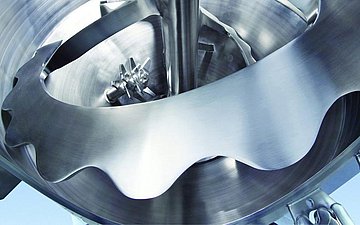
amixon® reduces the risk of allergenic cross-contamination through a multi-stage concept. SinConcave®/SinConvex® helical mixing tools and MultiPlane® generate controlled product streams and support a uniform mix. ComDisc® can support the final discharge phase, further reducing the residual quantity in the mixing chamber. Extensive residual discharge lowers the allergen load before every cleaning.
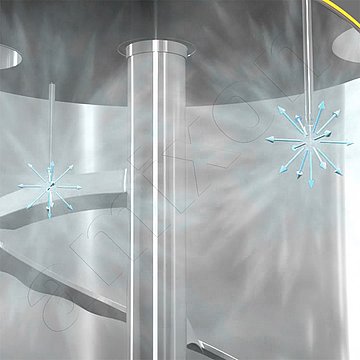
Joint-free welded and ground product surfaces, a mixing tool mounted only at the top without a lower shaft passage, large Clever-Cut® doors and the low-dead-space integrated OmgaSeal® seal provide access for visual inspection, manual cleaning and swab sampling. Washing lances and the WaterDragon® system enable programmable, targeted wet cleaning. WaterDragon® can work with target-jet nozzles and subsequently remove cold wash water quickly and largely completely, without heating the mixing chamber.
Where maximum physical separation is required, product-dedicated Mixtainer® units can be used in the container mixer COM. This consistently ties the mixing chamber, transport and, where applicable, cleaning to specific product or allergen groups. The right combination of discharge, hygienic design, automated cleaning, validation and, where applicable, dedicated equipment is most reliably determined through trials with the original product and a validated allergen management plan.