Diffusion
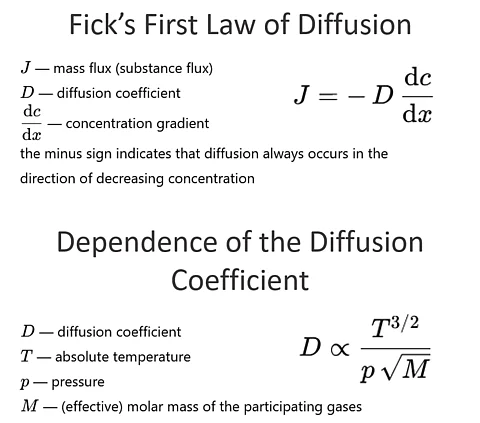
Diffusion is a physical transport process in which atoms, molecules or ions compensate for concentration differences as a result of their thermal motion. The particles move statistically in all directions, but net from high to low concentration. In the simplest case, the resulting diffusion flux JJ can be described by Fick's 1st law:
J= − D · dc/dx
- J stands for material flow
- D stands for the diffusion coefficient.
- dc/dx stands for the concentration gradient.
The minus sign indicates that the flow is always directed towards decreasing concentration.
D∝ T^(3/2) / (p · M^(1/2))
- D: Diffusion coefficient
- T: absolute temperature
- p: Pressure
- M: (effective) molar mass of the gases involved
The higher the temperature and the lower the viscosity of a medium, the greater the diffusion coefficient DD and the faster the concentration equilibrium. In gases and liquids, DD is significantly greater than in solids; pure solid diffusion is therefore very slow. In real solids, fluids contained in pores (e.g. moisture, solvents) with significantly higher diffusion coefficients often contribute significantly to the observed mass transport.
In powder mixers, mechanical mixing dominates the actual mixing process, while diffusion plays only a minor role. During long-term storage of powder mixtures, diffusion processes – both in solid particles and in existing fluid phases – can contribute to homogenisation or alter product quality through the migration of water, flavourings or active ingredients.
 Blog
Blog