
Summary
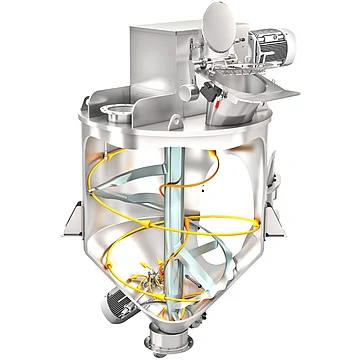
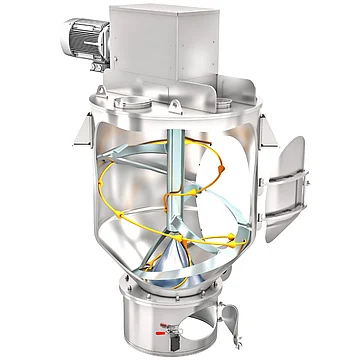
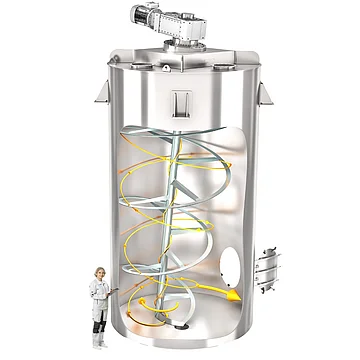
Conical mixers are batch mixers with a conical vessel and a helical mixing tool. The conical geometry directs the product towards the outlet by gravity, enabling near-complete discharge across a wide usable filling range.
Key Facts About Conical Mixers: Operating Principle, Cost-Effectiveness and Selection
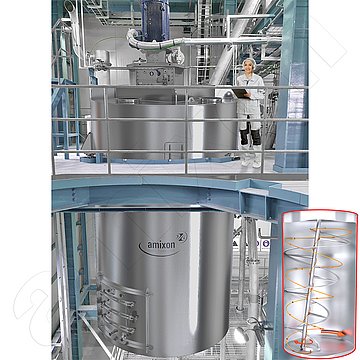
A conical mixer is a batch mixer with a conical vessel in which one or two helical mixing tools—such as helical mixing tools—lift and rearrange the product. The conical geometry directs the product towards the outlet by gravity. Discharge can therefore take place without mechanical clearing while achieving minimal residual product levels.
This design is cost-effective primarily because of three characteristics: low specific energy input, short mixing times combined with gentle product handling, and a wide usable filling range. The same machine can process partial batches without compromising the quality assessed against defined mixing quality criteria. Where product changeovers are frequent, a design free of dead spaces and ergonomic cleaning also contribute directly to higher equipment availability.
Selection requires careful consideration of the batch-size range, the product’s flow behavior and tendency to adhere, the permissible shear load, liquid addition, and cleaning and inspection requirements. For rapid batch changeovers, it is also important to assess how easily the vessel and mixing tool can be accessed for visual inspection and swab testing.
Selection Matrix
| Criterion | Key Question | Implications for Mixer Selection |
|---|---|---|
| Batch-size range | What is the ratio between the smallest and largest batch? | A wide range requires a mixer design with a large usable filling range. Otherwise, two machines may be necessary. |
| Flow behavior and cohesion | Is the product free-flowing, or does it tend to form bridges and deposits? | Cohesive products require forced-conveying mixing tools that reach the entire mixing chamber. Gravity-based designs such as free-fall mixers are unsuitable. |
| Liquid addition | Will liquids be added, and in what proportion? | At liquid contents of a few percent or more, a spray system, a defined dosing rate and an auxiliary cutting rotor for breaking down lumps should be included. |
| Shear sensitivity | Must granulates, flakes or fibers remain intact? | Large mixing tools operating at a low peripheral speed should be used instead of auxiliary cutting rotors. The mixing-tool geometry therefore becomes a key selection criterion. |
| Residual discharge | How much residual product is acceptable in terms of cost and cross-contamination? | A conical vessel with a bottom closure at its lowest point enables near-complete discharge. |
| Cleaning method | Is dry, damp or wet cleaning in a closed system required? | Wet cleaning requires a design free of dead spaces, sloped surfaces and defined accessibility. Retrofitting existing equipment is possible but must be assessed for cost-effectiveness. |
| Frequency of product changeovers | How many changeovers occur each week, and how much cleaning do they require? | At high changeover frequencies, setup and cleaning times have a greater impact on cost-effectiveness than the mixing time itself. |
| Batch or continuous operation | Are defined formulation batches or a constant mass flow required? | Batch operation is suitable for formulation changes and batch-specific traceability. Continuous operation is suitable for consistent formulations and high throughput. |
| Temperature control, drying and inerting | Must heat be added or removed, moisture extracted or the process inerted? | The double jacket and pressure rating must be specified at an early stage. If drying is part of the process, a mixer dryer should be selected instead of a mixer. |
| Explosion protection | Which hazardous-area zones apply inside and outside the mixer, and what is the product’s minimum ignition energy? | This determines the drive, bearing and sealing concepts. These specifications cannot be changed retrospectively and must therefore be established at the start of the selection process. |
 FAQ
FAQ

 Blog
Blog