
Residual Discharge
Residual discharge refers to the automatic discharge of a product from a process plant that is as complete as possible, i.e. without manual scooping or subsequent cleaning. The aim is to reduce the amount of product remaining in the system to a technically achievable and economically viable minimum.
In practice, the term is often equated with ‘complete emptying’. This term suggests a completely residue-free emptying process without any product adhesion. In powder processes, however, such absolute complete emptying is hardly achievable due to adhesion, cohesion and product sticking to surfaces. Although modern plant designs come close to this ideal in terms of construction, they cannot achieve it completely.
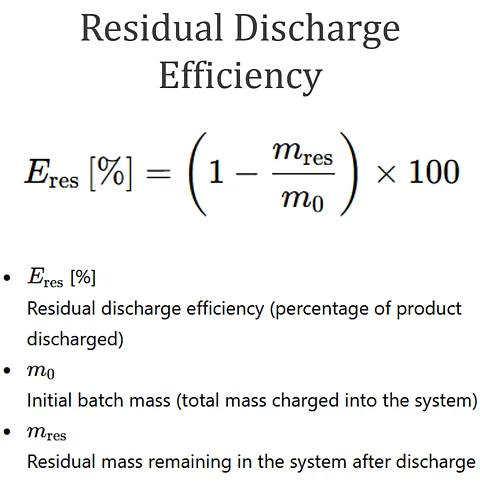
The quality of residual discharge is often described by the residual discharge rate. This indicates what proportion of the initial charge has been discharged following an automatic discharge process.
Residual discharge rate [%] = (1 - m_rest / m_0) * 100
Here, m_0 denotes the batch quantity and m_(rest) the residual quantity remaining in the system. A residual discharge rate of 99.98%, for example, corresponds to a residual of just 0.02% of the product quantity.
If a plant for powder mixing or processing could actually be emptied completely, this would have far-reaching advantages: a wide variety of formulations and raw materials could be processed one after the other without the need for cleaning processes. Product changes would take place with virtually no downtime, the risk of cross-contamination would be practically eliminated, and plant availability would increase significantly. From today’s perspective, however, this remains an ideal scenario.
In process engineering, the quality of residual discharge is therefore of central importance. It directly influences the cleaning effort, the duration of product changes, product loss and the cost-effectiveness of the overall process. Particularly in demanding applications with frequent formulation changes, excellent residual discharge is a decisive design criterion.
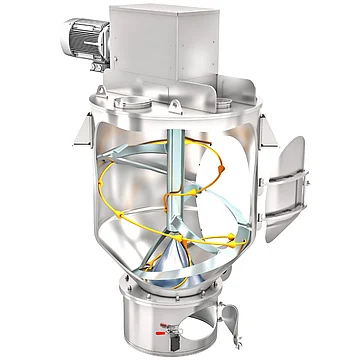
High residual discharge is the result of targeted design measures: optimised mixing chamber geometry, minimised dead spaces, defined transitions, suitable surface qualities (roughness, coatings), well-thought-out discharge concepts, and a mixing and discharge principle tailored to the product.
amixon® has invested heavily in development work in this area and offers sophisticated solution concepts that enable exceptionally high residual discharge rates – including SinConvex®, SinConcave®, ComDisc® and KoneSlid®. The aim is to consistently minimise product residues and thus sustainably reduce cleaning effort, downtime and product losses. In practice, residual discharge rates of up to 99.98% are achieved with large amixon® mixers.

 FAQ - Residual Discharge
 Blog
Blog