

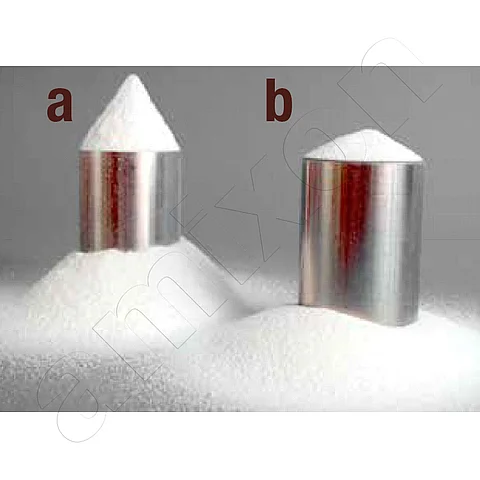
flow behaviour
Flow behaviour describes how a material moves or deforms under mechanical stress. In the case of bulk solids, it refers in particular to the conditions under which a compacted particle structure starts to move or remains stationary. This depends on the material properties (particle size, shape, surface texture, moisture, cohesion), the packing condition and the applied stress state.
When at rest, bulk solids can resist both normal and shear stresses and behave like a stable body. If the shear stress is increased and a material-specific yield point is exceeded, the particle structure begins to flow (plastic deformation, shearing). "Good" flow behaviour is achieved when bulk solids flow reliably out of hoppers, silos or dosing devices without significant pre-compaction and with minimal stimulation (e.g. gravity or slight vibration).
Parameters such as bulk density σ_c, consolidation stress σ₁, internal friction angle φ_i and flow factor ffc are used to quantitatively describe the flow behaviour of bulk solids. A commonly used measure is the flow factor:
ffc = σ_1 / σ_c
- ffc: Flowability index
- σ_1: consolidation stress
- σ_c: bulk density
Low ffc values indicate cohesive, poorly flowing powders, while high ffc values indicate free-flowing bulk solids. Flow behaviour has a direct influence on the design of silos, discharge devices, conveyor systems and mixers, as it determines bridge formation, shaft formation, dosing accuracy and emptying capability.
 FAQ - flow behaviour
 Blog
Blog