
continuous mixer
A continuously operated mixer is also referred to as a continuous flow mixer. It differs fundamentally from a batch mixer, which is operated discontinuously. With a batch mixer, the process takes place in separate steps: filling, mixing and emptying. The material to be mixed is filled in, homogenised by rotating tools and discharged at the end of the mixing time via a shut-off valve.
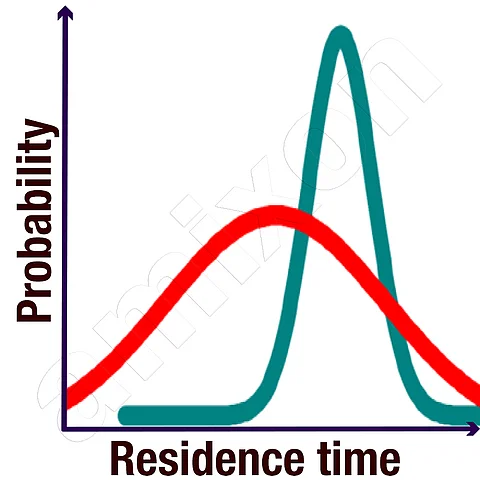
In a continuously operated mixer, however, these steps take place simultaneously. While new mix is continuously fed in, homogenisation takes place and the mix is discharged at the same time. Typically, the mixing chamber is designed as a horizontal pipe. Inside this pipe is a centrally mounted mixing shaft with various mixing elements. These elements cause both axial transport and radial mixing. In terms of fluid mechanics, this is a pipe flow with more or less pronounced plug flow.
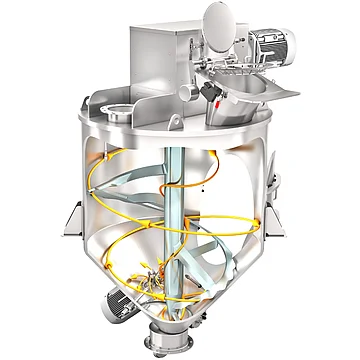
In addition, there are also continuous mixing systems in the form of flow-through kettle mixers. amixon® manufactures this type of mixer as a cone mixer under the type designation AMK. These devices have a significantly wider residence time spectrum. This means that individual particles remain in the mixing chamber for different lengths of time. This represents a deviation from the "first-in-first-out" principle. Such systems are particularly suitable for processes in which precise dosing of the individual components is difficult. Choosing the right mixer type is a process-oriented decision. In this context, we refer to the "short-term accuracy" of a dosing system.
Choosing the right type of mixer is a process-oriented decision. The pipe mixer offers narrow residence time distributions, high throughput and easy scalability. The flow-through kettle mixer allows for compensation of dosing errors.