
Skip to main navigation Skip to main content Skip to page footer

Summary

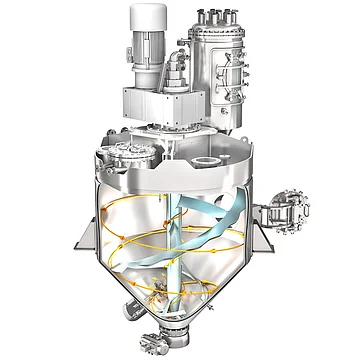
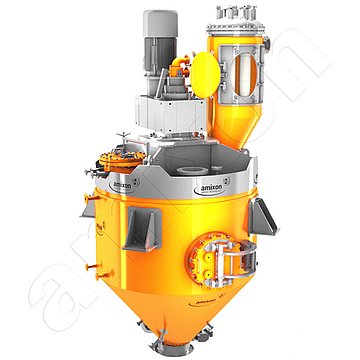
Conical mixer dryers combine mixing, drying, reacting and granulating in a single conical vessel. Heated surfaces and reduced pressure enable even temperature-sensitive products to be dried gently.

Key Facts About Conical Mixer Dryers: Drying, Granulating and Reacting

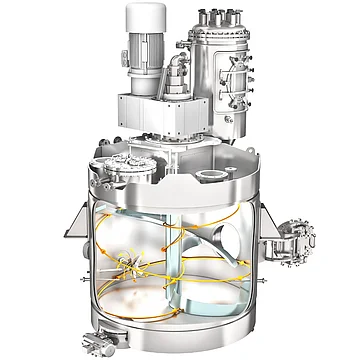
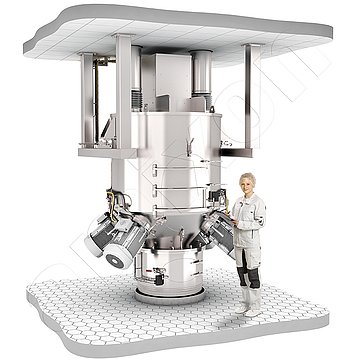
A conical mixer dryer combines mixing and drying in a single conical vessel. A mixing tool keeps the product in constant motion, while heated vessel walls and mixing-tool surfaces transfer heat into the product and moisture is removed under vacuum. Because heat transfer takes place through direct contact (vacuum contact drying), the reduced pressure—down to high-vacuum conditions—lowers the evaporation temperature sufficiently to dry even temperature-sensitive products gently. Continuous circulation prevents crust formation and ensures a uniform moisture content throughout the batch. The vessel wall and mixing-tool surfaces are maintained at precisely controlled temperatures.

During granulation, a precisely metered quantity of liquid is added and the product is subsequently dried in the same vessel. Build-up granulation produces a defined particle size distribution during the granulation process, without transferring the product between separate processing vessels. Vapour filters retain fine particles within the process chamber.

Reaction drying applies the same principle to processes in which chemical reactions and moisture removal take place simultaneously. The key parameters are the reaction kinetics and temperature profile, for example during a synthesis reaction. Solvents can be recovered through recondensation. Selection criteria include the heat-transfer surface area per unit volume, pressure rating, temperature profile and cleaning requirements.

Selection Matrix

CriterionKey QuestionImplications for Mixer Selection
Scope of the processIs the unit required only for drying, or also for granulating and reacting?This determines whether liquid addition, process sensors and the required pressure rating must be included from the outset. Retrofitting options are limited by the equipment design.
Permissible product temperatureTo what temperature may the product be heated?This limits the jacket temperature and operating pressure. A lower pressure reduces the boiling point and protects temperature-sensitive products.
Medium to be removedIs water or a solvent being removed?Solvents require condensation and recovery systems, inerting and a separate explosion-protection assessment.
Heat-transfer surface area per unit volumeHow quickly must the batch be dried?This has a greater influence on the equipment size than the batch volume. Drying time depends more strongly on the available surface area than on volume.
Final moisture content and endpoint detectionWhat residual moisture content is required, and how will the endpoint be identified?The endpoint can be determined using process variables such as torque, temperature differential and pressure profile. Sampling under vacuum is also possible.
Granulation targetWhat particle size distribution and granule strength are required?This determines the type of binder, addition rate and post-drying requirements. Granulation and drying must be carefully balanced because both affect the processing time and particle size distribution.
Reaction controlIs the reaction exothermic or endothermic, and what are its kinetics?This determines the required heating and cooling capacity as well as the safety assessment. The mixing action must reliably dissipate the heat of reaction.
Crust and deposit formationDoes the product tend to adhere to the heated vessel wall?The mixing tool must keep the wall surface as free of product as possible. Otherwise, heat transfer decreases during the batch and the drying time increases.
Sealing conceptHow many temperature and pressure cycles occur each year?This determines the type of seal and maintenance interval. The number of cycles—not the operating hours—is the primary driver of wear.
Cleaning and product changeoversHow frequently are they required, and which cleaning method is used?Wet cleaning in a closed system requires a design free of dead spaces and sloped surfaces. These features must be incorporated during engineering and cannot be retrofitted.

FAQ

With an appropriate design, conical reactor mixers are well suited to crystallising processes with precise temperature control, because they combine reactor, mixer and temperature control in a single apparatus. Additional heating and cooling surfaces and a slow, high-torque mixing operation support a uniform temperature distribution and controlled crystal growth.

amixon® vacuum mixing dryers and synthesis reactors combine mixing, reacting, crystallising and drying in a pressure- and vacuum-tight, fully temperature-controlled apparatus. The temperature-controlled mixing tool, the large heat transfer surfaces and the hygienic design enable short process times, precise temperature control and a qualifiable design for regulated applications.

Read more

Multifunctional vacuum reactor mixers combine mixing, reaction and crystallisation in a single closed apparatus; depending on the design, drying, solvent recovery and filtration can also be integrated. They are particularly suited to pharmaceutical, fine chemical and specialty chemical processes because they reduce product transfers and allow a closed, readily controllable mode of operation.

Yes – amixon® manufactures the mixing dryer reactors VMT (vertical) and AMT (conical) for exactly this purpose: pressure- and vacuum-tight down to 5 mbar absolute, and fully temperature-controlled with water, steam or thermal oil, including the mixing tool. Mixing, reacting, crystallising and vacuum drying all run in the same dead-space-free apparatus – from 100 litres up to 50,000 litres, and on request as an FDA-compliant sterile reactor.

Read more

Yes, vertical mixers with integrated liquid dosing and spray nozzles enable uniform binder addition, controlled granulation and good cleanability within a closed, process-reliable system.

Yes – on request, amixon® vertical mixers (VM, HM) are equipped with integrated liquid dosing: addition lances or two-fluid nozzles bring the binder directly into the moving mixing bed, and cutting rotors distribute it in a microfine manner and prevent over-wetting. Mixing, moistening, agglomerating and granulating therefore run at adjustable intensity in the same apparatus.

Read more

Yes, vertical twin-shaft mixers can be equipped with integrated liquid spray units for wet granulation.

Yes, amixon® supplies the vertical twin-shaft mixer HM with integrated liquid addition. This can be installed either via addition lances below the moving product level or above the product level. Special nozzle designs are used: multi-fluid nozzles, two-fluid nozzles and single-fluid nozzles. The more uniform the wetting, the more efficient the agglomeration.

Read more

Modern mixing reactors are designed as multifunctional process apparatus able to combine mixing, drying and reaction processes in a single closed process sequence. This integrated mode of operation is often referred to as one-pot processing.

Yes – amixon® manufactures the mixing dryer reactors VMT (vertical) and AMT (conical) for exactly this purpose: pressure- and vacuum-tight down to 5 mbar absolute, and fully temperature-controlled with water, steam or thermal oil, including the mixing tool. Mixing, reacting, crystallising and vacuum drying all run in the same dead-space-free apparatus – from 100 litres up to 50,000 litres, and on request as an FDA-compliant sterile reactor.

Read more

Setting granule size and structure reliably in a ring-layer granulator relies on the coordinated interplay of mechanical stress, liquid input and drying capacity, binder properties, residence time and fill level, complemented by robust inline process monitoring.

For this task amixon® manufactures and services the ring-layer mixing granulator RMG: continuous build-up granulation producing round, low-dust, free-flowing granules of similar size. Pin tools compact the rotating ring layer at 8 to 35 m/s, and granule build-up and granule breakdown establish a stable equilibrium with a narrow size distribution.

Read more

Modern cone mixing dryers save process time by continuously guiding the product to temperature-controlled contact surfaces during vacuum drying, better managing moist zones and lump phases, and combining several process steps in a single closed apparatus. Drying can take place at low product temperatures, while large heat-transfer surfaces constantly wetted by the mix improve heat and mass transfer.

Energy savings do not come from bypassing the enthalpy of vaporisation, but from lower heat losses, lower required temperature levels, shorter process times, demand-controlled mixing intensity, fewer transfers and solvent recovery. The real savings potential must be determined for each product through trials and a complete energy balance under the intended operating conditions.

Modern amixon® mixers and vacuum mixing dryers can reduce process time and energy through several mechanisms: low tool circumferential speeds, short and reproducible mixing times, large temperature-controlled heat-transfer surfaces, continuous contact of the mix with these surfaces, and extensive residual discharge.

The temperature-controllable SinConcave®/SinConvex® mixing helix complements the vessel wall, shaft and mixing arms. This gives amixon® large heat-transfer surfaces that are continuously touched by the mix through the three-dimensional product movement. This improves heat and mass transfer during vacuum drying and enables gentle process control at low product temperatures.

Good residual discharge is an equally important efficiency factor. It reduces product loss, cleaning effort, changeover times and carry-over risks. Based on drying trials with the original product, amixon® can properly extrapolate the necessary apparatus properties, bindingly fix the design, and construct and manufacture the target plant. This gives the operator a production plant that, once completed and qualified for commissioning, is designed for the intended process and can be operated productively without avoidable start-up problems.

Read more

In fine chemicals, vacuum reactors offer above all thermal protection of the product, improved mass and heat transfer, and efficient reaction control, mixing and drying within a single closed system.

amixon® builds the VMT and AMT vacuum mixing dryers and synthesis reactors for exactly this purpose: they are pressure- and vacuum-tight from 5 mbar absolute up to 30 bar. The apparatus can be fully temperature-controlled with water, steam or thermal oil, and the entire mixing tool can be temperature-controlled as well. Synthesis reaction, mixing and gentle vacuum drying take place in the same dead-space-free apparatus – from the 100-litre reactor up to 50 m³.

Read more

A conical mixing dryer with reactor function protects moisture-sensitive formulations against moisture, oxidation and contamination. At the same time it enables gentle mixing, efficient drying under vacuum or protective gas, and several process steps in a single apparatus.

amixon® selects the apparatus according to the process requirement: the AMT (conical) for almost complete discharge and low fill levels from approximately 15 %, and the VMT (vertical) for cubic installation spaces and the largest batches – both vacuum-tight down to 5 mbar absolute, fully temperature-controlled and gentle at low speed. For temperature-sensitive products, vacuum drying at low temperature is what counts; the selection is confirmed by a pilot-plant trial.

Read more

Recipe development for instantising processes with binder addition, meaning agglomeration, aims to formulate powders so that they wet quickly, disperse rapidly, show good flow behaviour and can be produced with a stable process.

On request, amixon® vertical mixers (VM, HM) are equipped with integrated liquid dosing: addition lances or two-fluid nozzles bring the binder directly into the moving mixing bed, and cutting rotors distribute it in a microfine manner and prevent over-wetting. Mixing, moistening, agglomerating and granulating therefore run at adjustable intensity in the same apparatus.

Read more

When designing a vacuum mixing dryer for sensitive food supplements such as vitamins, probiotics, enzymes and plant extracts, the key considerations are gentle drying, product quality, GMP conformity and process safety.

amixon® offers four different systems for vacuum mixing drying: the SpherHelics® hollow-sphere mixer (SH), the KoneSlid® (KS), the conical mixing dryer AMT and the flat-bottom mixer dryer VMT.

Read more

A cone mixing dryer/reactor is especially interesting for reacting and crystallising fine chemicals under vacuum because it can combine reaction, crystallisation, solvent removal and drying in a single closed process space. Vacuum lowers the boiling temperature and thus enables gentle processes at low product temperatures. The temperature-controllable conical geometry and the continuous product circulation promote uniform heat and mass transfer as well as defined temperature and concentration profiles.

Key advantages are fewer product transfers, lower contamination and loss potential, potential solvent recovery, gentle treatment of sensitive crystals, and a compact plant structure. Whether the apparatus is optimal for a specific material system must be verified through reaction calorimetry, crystallisation trials, solvent data, drying kinetics, particle stability, cleanability and safety assessment.

The cone mixing dryer/reactor AMT and the vertical mixing dryer/reactor VMT enable fine chemicals to be mixed, reacted, crystallised, de-agglomerated and dried under vacuum in a single closed apparatus. Their particular strength lies in the combination of a large-area temperature-controlled mixing chamber and an equally fully temperature-controllable mixing tool with shaft, arms and helix. This provides exceptionally large, actively usable heat-transfer surfaces.

What matters is that these surfaces are not merely present, but are continuously and intensively touched by the mix. The controlled three-dimensional product circulation continuously renews product contact at the vessel wall and mixing tool. This keeps heat and mass transfer efficient even under vacuum; heating and cooling processes can take place quickly and in a controlled manner at low product temperatures.

AMT and VMT can also handle strong rheological changes within the same apparatus body. A pumpable suspension can turn into a highly viscous, sticky lump mass during drying and then transform into a fine, free-flowing powder. The mixing tool keeps the product in motion; optionally engageable cutting rotors specifically break up lumps and promote access to the temperature-controlled surfaces. The specific design is secured through trials with the original product under real temperature, pressure and vacuum conditions.

Read more

In summary, metal-bellows-supported mechanical seals and double seal systems are the most important seal categories for vacuum mixing dryers with rapid temperature cycles. The metal bellows compensates for the thermal length change of the shaft, while a double seal with barrier fluid provides cooling, lubrication and monitoring. A gas-barrier seal prevents the ingress of a barrier fluid and can support inerting of the process. For flanges, manholes, sight glasses and other static interfaces, FFKM, FKM, EPDM, PTFE-based or metal-backed seals may be considered depending on temperature and chemistry. Decisive for a permanently safe solution is the interplay of seal category, material, sliding surfaces, barrier medium, temperature control, compensation of shaft movement, condition monitoring, cleaning and preventive maintenance.

amixon® seals vacuum mixing dryers permanently: OmgaSeal® door seals (vacuum-tight, dead-space-free) in Clever-Cut® doors, mechanical seals on cutting rotors, vacuum- and pressure-resistant ball-segment valves, manholes with bayonet closure. The exclusively top-mounted mixing tool eliminates the most critical shaft passage; the apparatus holds 5 mbar absolute even across frequent temperature cycles.

Read more

For producing free-flowing instant products, continuously operating ring-layer granulators are particularly suitable. They are designed for the build-up agglomeration of fine powders and offer a precise combination of mechanical fluidisation, targeted liquid injection and thermal process control.

amixon® solves this with the AMK continuous mixer: it builds up agglomerates with high porosity and thereby improves wettability, solubility and dispersibility – that is, the instant properties. Liquids are introduced in a microfine manner, throughput and residence time can be set independently of each other, and the mixing chamber is temperature-controlled. The design is established through trials with the original product in the amixon® pilot plant.

Read more

A cone mixing dryer or cone reactor is especially compelling when powders or moist solids are to be homogeneously mixed and gently dried under vacuum at the same time. Vacuum enables low product temperatures, while the conical geometry and continuous product circulation support uniform heat and mass transfer. Additional temperature-controlled surfaces on the mixing tool and vessel increase the effective contact area and can accelerate drying.

The concept is especially suitable for sensitive, valuable or demanding products that undergo strong rheological changes during drying. One-pot process control can combine reaction, crystallisation, evaporation, drying and cooling in a single closed apparatus. It reduces transfers, product losses, contamination risks and the plant footprint. The final selection should be based on original-product trials in which drying kinetics, rheology, heat transfer, residual solvent, particle quality, discharge, cleaning and safety are assessed across the entire process course.

What favours a cone mixing dryer or cone reactor is above all the batch-size range, the required fill-level flexibility, the desired residual discharge, the temperature sensitivity of the product, its rheological changes during drying, hygiene and sterility requirements, and the available floor space. AMT and VMT can mix, react, crystallise and dry powders, suspensions, pastes and viscoplastic intermediate states under vacuum.

The cone mixing dryer reactor AMT is especially advantageous when free-flowing products are to be discharged virtually completely via a central ball-segment valve, low fill levels are processed, and frequent product changes or high-value active ingredients demand a high yield. The vertical mixing dryer/reactor VMT is especially suitable for large batches and where installation height or footprint must be adapted to existing spatial conditions.

Both designs feature large, temperature-controlled heat-transfer surfaces on the mixing chamber and mixing tool. Because the mix continuously touches these surfaces, products can be dried quickly and gently under vacuum at low temperatures. For viscoplastic phases, a cutting rotor can specifically break up lumps and maintain heat and mass transfer. The suitable design is determined through original-product trials under the later temperature, pressure and process conditions.

Read more

The design of a ring-layer granulator depends above all on the product properties, the desired granule quality and the process control. A stable ring layer, controlled agglomeration and compaction, and the lowest possible dust formation are decisive.

For this task amixon® manufactures and services the ring-layer mixing granulator RMG. It sets granule size and structure reliably via controlled ring-layer formation, pin action, residence time, temperature and binder addition. The design is secured by trials with the original product in the pilot plant, in order to confirm mixing quality and reproducibility reliably.

Read more

German suppliers deliver vertical single-shaft mixers with heated or cooled jacket surfaces for mixing, drying, reaction and temperature-control processes. The decisive factors are appropriate thermal design, suitable materials, reliable sealing and sound pilot-plant trials.

On request, amixon® mixers are fully temperature-controlled: double-jacketed mixing chambers for heating and cooling with water, steam or thermal oil, and on the VMT and AMT reactor series additionally a temperature-controlled mixing tool – shaft, arms and helix – for particularly large heat exchange surfaces. Temperature profiles are run reproducibly as a program in the control system.

Read more

Vacuum mixing dryers, paddle dryers and conical reactors – also referred to as conical vacuum dryers, conical screw dryers, conical mixers or vacuum cone dryers – are offered by a limited number of specialised apparatus and plant manufacturers whose focus lies in mechanical and thermal process engineering.

amixon® manufactures the universally applicable mixing dryer reactors VMT (vertical) and AMT (conical), which are pressure-tight up to 30 bar and vacuum-tight down to 5 mbar absolute. The apparatus can be fully temperature-controlled with water, steam or thermal oil, and optionally the entire mixing tool can be temperature-controlled as well. Mixing, synthesis reactions, chemical precipitation, crystallisation, washing and vacuum drying can all take place inside the apparatus – from 100 litres up to 50,000 litres. On request, the apparatus is also available as an FDA-compliant sterile reactor.

Read more

Depending on the process route, ring-layer mixers, intensive mixers, ploughshare mixers, planetary and vacuum mixers, and inclined intensive mixers are used in the production of battery materials.

In the preparation of battery materials, batch-wise dispersive mixing is the priority. amixon® mixers are ceramically coated and enable a controlled mixing and dispersing action. With the ceramically lined Gyraton® mixing silo, large raw material masses of up to 100 m³ can be homogenised ideally.

Read more

When mixing reactive powder systems, precise thermal management is decisive for controlling reaction kinetics, product quality and process safety. Depending on the reactivity of the system, the batch size and the desired temperature profile, various technical heating and cooling options are available.

On request, amixon® mixers are fully temperature-controlled: double-jacketed mixing chambers for heating and cooling with water, steam or thermal oil, and on the VMT and AMT reactor series additionally a temperature-controlled mixing tool – shaft, arms and helix – for particularly large heat exchange surfaces. Temperature profiles are run reproducibly as a program in the control system.

Read more

Deliberately promoting agglomeration is based on the finely balanced interplay of mechanical energy input and liquid input.

On request, amixon® vertical mixers (VM, HM) are equipped with integrated liquid dosing: addition lances or two-fluid nozzles bring the binder directly into the moving mixing bed, and cutting rotors distribute it in a microfine manner and prevent over-wetting. Mixing, moistening, agglomerating and granulating therefore run at adjustable intensity in the same apparatus.

Read more

Reliably detecting the granulation end point in continuously operated flow-through mixers requires multidimensional process monitoring.

The RMG continuous mixer can be equipped with suitable process instrumentation for monitoring and for reproducible granulation; amixon® does not develop sensors of its own, but does handle their project-specific integration. Torque, power consumption, product temperature, moisture, solids mass flow and the quantity of granulating liquid added can all be used; imaging online measurement methods that continuously record particle size and particle shape are particularly informative. Which measured variable reliably marks the granulation end point depends on the formulation, the raw material quality and the process management, and is compared against analytically determined granulate properties. amixon® manufactures and services these apparatus and supplies spare parts for them in the long term; development work today concentrates on precision mixers with vertically or obliquely arranged mixing shafts.

Read more

Mixing plants used as reactors for crystallisation processes or solid-state reactions combine several mechanical, thermal and material unit operations in a single apparatus.

amixon® manufactures the mixing dryer reactors VMT (vertical) and AMT (conical) for exactly this purpose: pressure- and vacuum-tight down to 5 mbar absolute, and fully temperature-controlled with water, steam or thermal oil, including the mixing tool. Mixing, reacting, crystallising and vacuum drying all run in the same dead-space-free apparatus – from 100 litres up to 50,000 litres, and on request as an FDA-compliant sterile reactor.

Read more

Blog

Production of Pesticides (Part 1)
For reasons of longer shelf life and lower transport volume, plant protection products are often offered in powder form. amixon® has developed vacuum mix dryers that dry particularly quickly and gently. The powdered active ingredient concentrate is usually free-flowing, crystalline and low in dust.

Read more

Mixing-drying reactor for the synthesis of plant protection active ingredients
amixon® manufactures high-performance vacuum mixing dryers and synthesis reactors. These can process/dry chemicals of different consistencies. (POWDERY, SOLID, LIQUID, PASTY).

Read more

amixon® helps with the dimensioning of large vacuum mixer dryer systems
Successful tests in the pilot plant are the basic prerequisite for a well-functioning vacuum drying process. Thermodynamic calculations enable a safe scale-up of drying plants that are many times larger than the test plant. amixon® has 4 test plants (200 liters) in Paderborn. amixon® can safely…

Read more

Complex plant technology in the preparation of methyl cellulose, carboxymethyl cellulose, hydroxyethyl cellulose, etc.
Methylcelluloses have a wide range of technological properties. They are used for thickening, gluing, dispersing, emulsifying, filtering, flocculating and lubricating. They are used in the processing of paints, tablet masses, toothpaste, meat and fish, ice cream, baked goods, instant products,…

Read more

Starch extraction and starch preparation
Starch fermentation, starch conversion, starch modification, ... Starch can be cationised in the dry state or chemically or enzymatically modified in the wet state. We can demonstrate numerous processes in the amixon® technical centre.

Read more

amixon® mixers for "seafood" instant products
More and more people are choosing to follow a "pesco-vegetarian" diet. This means that meat is avoided for various reasons. In addition to the vegetarian diet, all types of seafood are also accepted. amixon® mixers/ blenders are used for the production of high-quality instant ready meals.

Read more

Powder agglomeration in the amixon® Ring-layer mixing granulator
We can also understand agglomeration built-up granulation without tools: We do dusty work and then vigorously rub our palms against each other. The small crumbs produced this way are the result of built-up agglomeration. The finest particles are compacted and roll up; in the presence of moisture…

Read more

Mixing plants for powder preparation of chemical and pharmaceutical active ingredients
The aim of processing chemical or active pharmaceutical ingredient powders in batches is to homogeneously distribute the active ingredients into suitable powdery fillers.

Read more