

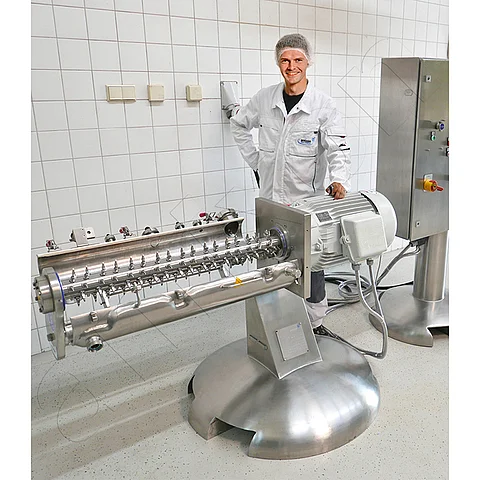
Granulation process
In granulation, larger grains (granules) are formed from fine powders or small particles by increasing the particle size. The goal is generally to improve flowability, dosability, dusting behavior, and, where applicable, dissolution or release behavior. A distinction is mainly made between wet, dry, and fluidized bed granulation.
In wet granulation, powders are wetted with a granulation liquid (usually water or an aqueous binder solution) and agglomerated under mechanical motion. This produces wet granules, which are then dried and, if necessary, classified to a target particle size or milled. Typical equipment includes high-shear mixers/granulators, granulating mixers, or fluidized bed granulators.
In dry granulation, no liquid is added. The powders are compacted by roller compactors or large tablet presses. The compacted material is then milled and sieved. This method is used when products are sensitive to moisture or elevated temperature. In fluidized bed granulation, the processes of fluidization, spraying, and drying are often combined in a single apparatus: a binder is sprayed onto the fluidized particles and the resulting agglomerates are dried directly. Granulation processes are widely used in the pharmaceutical, food, chemical, and fertilizer industries. They represent an intermediate stage between powder production and subsequent steps such as tableting, extrusion, coating, or direct compression.
Particle growth by coalescence. Several primary particles form an agglomerate. The total volume equals the sum of the individual volumes:
V_A = n · V_P
A spherical agglomerate grows with the cube root of the number of particles. Large diameters therefore require many primary particles.
d_A = d_P · n^(1/3)
- VA = volume of the agglomerate
- VP = volume of a primary particle
- dA = agglomerate diameter
- dP = primary particle diameter
- n = number of primary particles
Agglomerates contain voids. These affect strength and density. The porosity is calculated as
ε = 1 - (ρ_A / ρ_S):
- ε = porosity
- ρA = apparent agglomerate density
- ρS = material density