

Synthesis reaction
In a synthesis reaction, new molecules are formed. In the process, reactants react to form a desired product. The reaction can be exothermic or endothermic.
Important process parameters are temperature, pressure, concentration, and reaction time. Catalysts can increase the reaction rate. Solvents, solids, or gases may be involved.
Synthesis reactions take place in reactors, mixers, or continuous plants. They are used in the chemical, food, pharmaceutical, battery, and plastics industries. Good mixing is crucial for reaction yield and product quality.
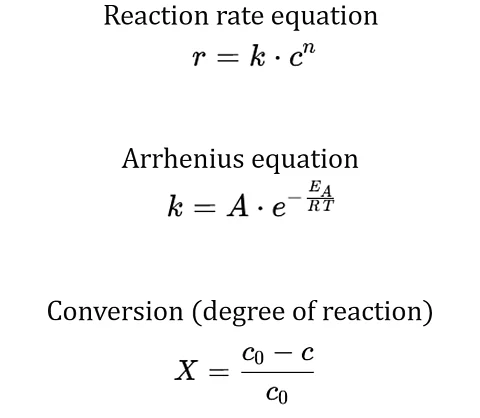
Reaction rate as a function of concentration:
R = K · cⁿ
- R = Reaction rate (e.g. mol·m⁻³·s⁻¹)
- K = rate constant
- c = concentration of the reactant (mol·m⁻³)
- n = reaction order (–)
Arrhenius equation for the rate constant; the temperature dependence of K:
K = A · e^(−E_A / (R · T))
- A = pre-exponential factor (frequency factor)
- E_A = activation energy (J·mol⁻¹)
- R = universal gas constant (8.314 J·mol⁻¹·K⁻¹)
- T = absolute temperature (K)
- e = Euler's number (≈ 2.718)
Definition of the conversion X via the concentrations:
X = (c₀ − c) / c₀
- X = conversion (–)
- c₀ = initial concentration of the reactant
- c = concentration of the reactant at time t