

Evaporation temperature
The evaporation temperature refers to the temperature at which a liquid changes into a gaseous state. It corresponds to the boiling point at a given pressure. A liquid begins to boil exactly when its vapor pressure equals the ambient pressure. This physical condition is:
p_(vapor)(T) = p_(ambient).
- p_(vapor) is the temperature-dependent vapor pressure of the liquid
- p_(ambient) is the external pressure.
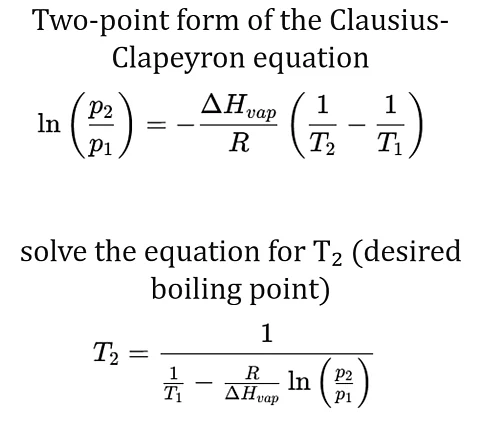
If the ambient pressure decreases, the evaporation temperature also decreases. This effect forms the basis for vacuum drying and vacuum distillation. The relationship between pressure and temperature is described by the Clausius-Clapeyron equation.
ln(p₂/p₁) = - ΔH_(vap) / R * (1/T₂ - 1/T₁)
From this equation, the evaporation temperature at a new pressure can be calculated.
T₂ = 1 / (1/T₁ - (R/ΔH_(vap)) * ln(p₂/p₁))
- T₂ is the evaporation temperature at the new pressure (K)
- T1 is the known reference temperature (K)
- p₂ is the target pressure (Pa)
- p₁ is the reference pressure (Pa)
- Δ_H_vap is the enthalpy of vaporization (J/mol)
- R is the universal gas constant (8.314 J/(mol·K))
These equations show that small changes in pressure can cause large changes in temperature. In industrial dryers and vacuum mixers, the evaporation temperature is therefore specifically adjusted via the pressure. This enables energy-efficient and gentle processing of temperature-sensitive products.
amixon® can manufacture pressure-resistant reactors. One of the many designs is the hollow sphere SpherHelics®.