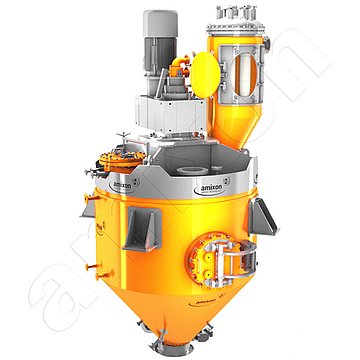

vapor filter
Dust filters are used in many areas of the bulk materials processing industry. They serve to separate small suspended particles from the air. They separate the gas phase from the solid phase.
The filter medium can be a textile fabric or a fabric made of fine metal wires. Metallic sintered materials can also serve as filters. The actual filtration process is based on the physical phenomenon of interparticle attraction. The smaller the powder particles, the stronger their cohesive forces (between similar molecules) and adhesive forces (attraction to different molecules/materials). These attractive forces can be several orders of magnitude greater than the force of gravity.
A distinction is made between depth filters and surface filters. Depth filters are, for example, sintered materials. Here, the fine dust particles penetrate deeply and remain trapped inside. Depth filters are usually disposable filters. They eventually become clogged and must then be replaced. This is the case with household vacuum cleaners, for example.
Surface filters have a fine-pored structure on the surface. Separation only takes place there. They can be cleaned by a pressurised gas pulse from the clean gas side. The adhering dust is blown off and falls downwards.
For self-cleaning reasons, dust filters are usually located in gas-tight housings.
Vapour filters must be distinguished from simple dust filters. They have a heated housing, which in many cases is designed to be pressure and vacuum resistant. They can be connected directly to synthesis reactors or vacuum filters. Heating the housing prevents dust condensation. During vacuum mixing drying, dust rises along with the vapour. Dust separation only works reliably if the filter medium is dry. This is the case when the system temperature is set above the dew point.
For this reason, vapour filters are much more complex and expensive than dust filters. The latter can only filter dry dust.
As a manufacturer of synthesis reactors and vacuum mixing dryers, amixon also produces a wide range of vapour filters. These are usually an important component of the dryer/synthesis reactor. Vapour filters from amixon have a very good self-cleaning effect.
Their dimensions are based on process engineering design data.
 FAQ - vapor filter
 Blog
Blog