

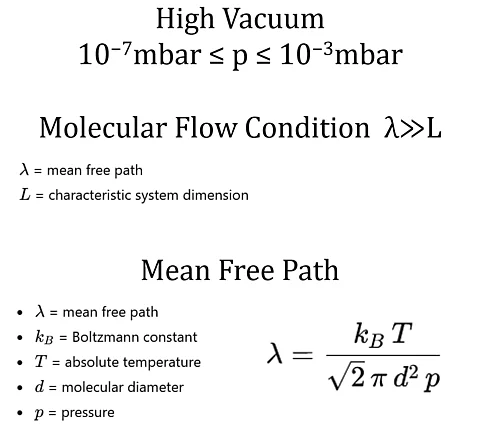
High vacuum
High vacuum refers to an extremely low gas pressure in closed systems. In this pressure range, molecular flow dominates, so many classical flow laws no longer apply. The high-vacuum range covers pressures from about 10⁻⁷ to 10⁻³ mbar. In this range, the particle density is very low, so the mean free path of the gas molecules becomes very large. The gas molecules collide with the walls more often than with each other, hence the term molecular flow.
The mean free path λ can be described in an idealized way by the following equation:
λ = k_B · T / (√2 · π · d² · p)
- λ is the mean free path,
- k_B is the Boltzmann constant,
- T is the temperature,
- d is the molecular diameter
- p is the pressure
In practice, high vacuum is generated in multiple stages. First, a fore-vacuum pump evacuates the fine-vacuum range. Then a high-vacuum pump takes over, for example a turbomolecular or diffusion pump. The achievable final pressure depends strongly on leaks, outgassing, and the cleanliness of the surfaces. The performance of a high-vacuum system is described by the pumping speed S and the leak rate Q_L. A simple balance equation is:
Q_L = p_(end) · S
- p_(end) is the steady-state final pressure
- Q_L is the leak rate,
- p_end is the steady-state final pressure
- S is the pumping speed
Small leak rates and a high effective pumping speed enable lower final pressures. High vacuum is used in thin-film and semiconductor technology because the low residual gas density facilitates the deposition of pure layers. In electron optics, high vacuum ensures that electron beams hardly scatter off gas atoms. Typical applications are electron microscopes and electron beam welding systems. High vacuum is also important in the heat treatment of metals. Vacuum furnaces prevent oxidation and enable bright metallic surfaces. In analytics, mass spectrometric methods are often operated in high vacuum to ensure well-defined ion trajectories. In mixers and in powder technology, high-vacuum conditions are used only in specialized applications.