

dead space
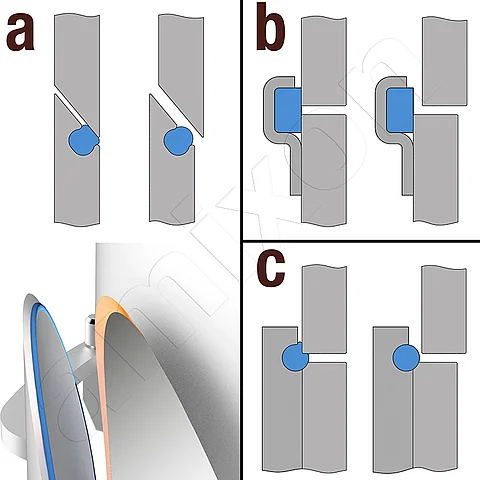
Image on the left: Avoiding dead spaces is particularly challenging when a process apparatus is intended to have large inspection doors. Inspection doors are necessary by design, but can cause potential flow disturbances and dead spaces. Shown alongside are design solutions that exhibit very small (b, c) or no (a) dead spaces.
Dead space refers to areas within a process engineering apparatus that are not reached, or only inadequately, by the intended process step. This concerns, for example, the areas of flow, mixing, temperature control, or cleaning. Hardly any material exchange takes place in a dead space. In mixers, dead spaces are particularly critical. There, the product can remain behind, remain unmixed, or adhere. This degrades mixing quality and increases the risk of contamination. Thermal gradients, reaction deviations, and hygiene problems can also arise.
amixon® mixing systems are designed so that the entire mixing chamber is swept by the driven flow. The process proceeds without dead spaces, so that an ideal random mixture is formed throughout the entire chamber volume. Dead-space-free vessel geometries, internals, and fittings – such as discharge-side shut-off devices – support complete discharge and hygienic cleaning. In process engineering, dead spaces are minimized by flow-optimized geometries, suitable mixing tools, and optimized internals.