Skip to main navigation Skip to main content Skip to page footer

Summary

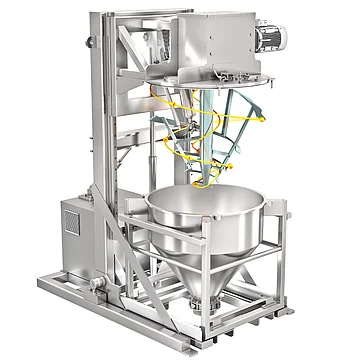
Container mixers process the product in an interchangeable container that docks with a stationary drive unit. This design reduces setup and cleaning times, keeps batches physically separated and enables dust-tight IBC docking.

Key Facts About Container Mixers: Operating Principle, Flexibility and IBC Docking

A container mixer processes the product in an interchangeable container that docks with a stationary drive unit. From container filling and mixing through to product removal, the material remains in the same container. This significantly reduces the number of product-contact components within the mixer.

This is the key advantage for flexible production. Setup and cleaning times between products are considerably shorter because the mixer does not require wet cleaning or CIP cleaning between batches. The batches remain physically separated, minimizing the risk of cross-contamination. The number of containers can be scaled independently of the system capacity, with standard containers and standardized drums commonly used.

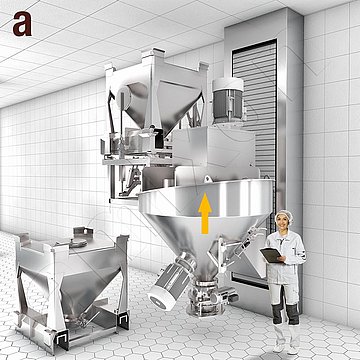
IBC docking creates a closed connection between the container and the docking station, enabling dust-free filling and discharge. Containment docking stations are used for applications with more stringent containment requirements. Because the product does not need to be transferred between containers, this design also supports segregation-free handling. Selection criteria include the container volume and geometry, docking tolerances, system layout and required leak-tightness class.

Selection Matrix

CriterionKey QuestionImplications for Mixer Selection
Frequency of product changeoversHow many changeovers occur per day or week?With daily changeovers, setup time becomes the dominant factor in cost-effectiveness. The container allows cleaning and mixing to be scheduled independently.
Container volume and geometryWhich containers are used in-house and at the customer’s site?The standard IBC or drum determines the mounting system, docking height and mixing-chamber geometry.
Container filling levelHow full is the container during mixing?Free space above the bulk material is essential. Mixing is not possible in a completely full container.
Docking conceptMust the connection be dust-tight or provide containment for allergens or active ingredients?This determines the valve type and sealing concept. Retrofitting containment at a later stage is generally not cost-effective.
Cleaning responsibilityIs the container or the mixer cleaned?This determines whether a separate container-cleaning system is required and how many containers must remain in circulation.
Container logistics and layoutHow are the containers transported, lifted and docked?Forklifts, pallet trucks or lifts determine the docking height and floor load. The layout is therefore part of the machine-selection process.
TraceabilityMust the batch remain identifiable through the container?The container must be labeled and linked to the batch documentation. Without this assignment, a key advantage of the concept is lost.
Number of containers in circulationHow many batches are processed in parallel or awaiting further processing?Capacity is scaled through the number of containers rather than the mixing station. This shifts part of the investment from the machine to the container fleet.
Delivery in the containerIs the product delivered in the same container or transferred to another container?For delivery, the product is generally transferred into suitable transport containers, as these are often considerably less expensive than the mixing containers.
Batch-size rangeShould development and production batches be processed at the same station?The system can remain practical even at minimum filling levels of approximately 10%.

FAQ

Best practices include sound layout and structural planning, safe and ergonomic integration, standardised utility and automation interfaces, and a consistently hygienic and modular plant concept.

amixon® offers three drum- and IBC-based mixing concepts: the single-shaft mixer EM for flexible small batches in a standard drum, the container mixer COM for precise mixing in a closed IBC, and dedicated IBC solutions for production areas with low ceiling height. All systems allow gentle, hygienic mixing with high reproducibility and are verified in the amixon® pilot plant, so that reliable design and dependable scale-up are ensured.

Read more

There are container mixers designed as closed systems that can be coupled directly to standardised transport and storage containers such as drums, for example 200-litre steel or plastic drums, and IBCs (intermediate bulk containers) of approximately 300 to 1,000 litres.

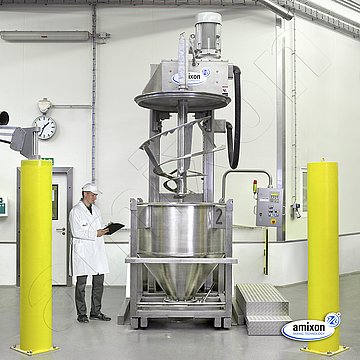
Yes, the amixon® container mixer COM uses the container itself as the mixing chamber: Mixtainer® or standard IBCs are docked on, the SinConcave®/SinConvex®-MultiPlane® mixing tool enters from above and mixes inside the gas-tight sealed container. The entire mixing process takes place in the container, and the product does not have to be transferred. As an alternative, amixon® offers the EM concept for standard drums.

Read more

Yes, there are container mixers that work directly with 200-litre standard drums. Validatable cleaning is possible through single-use liners or defined CIP and WIP concepts with documented qualification.

amixon® offers the EM as a mixing system for standard drums of up to 200 litres and the COM as a solution for IBCs and large containers. Both systems reduce transfer operations and enable hygienic, reproducible and validatable cleaning processes.

Read more

Free-fall container mixers can be a very suitable solution for allergen-critical powders with frequent product changeovers, because the product only touches the exchangeable container and the mixer frame does not need to be cleaned between batches. The containers can be assigned by product or allergen profile, cleaned separately, and clearly tracked. However, the technology is not a universal solution: it is especially suitable for free-flowing, largely agglomerate-free powders with sufficiently similar particle shape, particle size, bulk density and flow behaviour. For strongly cohesive powders, large differences between components, demanding minor-component dosing, or necessary liquid addition, the mixing task should be verified by trial and, where applicable, a different mixing principle chosen. Reliable allergen control only results from the interplay of closed container handling, hygienic design, clear allergen and container assignment, validated cleaning, documented release and effective control of all interfaces.

amixon® addresses the requirements for allergen control and fast product changeover not through free-fall container mixers, but through the combination of standardised bulk-solids containers with a stationary, dynamic high-performance mixer. Containers take on the functions of weighing-in, transport and product provision; the mixing itself takes place in the amixon® mixer and can therefore be designed for dry, moist, cohesive, agglomerated or suspended products. Dust-tight docking, closed material transfers, clear container assignment, validated cleaning and documented batch management reduce the risk of cross-contamination. The time decoupling of charging, mixing, filling, cleaning and drying simultaneously increases flexibility and plant availability.

Read more

Modern industrial container mixers are designed so that they can be integrated into existing, fully or partly automated production lines with automatic drum or container logistics and dosing systems.

Yes, container mixers can be integrated into existing infrastructures with bulk containers already in use, provided that container geometry, docking technology and control system are compatible. Only the COM container mixer mixes in the bulk container itself – the Mixtainer®, which is open at the top; container mixing plants based on the AM conical mixer work with standard bulk containers, and here the mixing process takes place outside the container.

Read more

Container mixers are often economically advantageous where there is a wide product range and frequent recipe changes, because cleaning and changeover largely take place offline and downtime is therefore reduced. Permanently installed vertical mixers are frequently more favourable with few recipes and large, recurring batches, because the investment in the mixing unit is spread across high volumes and operation is efficient with a constant product flow.

amixon® presents the comparison honestly: the amixon® container mixer scores with frequent recipe changes – decoupled changeover and cleaning, the container serving as transport and holding vessel, and hardly any cleaning downtime – while the permanently installed amixon® vertical mixers (VM, HM, AM, SpherHelics®) score with large batches and high throughput per footprint. All apparatus delivers identical precision mixing quality; the decisive factor is the production logistics.

Read more

Product changeovers in a container mixer with a dead-space-free design are usually possible within a few minutes. Depending on the degree of automation and the plant, the container exchange alone often takes only 1 to 6 minutes, while a complete changeover including docking, cleaning and documentation typically takes 5 to 20 minutes. One point to note: during docking and undocking the container cross-section is open, which can temporarily allow more dust to escape. The benefit lies in fast, hygienic changeover with short downtime and a low risk of product residues.

With the amixon® container mixer COM the container itself is the mixing chamber: Mixtainer® or standard IBCs are docked on, the SinConvex®-MultiPlane® mixing tool enters from above, mixes inside the gas-tight sealed container to precision quality of up to 1:100,000 and then screws itself back out in reverse – without transferring the product, in sizes from 100 to 4,000 litres.

Read more

Container mixers in which the intermediate bulk container (IBC) itself serves as the mixing vessel offer contract mixing operations considerable advantages in process engineering, logistics and economics.

With the amixon® container mixer COM the container itself is the mixing chamber: Mixtainer® units are docked on, the SinConcave®/SinConvex® mixing tool enters from above, mixes inside the gas-tight sealed container to precision quality of up to 1:100,000 and then screws itself back out in reverse. Optionally, the helical mixing tool is available in the MultiPlane® design.

Read more

Container mixers are used in the food industry across a wide performance range, from recipe development through to large-scale production. Typical batch sizes and throughputs depend on the product properties.

With the amixon® container mixer COM the container itself is the mixing chamber: Mixtainer® or standard IBCs are docked on, the SinConcave®/SinConvex®-MultiPlane® mixing tool enters from above, mixes inside the gas-tight sealed container to precision quality of up to 1:100,000 and then screws itself back out in reverse – without transferring the product, in sizes from 100 to 4,000 litres.

Read more

In summary, container mixers cannot be assessed by their outer design alone. A free-fall or IBC tumble mixer is especially product-gentle when the components are dry, free-flowing and similar in their physical properties. A container mixer with an active tool extends the range of application to more difficult recipes, but requires special attention to dust protection and containment. A stationary precision mixing plant with standard IBC connection offers high process flexibility, controllable closed transfers, and good suitability for demanding, dusting or health-hazardous products.

The right choice depends on the recipe, the mixing ratio, the particle properties, the dust and hazard potential, the batch size, the changeover frequency, the cleaning strategy, the containment requirements, and the internal logistics. Especially for critical recipes, suitability should not be assessed theoretically alone. Decisive are trials with the original product, realistic fill levels, representative IBC geometry, and an assessment of mixing quality, discharge behaviour, residual quantities, segregation tendency, dust emission and cleanability.

amixon® offers three concepts for container-based mixing processes. The drum mixer EM processes batches up to the size of a 200-litre standard drum and is especially suitable for smaller, drum-based production quantities. The container mixer COM uses the bulk-solids container itself as the mixing chamber: a dynamic helical mixing tool descends into the product from above, generates the mixing action, and is withdrawn again after the process. The batch remains in the same container, reducing transfer steps, product losses and possible segregation. This concept is especially suited to uncritical, low-dust or dust-free products.

For dusting, health-hazardous, odour-intensive or particularly demanding products, the stationary cone mixer AM, which is filled with and discharged into standard IBCs, is often suitable. The IBC serves as the supply, transport and receiving container, while the mixing process takes place in the cone mixer. Dust-tight docking stations enable controlled product transfers. Charging, mixing, discharging, filling and cleaning can be decoupled in time, reducing waiting times and increasing production output. Where headroom is limited, a lift-lower system can enable container-based filling and emptying.

Read more

For small powder batches in standardised drums, rotating drum mixers, tumble mixers and 3D free-fall mixers are well suited when free-flowing, agglomerate-free powders with similar particle properties are to be gently homogenised. The closed original container reduces transfer operations, product losses and cleaning effort at the mixer. For strongly cohesive powders, pronounced agglomerates, very different components, minor components, liquid addition or demanding homogeneity requirements, dockable laboratory mixing heads with helical, propeller or other dynamic mixing tools usually offer the more robust solution. For suspensions, dispersions and pasty systems, agitators, dissolvers, rotor-stator units or planetary mixers may be considered depending on the task. Regardless of the concept, secure drum fixing, suitability of the container, containment and explosion protection, the cleaning strategy, and mixing and discharge trials with the original product are decisive.

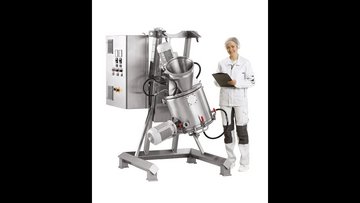
For small powder batches in standardised drums, the amixon® single-shaft mixer EM offers a dynamic and flexibly adjustable mixing solution, in which the drum is used for charging, transport and holding the finished product. The EM is suitable for development batches, premixes and trituration as well as for dry, moist and, where needed, liquid-wetted solids. For larger IBC-based batches, the amixon® container mixer COM mixes directly in the upright container with a mixing tool immersed from above. SinConvex® supports flow-through, MultiPane® particularly gentle mixing processes, and the Washtainer® can take on automatic tool cleaning. Both concepts reduce transfer operations and can be adapted to demanding production environments with hygienic construction, automated recipe management and documented process control.

Read more

Industrial Mixers

Blog

Container mixer for bulk materials
Most IBC mixing systems/ Container-Blenders are 'free fall mixers/tumblers'. Their mixing chamber is the intermediate bulk container (IBC), which is rotated or shaken. The advantages and disadvantages of 'free fall mixers' and 'precision mixers' are explained. Precision blenders have…

Read more

amixon® Mixer with standard drum for "premixes" and "triturations"
A brief digression on the amixon® single-shaft mixer with EM standard barrel, which is particularly suitable for the pharmaceutical, baby food and nutraceutical industries.

Read more

Excursus container mixer: amixon® conical mixer size AM 1500, filled and discharged by means of Intermediate Bulk Containers (IBC)
What are typical advantages of a container-based mixing facility? A powder blending plant, which works with standard containers, can decouple its production steps 1 to 7 in terms of time and space: Composition and weighing of the raw materials in the container (charging).

Read more

FAQ: The ideal mixer for your needs?
The amixon® product range is uniquely comprehensive and particularly sophisticated. This means that amixon® meets the requirements of many different industries. amixon® experience is based on 40 years of tradition. Within the sectors, the processing stages of the bulk materials are more or less…

Read more