
Summary
Vertical mixers are batch mixers with an upright vessel in which a single mixing tool circulates the product vertically. This design is particularly suitable for adding liquids through spray lances and for uniformly coating particles.
Key Facts About Vertical Mixers: Operating Principle, Liquid Addition and Coating
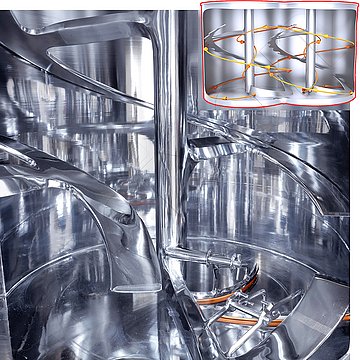
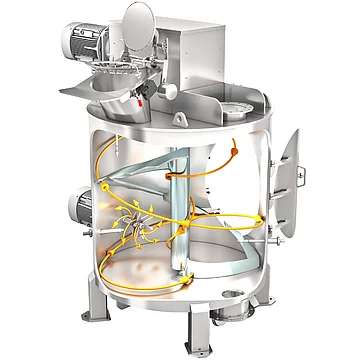
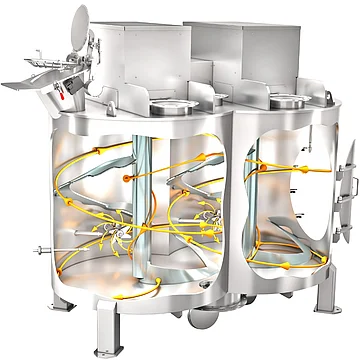
A vertical mixer is a batch mixer with an upright vessel. A single mixing tool conveys the product from bottom to top before allowing it to flow freely downwards under gravity along the vertical axis of the mixing tool. This three-dimensional circulation reaches the entire batch with low energy input and minimal shear—even when the components differ significantly in bulk density, particle size and flow properties.
This highly effective circulation throughout the entire mixing chamber makes the design particularly suitable for liquid addition. Spray lances (spraying process) wet the circulating product uniformly without creating localized overwetting. The key parameters are the dosing rate, droplet size and ratio of the added liquid to the powder’s absorption capacity (powder wetting, powder moistening). Any lumps that form can be broken down through additional deagglomeration.
Coating is based on the same principle: particles are encapsulated with a defined layer, with the mixing time determining the thickness and uniformity of the coating. Selection criteria include the batch size, moisture content, tendency to stick and required degree of coating.
Selection Matrix
| Criterion | Key Question | Implications for Mixer Selection |
|---|---|---|
| Liquid content | What proportion of the batch weight is liquid? | For liquid contents of up to a few percent, applying the liquid to the moving product surface is sufficient. At higher levels, the point of addition, spray pattern and dosing time must be specifically designed and tested. |
| Liquid viscosity and temperature | Can the liquid be sprayed at the dosing temperature? | Oils and fats may require temperature-controlled pipes and nozzles. Otherwise, droplets form instead of a spray cone, resulting in localized overwetting. |
| Point of addition | Is the liquid sprayed onto the circulating product, into the product flow or onto the vessel wall? | The liquid must be added directly to the moving product. Spraying it onto the vessel wall or a stationary product layer causes deposits and lumps. |
| Absorption capacity of the carrier powder | How much liquid can the powder absorb before it becomes sticky? | This limits both the amount of liquid added per batch and the permissible dosing rate. The limit is determined through trials rather than calculations. |
| Lump formation | Does the product tend to form agglomerates after wetting? | This determines whether additional deagglomerating tools are required or whether the mixing action alone is sufficient. |
| Coating target | Should the particles be uniformly coated or should the liquid merely be mixed in? | Coating requires all particles to have a defined and equal residence time within the spray zone; simple incorporation does not. |
| Shear sensitivity | Must the applied coating be protected from abrasion? | A low mixing-tool speed and limited post-mixing time are required; otherwise, the coating may be worn away. |
| Dust and fines content | Does wetting generate dust, or does it bind the fines? | The fines are deliberately bound, while the process parameters are controlled to prevent additional fines from forming. |
| Cleaning after fat addition | Is dry or wet cleaning required, and at what intervals? | Greasy residues require wet cleaning. Accessibility of the nozzles and spray lances therefore becomes an important selection criterion. |
| Partial-batch operation | Will the machine also operate with partial filling? | The spray pattern and dosing rate must be suitable for the minimum filling level, not only for a full batch. |
 FAQ
FAQ

 Blog
Blog