

No room for error: amixon® mixing systems for battery materials
The article highlights the stringent process demands in producing and recycling battery materials—requiring ultra-high homogeneity, minimal residual moisture, complete discharge, and closed, inert/vacuum-controlled operations—especially for sensitive materials and hydrometallurgical “black mass” processing with solvent recovery. amixon® offers specialized solutions: AM/VM gentle cone/vertical mixers, the VMT vacuum mixing dryer/reactor for low-temperature drying and DMC recovery, the AMT cone mixing dryer for higher drying loads, and the Gyraton® GM silo mixer for large batches, with options like ceramic contact surfaces and full inert/vacuum capability. The company’s technical center enables pilot-scale validation of mixing quality, moisture profiles, discharge behavior, and scale-up, underscoring process technology as a key driver of battery cell performance.
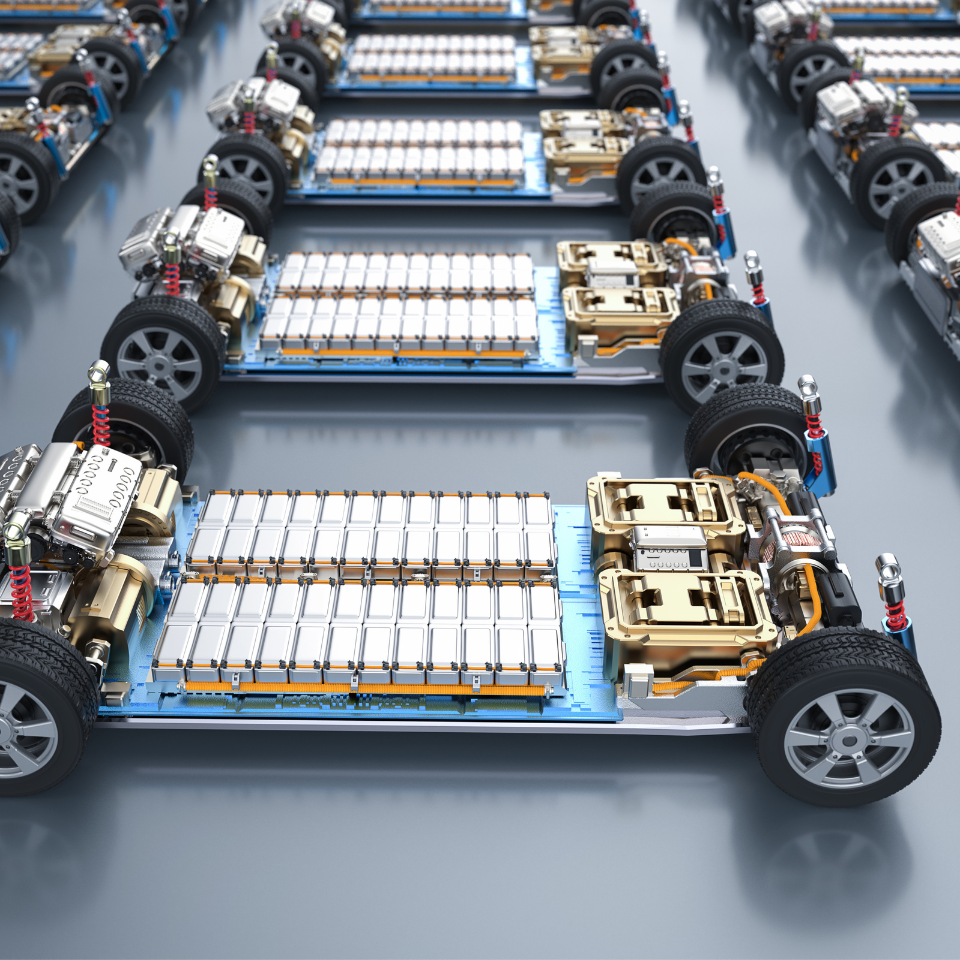
The production and recycling of battery materials place the highest demands on process technology. Those who process lithium salts, cathode and anode active materials, or black mass need mixing and drying systems that operate precisely, reproducibly, and without residue. amixon® from Paderborn is a manufacturer of mixers, mixing dryers, and reactors for the battery materials industry, specialized in these applications.
Why Battery Materials Have Special Requirements
Lithium salts, nickel-manganese-cobalt oxides (NMC), lithium iron phosphate (LFP), graphite, and conductive additives are the core materials of modern lithium-ion batteries. Their common characteristic: they are sensitive to moisture, impurities, and mechanical stress. Even slight variations in the homogeneity of the electrode mixture can measurably reduce a battery cell’s capacity, charging speed, and service life.
For manufacturers and contract manufacturers of battery materials, this results in a clear set of requirements for process technology:
- Homogeneity at the highest level – uniform distribution of all components, even with widely varying particle sizes and bulk densities
- Minimal residual moisture – many active materials and lithium salts are highly hygroscopic and must be dried under controlled conditions
- Complete discharge—no product residue in the apparatus, especially during frequent formula and batch changes
- Closed-loop process control—inert gas atmosphere (N₂, Ar) and vacuum operation to protect reactive or toxic substances
- Reproducibility and validatability—quality assurance in battery manufacturing requires documentable, repeatable processes
- The Recycling Challenge: Thermal Separation and Homogenization
As electric mobility gains momentum, the volume of end-of-life lithium-ion batteries is also growing. The EU Battery Regulation stipulates that materials such as lithium, cobalt, nickel, manganese, and graphite must be recovered at defined purity levels. Hydrometallurgical processes are gaining importance over energy-intensive pyrometallurgy—they enable a higher yield of raw materials with lower emissions of pollutants.
The core technical challenge in recycling: After the wet separation stage, moist powders and slurries are produced—the so-called “black mass.” These must be dried, homogenized, and further processed under controlled conditions. The following factors must be taken into account simultaneously:
- Thermal sensitivity – lithium compounds must not be overheated
- Solvent recovery – dimethyl carbonate (DMC) and other organic solvents must be safely separated and condensed
- Protective atmosphere – many process steps must take place under an inert gas or in a vacuum
- Abrasiveness of the materials – graphite, metal oxides, and black mass place heavy strain on equipment surfaces
Lithium salts, nickel-manganese-cobalt oxides (NMC), lithium iron phosphate (LFP), graphite, and conductive additives are the core materials of modern lithium-ion batteries. Their common characteristic: they are sensitive to moisture, impurities, and mechanical stress. Even slight variations in the homogeneity of the electrode mixture can measurably reduce a battery cell’s capacity, charging speed, and service life.
For manufacturers and contract manufacturers of battery materials, this results in a clear set of requirements for process technology:
- Homogeneity at the highest level – uniform distribution of all components, even with widely varying particle sizes and bulk densities
- Minimal residual moisture – many active materials and lithium salts are highly hygroscopic and must be dried under controlled conditions
- Complete discharge—no product residue in the apparatus, especially during frequent formula and batch changes
- Closed-loop process control—inert gas atmosphere (N₂, Ar) and vacuum operation to protect reactive or toxic substances
- Reproducibility and validatability—quality assurance in battery manufacturing requires documentable, repeatable processes
- The Recycling Challenge: Thermal Separation and Homogenization
As electric mobility gains momentum, the volume of end-of-life lithium-ion batteries is also growing. The EU Battery Regulation stipulates that materials such as lithium, cobalt, nickel, manganese, and graphite must be recovered at defined purity levels. Hydrometallurgical processes are gaining importance over energy-intensive pyrometallurgy—they enable a higher yield of raw materials with lower emissions of pollutants.
The core technical challenge in recycling: After the wet separation stage, moist powders and slurries are produced—the so-called “black mass.” These must be dried, homogenized, and further processed under controlled conditions. The following factors must be taken into account simultaneously:
- Thermal sensitivity – lithium compounds must not be overheated
- Solvent recovery – dimethyl carbonate (DMC) and other organic solvents must be safely separated and condensed
- Protective atmosphere – many process steps must take place under an inert gas or in a vacuum
- Abrasiveness of the materials – graphite, metal oxides, and black mass place heavy strain on equipment surfaces
amixon® Mixing Systems for Battery Materials: The Four Core Solutions
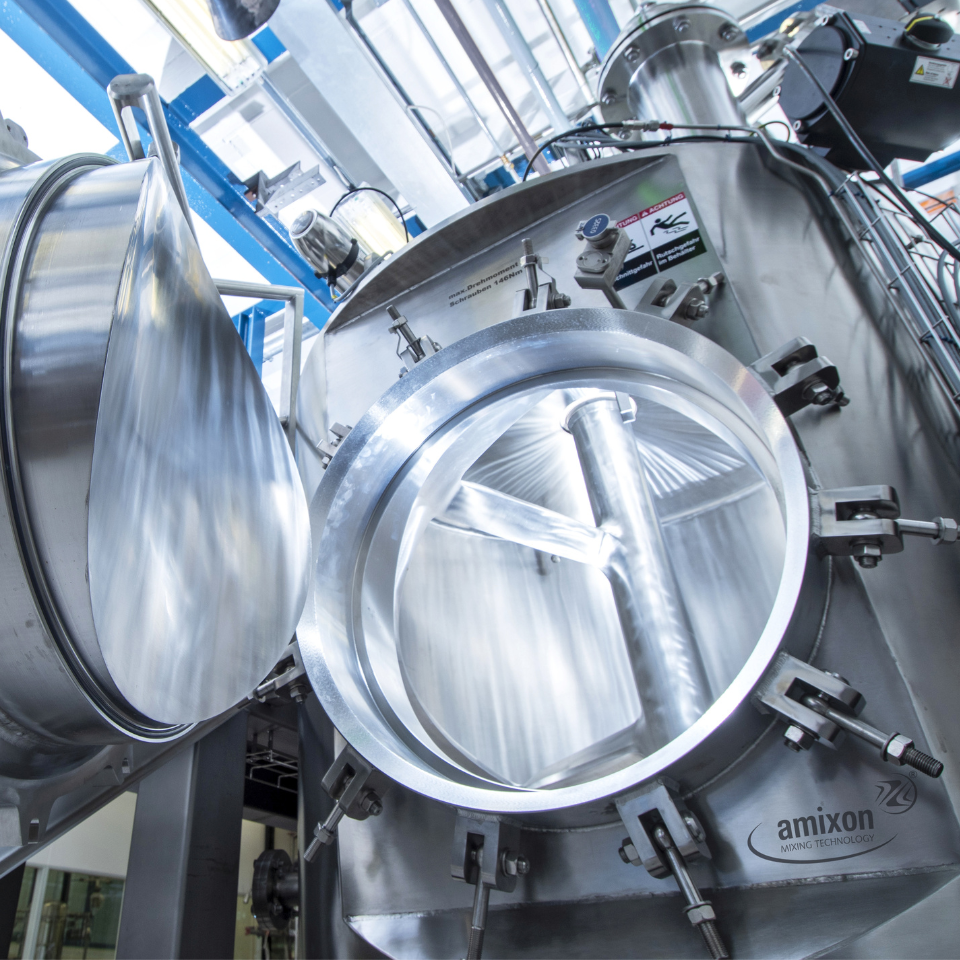
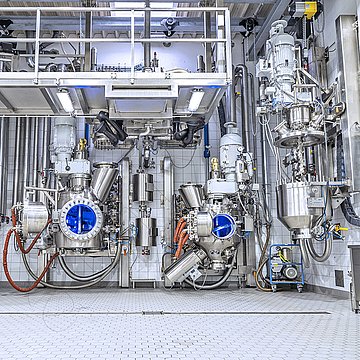
The VMT combines mixing, drying, and reaction in a single closed-loop apparatus.
amixon® develops and manufactures mixers, mix-dryers, and reactors specifically designed for processing battery materials. All units operate on the principle of gentle, intensive homogenization with complete discharge—a decisive advantage when handling valuable and often toxic materials.
AM / VM – Cone and Vertical Mixers for Active Materials
The cone and vertical mixers of the AM and VM series homogenize powders, granules, and bulk materials with minimal shear stress. Thanks to the geometrically optimized mixing spiral and the conical vessel shape, these mixers discharge with virtually no residue—a critical feature for frequent product changes between different active materials or lithium salts. The mixers are suitable for both dry mixing and the preparation of electrode paste components.
VMT – Vacuum Mixing Dryer and Reactor
The VMT combines mixing, drying, and reaction in a single closed apparatus. Vacuum operation (down to 5 mbar) allows residual moisture and solvents to be removed at low product temperatures—gently and without thermal damage to sensitive lithium compounds. Condensation temperatures as low as –20 °C enable the recovery of highly volatile solvents such as dimethyl carbonate (DMC). The VMT is thus a key component in hydrometallurgical battery recycling.
AMT – Cone Mixing Dryer and Reactor
The AMT is designed for processes with increased drying requirements. Heated walls and mixing tools ensure efficient, uniform heat transfer—even with paste-like or highly viscous intermediate products from the recycling process. The unit is suitable for reactive materials that must be processed under an inert gas atmosphere or in a vacuum.
Gyraton® GM – Precision Silo Mixer for Large Batches
For the homogenization of large quantities of material (3 to 100 m³), amixon® offers the Gyraton® mixer. It homogenizes with minimal energy consumption—even with widely varying bulk densities and particle sizes. The Gyraton® is suitable for quality assurance of precursors and raw materials prior to cell production and can be operated continuously or discontinuously.
The VMT combines mixing, drying, and reaction in a single closed-loop apparatus.
amixon® develops and manufactures mixers, mix-dryers, and reactors specifically designed for processing battery materials. All units operate on the principle of gentle, intensive homogenization with complete discharge—a decisive advantage when handling valuable and often toxic materials.
AM / VM – Cone and Vertical Mixers for Active Materials
The cone and vertical mixers of the AM and VM series homogenize powders, granules, and bulk materials with minimal shear stress. Thanks to the geometrically optimized mixing spiral and the conical vessel shape, these mixers discharge with virtually no residue—a critical feature for frequent product changes between different active materials or lithium salts. The mixers are suitable for both dry mixing and the preparation of electrode paste components.
VMT – Vacuum Mixing Dryer and Reactor
The VMT combines mixing, drying, and reaction in a single closed apparatus. Vacuum operation (down to 5 mbar) allows residual moisture and solvents to be removed at low product temperatures—gently and without thermal damage to sensitive lithium compounds. Condensation temperatures as low as –20 °C enable the recovery of highly volatile solvents such as dimethyl carbonate (DMC). The VMT is thus a key component in hydrometallurgical battery recycling.
AMT – Cone Mixing Dryer and Reactor
The AMT is designed for processes with increased drying requirements. Heated walls and mixing tools ensure efficient, uniform heat transfer—even with paste-like or highly viscous intermediate products from the recycling process. The unit is suitable for reactive materials that must be processed under an inert gas atmosphere or in a vacuum.
Gyraton® GM – Precision Silo Mixer for Large Batches
For the homogenization of large quantities of material (3 to 100 m³), amixon® offers the Gyraton® mixer. It homogenizes with minimal energy consumption—even with widely varying bulk densities and particle sizes. The Gyraton® is suitable for quality assurance of precursors and raw materials prior to cell production and can be operated continuously or discontinuously.
Technical specifics for use in the battery industry
All amixon® units can be equipped with product-contact parts made of high-performance ceramics—a decisive advantage when handling abrasive materials such as graphite or NMC oxides, since metal abrasion would directly impair battery quality. Furthermore, the systems are designed for operation under inert gas (N₂, Ar) as well as under full vacuum, thereby meeting the requirements for closed, contamination-free processing.
All amixon® units can be equipped with product-contact parts made of high-performance ceramics—a decisive advantage when handling abrasive materials such as graphite or NMC oxides, since metal abrasion would directly impair battery quality. Furthermore, the systems are designed for operation under inert gas (N₂, Ar) as well as under full vacuum, thereby meeting the requirements for closed, contamination-free processing.
Process Validation at the amixon® Technical Center
Scalability is an often-overlooked factor when introducing new processes. amixon® offers testing capabilities at its own technical center with batch sizes ranging from a few liters to several thousand liters. Manufacturers and contract manufacturers can evaluate the following parameters here under real-world process conditions using their original materials:
- Mixing quality and proof of homogeneity
- Residual moisture profiles as a function of pressure, temperature, and time
- Discharge behavior and cleanability
- Scale-up behavior for the planning of industrial plants
This step shortens the process development phase and significantly reduces the risk associated with the commissioning of industrial plants.
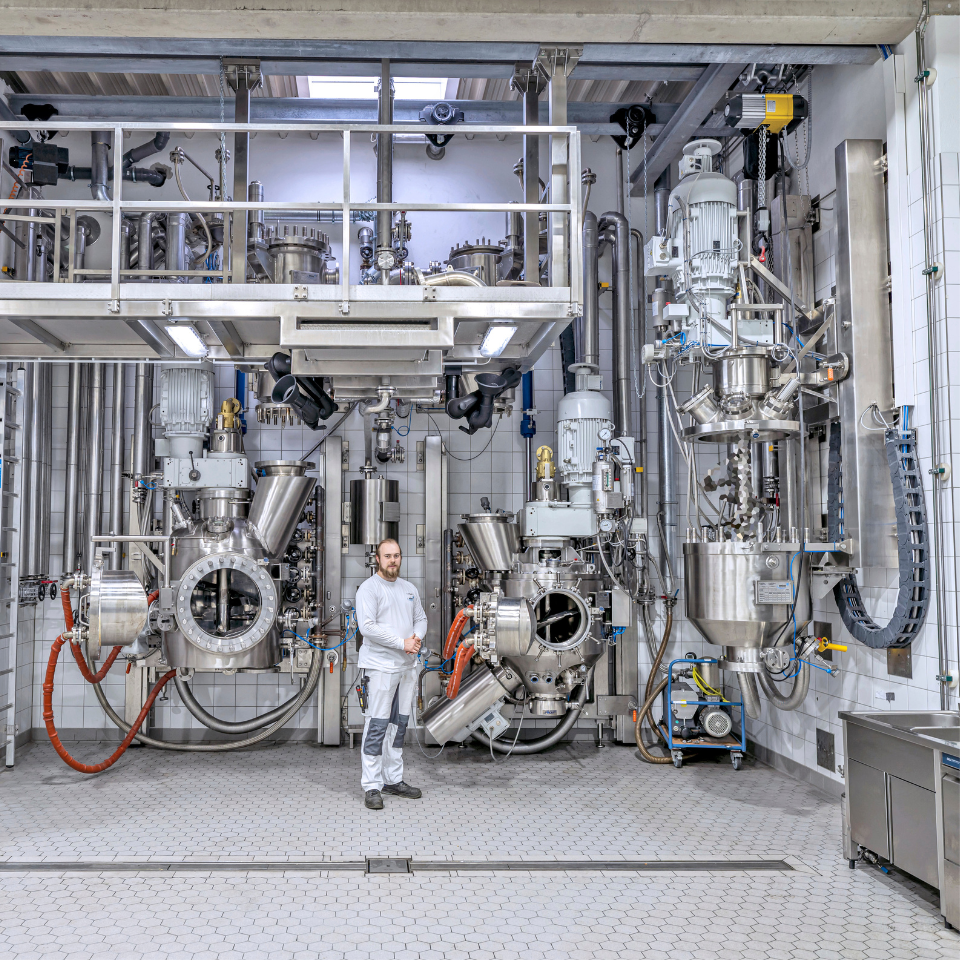
At the amixon® Technical Center, processes can be tested under real-world conditions.
Scalability is an often-overlooked factor when introducing new processes. amixon® offers testing capabilities at its own technical center with batch sizes ranging from a few liters to several thousand liters. Manufacturers and contract manufacturers can evaluate the following parameters here under real-world process conditions using their original materials:
- Mixing quality and proof of homogeneity
- Residual moisture profiles as a function of pressure, temperature, and time
- Discharge behavior and cleanability
- Scale-up behavior for the planning of industrial plants
This step shortens the process development phase and significantly reduces the risk associated with the commissioning of industrial plants.
At the amixon® Technical Center, processes can be tested under real-world conditions.
Frequently Asked Questions (FAQ)
Which mixer is suitable for cathode active materials such as NMC or LFP?
For the homogenization of cathode active materials such as NMC or LFP, amixon® cone or vertical mixers (AM/VM) are recommended. They mix gently without damaging the particle structure and discharge with virtually no residue—a critical factor for frequent batch changes and valuable materials.
How are lithium salts safely dried?
Lithium salts are highly hygroscopic and must be dried under controlled conditions. The amixon® VMT (vacuum mixing dryer) enables drying at pressures as low as 5 mbar and low product temperatures—this prevents thermal damage while ensuring a reproducible residual moisture content.
How can the black mass from battery recycling be further processed?
The black mass—a mixture of graphite, lithium, cobalt, nickel, and manganese—is produced after the mechanical comminution and wet separation of end-of-life cells. amixon® mixing dryers (VMT, AMT) handle the drying and homogenization of these materials under an inert gas atmosphere or vacuum, including the safe recovery of organic solvents such as DMC.
How can metal contamination be prevented when mixing battery materials?
Abrasive battery materials such as graphite or metal oxides can lead to metal abrasion if unsuitable mixers are used—a direct quality issue for the cell. amixon® offers models with a high-performance ceramic coating on all parts in contact with the product, which reliably prevents abrasion.
Can battery materials be tested at the pilot plant before ordering a system?
Yes. amixon® operates its own pilot plant in Paderborn, where mixing and drying processes can be tested with actual batches ranging from a few liters to several thousand liters. Results from the pilot plant are directly scalable to industrial systems and form the basis for the reliable design of the production plant.
Which mixer is suitable for cathode active materials such as NMC or LFP?
For the homogenization of cathode active materials such as NMC or LFP, amixon® cone or vertical mixers (AM/VM) are recommended. They mix gently without damaging the particle structure and discharge with virtually no residue—a critical factor for frequent batch changes and valuable materials.
How are lithium salts safely dried?
Lithium salts are highly hygroscopic and must be dried under controlled conditions. The amixon® VMT (vacuum mixing dryer) enables drying at pressures as low as 5 mbar and low product temperatures—this prevents thermal damage while ensuring a reproducible residual moisture content.
How can the black mass from battery recycling be further processed?
The black mass—a mixture of graphite, lithium, cobalt, nickel, and manganese—is produced after the mechanical comminution and wet separation of end-of-life cells. amixon® mixing dryers (VMT, AMT) handle the drying and homogenization of these materials under an inert gas atmosphere or vacuum, including the safe recovery of organic solvents such as DMC.
How can metal contamination be prevented when mixing battery materials?
Abrasive battery materials such as graphite or metal oxides can lead to metal abrasion if unsuitable mixers are used—a direct quality issue for the cell. amixon® offers models with a high-performance ceramic coating on all parts in contact with the product, which reliably prevents abrasion.
Can battery materials be tested at the pilot plant before ordering a system?
Yes. amixon® operates its own pilot plant in Paderborn, where mixing and drying processes can be tested with actual batches ranging from a few liters to several thousand liters. Results from the pilot plant are directly scalable to industrial systems and form the basis for the reliable design of the production plant.
Conclusion: Process Technology as a Critical Success Factor
amixon® is a specialized supplier of mixers, mixing dryers, and reactors for the production and recycling of battery materials. The homogeneity of the raw materials and the quality of the drying processes are key factors in determining the performance of the finished battery cell. Anyone looking to scale up in this market—whether as a cell manufacturer, material producer, or recycling company—needs process technology that is reproducible, validatable, and economically robust. amixon®’s mixing and drying systems are designed for this purpose.
Learn more about the benefits of amixon® mixers, dryers, and reactors for battery materials in our fact sheet!
amixon® is a specialized supplier of mixers, mixing dryers, and reactors for the production and recycling of battery materials. The homogeneity of the raw materials and the quality of the drying processes are key factors in determining the performance of the finished battery cell. Anyone looking to scale up in this market—whether as a cell manufacturer, material producer, or recycling company—needs process technology that is reproducible, validatable, and economically robust. amixon®’s mixing and drying systems are designed for this purpose.
Learn more about the benefits of amixon® mixers, dryers, and reactors for battery materials in our fact sheet!
 Related News
© Copyright by amixon GmbH