
mixing test
A mixing test can have different objectives. One objective, for example, is to determine the fundamentally achievable mixing qualities of different mixing systems. A defined reference recipe is used for this purpose. This enables reproducible and comparable analyses. The aim is to objectively compare different mixing principles.
The investigations can be systematically expanded. For example, the filling level can be varied. The same applies to the rotation frequency and mixing time. The moisture content of the mixture can also be changed. In addition, particle stress, the tendency to segregate and the achievable residual emptying levels are considered. For such test series, several mixing machines from different manufacturers with comparable batch sizes must be available.
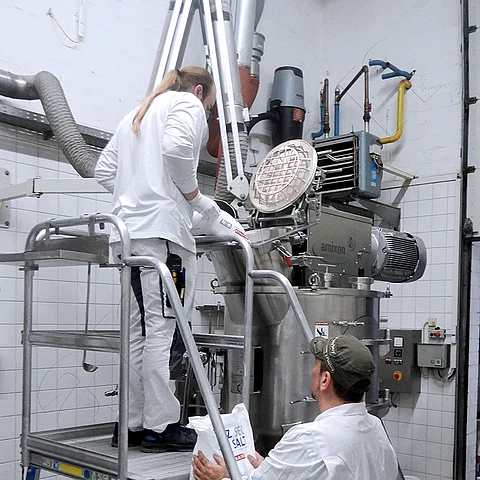
In practice, the user usually makes a preliminary selection. The aim is to limit the number of tests required. The mixing tests are usually carried out in the technical centre of the respective manufacturer. Several sophisticated formulations are prepared for this purpose. It is advisable to prepare several batches for each formulation. This allows different operating modes to be compared.
During the test, the usual driving mode of the user is first implemented. This is followed by a test in accordance with the mixer manufacturer's recommendation. A further approach serves to optimise or confirm the results. In this way, optimisations can be made. In addition, the robustness of the process can be assessed.
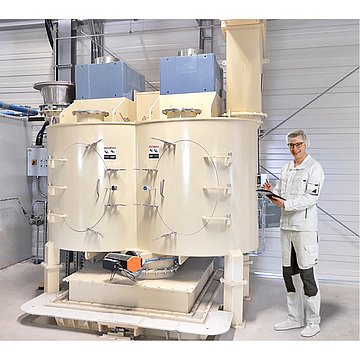
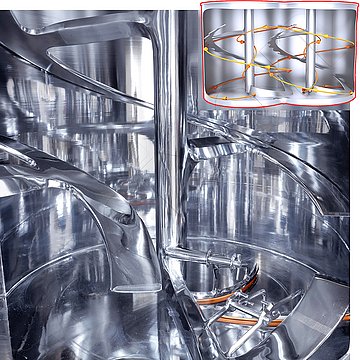
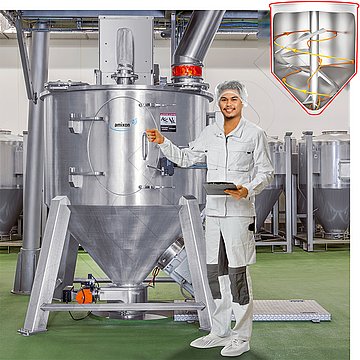
In some cases, the mixer manufacturer can offer several seemingly ideal solutions. This is particularly possible during trials at amixon GmbH, where more than 30 test mixers are available in a total of six different types. Depending on the task at hand, one or two suitable solutions can be identified. The trials then quickly reveal which mixer design is preferred by the customer.
The results are evaluated based on many criteria. These are often not known in detail to the machine manufacturer. In addition to the mixing quality, the complete emptying capability and suitability for dry cleaning are also assessed. Cleanability using wet methods also plays an important role. Modern wet cleaning systems, such as programmable target jet cleaners, enable short cleaning times with low water consumption. All these aspects are part of a complete mixing test.
Some mixed goods are particularly sensitive. Muesli is one example of this. In such cases, it makes sense to carry out at least one trial in a large-scale mixer. If subsequent production is to involve batches of around 3 m³, at least one trial should be carried out in a mixer with a usable volume of 2 or 3 m³.
Economic and ergonomic aspects are also taken into account in the decision. These include the investment price, maintenance costs and space requirements. Integration into existing production processes is also relevant. Since the service life of an amixon® mixer is more than 30 years, plant planning is particularly important. The installation situation at the customer's premises can be digitally recorded by amixon. On this basis, three-dimensional layout variants can be created. This allows material flows and work processes to be simulated. The result is a reliable layout drawing that serves as the basis for the investment decision.
 FAQ - mixing test
 Blog
Blog