

Spray processes for powder production
The spray process is a process engineering method for the production of powders from solutions, suspensions, or melts. In this process, the liquid is finely atomized and dried or solidified in a gas stream or reaction chamber. This results in solid particles with a defined size and shape.
A common spray process is spray drying. In this process, the solvent evaporates while the droplets dry in the hot gas flow. The particle structure can be porous or compact. In spray granulation, atomization and agglomeration are combined to produce larger granules. In spray congealing (or spray melting), droplets from a melt solidify directly into solid particles.
Spray processes enable a narrow particle size distribution. They influence morphology, porosity, and surface structure. This allows flowability, solubility, and reactivity to be specifically adjusted. Applications are found in the chemical, food, pharmaceutical, battery, and plastics industries.
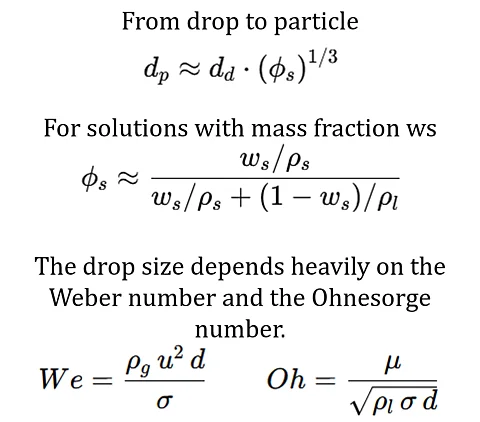
Empirical approximation formulas for particle size: From droplets to powder particles: If a droplet with a solid content dries and becomes a particle "without losses," the following approximation applies:
dp ≈ dd⋅ (ϕs)1/3
- dp is the particle diameter
- dd is the droplet diameter
- ϕs is the volume fraction of the solid in the droplet
For solutions with the mass fraction ws, the following approximation formula is often used:
Φs ≈ (ws/ρs) / [(ws/ρs + (1 – ws)/ρl]
- ρₛ is the density of the solid
- ρₗ is the density of the liquid