

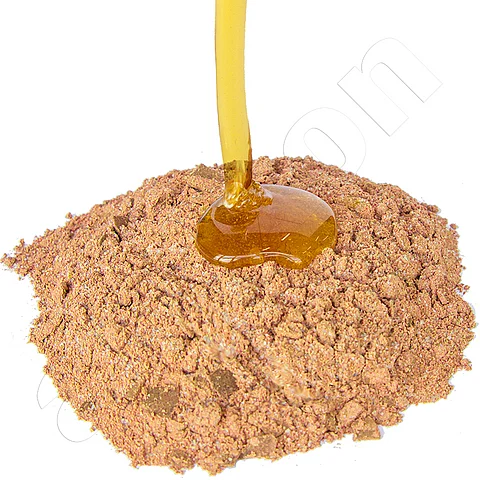
Powder dampening
The term ‘powder wetting’ is often used synonymously with ‘powder moistening’. It is one of the most important process engineering steps in powder processing. Powder wetting involves the combination of two components in different states of matter. Solid particles are brought into contact with a liquid phase.
Even small amounts of liquid can fundamentally alter the flow and deformation behaviour of the powder.
In their dry state, powders exist as dispersed solid-gas systems. Wetting creates a multiphase system consisting of solid, liquid and gas. As the liquid content increases, the interactions between the particles change significantly.
Initially, liquid bridges form between neighbouring particles. These generate capillary forces and increase the cohesion of the system. The powder becomes less free-flowing and exhibits plastic behaviour. With further liquid addition, the system transitions into a paste-like or slurry-like state. The capillary force of a liquid bridge can be described in simplified terms by:
Fk ≈ 2 ·π ·r· γ · cos θ
- r is the effective particle radius
- γ is the surface tension of the liquid
- θ is the contact angle
The smaller the contact angle, the stronger the wetting and the higher the capillary binding forces. Whether a liquid wets a powder well depends on the surface energy of the particles and the surface tension of the liquid. The wetting state is described by the contact angle:
cos θ = (γSV−γSL) / γLV
- γSV is the solid-gas interfacial tension
- γSL is the solid-liquid interfacial tension
- γLV is the liquid-gas interfacial tension
A small contact angle indicates good wettability. As wetting increases, the rheological properties of the system change. The powder exhibits non-Newtonian behaviour. A yield point often occurs. Under low stress, the material behaves like a solid and only begins to flow above a critical shear stress. This behaviour can be ideally described using the Bingham model:
τ = τ0 + ηp · γ˙
- τ is the shear stress
- τ0 is the yield stress
- ηp is the plastic viscosity
- γ˙ is the shear rate
Powder wetting therefore has a decisive influence on the mixing mechanism, energy input and process control. Technically, powder wetting is used to bind dust, initiate agglomeration, apply additives evenly or enable chemical reactions. It is a key step in granulation, coating, impregnation and the production of functional powders.
The reverse process is dehumidification or drying. In this process, the liquid is removed again. The consistency of the material passes through the same states in reverse order. Understanding wetting mechanisms is therefore also of central importance for vacuum mixing and drying processes.
Powder wetting is a complex interplay of powder technology, interfacial physics and rheology. amixon® mixers feature state-of-the-art wetting methods. These allow powders to be wetted particularly gently and uniformly. In this way, the material properties can be specifically improved.