
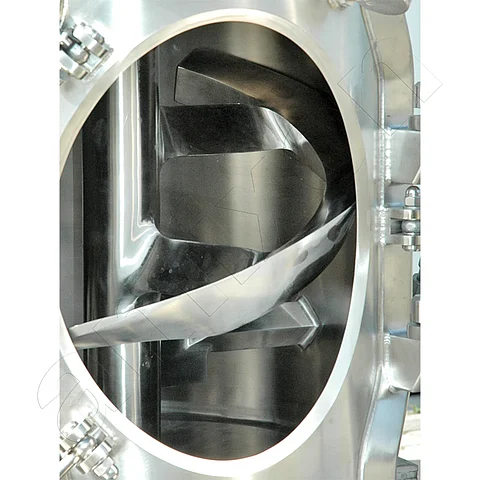
Mixing tools
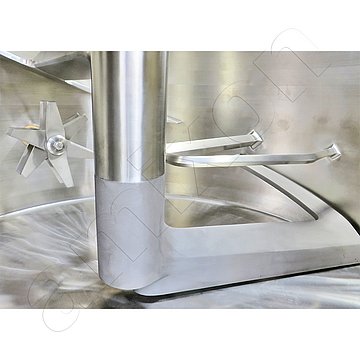
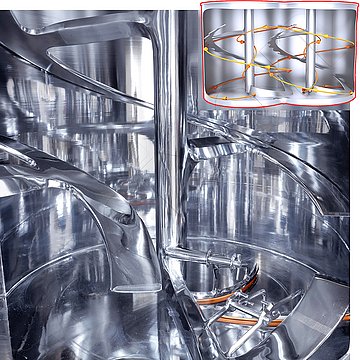
Mixing tools are the directly acting functional elements of powder mixers. They influence the movement behavior of the mixed materials. They determine the achievable mixing intensity. Depending on their geometry and arrangement, they produce different effects. They can work by displacing, scattering, compacting, deagglomerating, or conveying.
In this article, the materials to be mixed are dry, moist, or wet powders. The mixing tools are connected to the mixing shaft. Depending on the design, the connection is made directly or via mixing arms. The design depends on the size, drive power, and speed.
In practice, there are various types of tools. These include Becker blades, plowshare mixing tools, spiral mixing tools, pin mixing tools, and paddle mixing tools. The type of tool is selected depending on the product. The mixing task and the desired mixing effect are decisive factors.
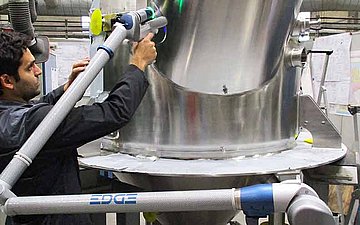
Mixing tools are subject to normal wear and tear. This depends on the abrasiveness of the material being mixed. It is influenced by the normal force, the operating time, and the relative speed. In the case of mild, sliding abrasion, wear can be described approximately linearly with the relative speed.
In simple models, a proportionality between the wear rate, force, sliding distance, and the inverse hardness of the material is often assumed. In tribology, abrasive wear is often described by Archard's law of wear:
V = k ⋅ H ⋅ F ⋅ vr⋅ t / H
where
V is the wear volume,
k is the dimensionless wear coefficient,
F is the normal force between the tool and the bulk material,
vr is the relative speed
t is the duration of exposure, and
H is the hardness of the material.
In industrial applications, wear can be very low. Under favorable conditions, powder mixers can operate for decades without visible tool wear. This is particularly the case with low-abrasive products and moderate peripheral speeds.
The situation is different with abrasive powders. At high peripheral speeds, wear often increases disproportionately. Material removal then no longer increases linearly with speed. Instead, it potentially increases with a power of the relative speed. The exponent “m” is typically in the range of 2 to 3, which is due to the rapidly increasing kinetic energy of the particles. At the same time, the impact and contact intensity on the tool surface increases.
V˙ = C ⋅ (vr)m
where
V˙ is the wear rate per time
vr is the relative speed
C is the material- and system-dependent constant
m is the speed exponent
Wear protection is required for mixing tools used with abrasive products. Typical measures include hard facing and carbide armouring. In addition, highly wear-resistant materials are used. As amixon powder mixers demonstrate, this can extend the service life of the mixing tools many times over. In individual cases, an increase in service life by a factor of one hundred can be achieved. Details are described in the amixon blog post “amixon® powder mixers with wear protection.”
 FAQ - Mixing tools
 Blog
Blog