

Segregation-free handling
Segregation-free handling describes the design of processes in which a previously homogenized bulk solid mixture is kept from breaking down into its individual particle fractions as much as possible during transport, storage, and dosing. The goal is to keep the composition (e.g., active ingredient content, particle size distribution, color or flavor components) constant from the mixer to the packaging.
Many powder blends, however, have a strong tendency to segregate, for example due to different particle sizes, bulk densities, particle shapes, or surface roughness. Mechanisms such as segregation during trickling, stratification during falling motion, percolation of small particles downward, or rolling segregation of larger particles cause an originally homogeneous mix to differentiate again along the conveying path. Segregation-free handling seeks to minimize these effects through design and process measures.
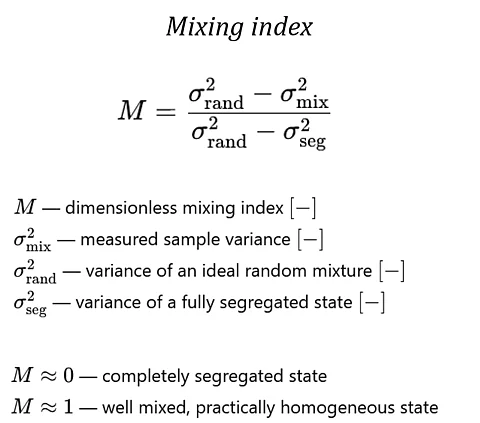
Variance‑/standard deviation‑based mixing indices
M = (σ²_rand − σ²_mix) / (σ²_rand − σ²_seg)
- σ²_mix = measured variance of the samples
- σ²_rand = variance of a randomly, ideally mixed sample of the same composition
- σ²_seg = variance in the fully demixed (segregated) state
- M ≈ 0: fully segregated state
- M ≈ 1: well mixed, practically homogeneous state
Practical measures include, among other things, low drop heights, calm and as uniform as possible conveying, the avoidance of large free bulk cones, gentle deflections, as well as suitable discharge and dosing equipment that withdraws the bulk material uniformly across the entire cross-section. Especially for high-value or active-ingredient-containing mixtures (e.g., dietary supplements, pharma or convenience-food premixes), segregation-free handling is crucial for batch homogeneity, process reliability, and compliance with specified quality parameters up to the primary or secondary packaging.
A good solution is to carry out the mixing process in an amixon® conical mixer as the final process step before filling.