

Drying experiments
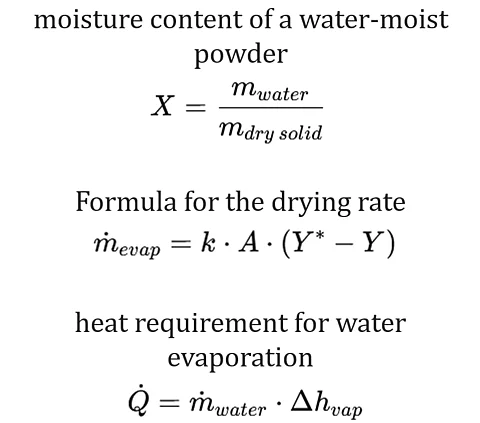
Drying tests are experiments to investigate the drying behavior of materials. They are carried out in laboratories, technical centers, or pilot plants. The goal is to determine the drying rate, the final moisture content, and the product behavior. The moisture content of a water-wet dispersed powder is described by
X = mwater / mdry solid
- X is the moisture content
- mwater is the mass of the water
- mdry solid is the dry mass of the solid
The drying rate can be approximately described if gas-assisted convective drying (for example, hot air or inert gas) is used:
m˙evap = k⋅ A⋅ (Y∗−Y)
- m˙evap is the evaporation rate
- k is the mass transfer coefficient
- A is the heat transfer area
- Y∗ is the saturation humidity of the boundary layer
- Y is the humidity of the drying gas
The heat required for evaporation is described by
Q˙= m˙water ⋅ Δhvap
- Q˙ is the required heat duty
- m˙water is the water evaporation rate
- Δhvap is the enthalpy of vaporization of water
In drying tests, temperature, gas flow, pressure, residence time, and material movement are varied. The measured variables are moisture content, weight loss, temperature profiles, and product structure. These are used to derive drying curves and design parameters.
Drying tests serve the design of dryers and process optimization. In the blog post „amixon® helps with the sizing of large vacuum mixer-dryer systems“ amixon® shows how a scale-up calculation can be implemented from a technical center trial.