
heat transfer fluid
A heat transfer fluid is a substance that transports thermal energy from a heat source to a consumer. It circulates in a closed or open circuit and transfers heat to, or absorbs heat from, equipment, products or processes.
In process engineering, heat transfer fluids are used for heating, cooling or temperature control. Typical heat transfer fluids include water, hot water, steam, thermal oil, heat transfer oils, glycol-water mixtures and, in special cases, gases. The choice depends on the temperature range, heat flux, pressure level and safety requirements.
Heat transfer fluids transfer heat via heat transfer surfaces, such as in double jackets, tube bundles or heated walls. Effective heat transfer requires appropriate flow velocities as well as clean, wetted surfaces.
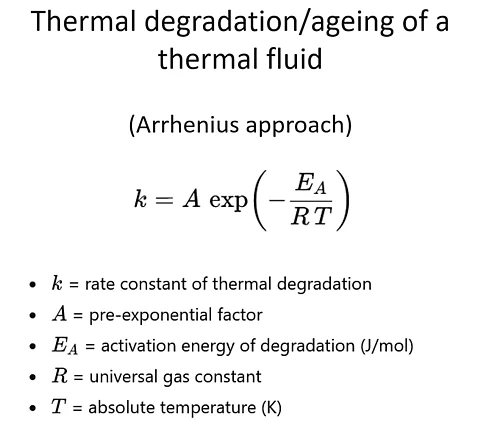
The more stable the physical and chemical properties of a heat transfer fluid, the more suitable it is. Low ageing and high thermal stability are particularly crucial when the fluid is subjected to prolonged exposure to high temperatures. Fluids that are prone to thermal decomposition or cracking lose their properties and compromise operational safety. There is no simple, definitive formula for ageing/cracking, but there is an important rule of thumb:
rate of ageing ~ exp (-E_A / (R * T))
- E_A is the activation energy of the decomposition
- T is the temperature
Similarly, the lower the system pressure required at high temperatures, the more attractive a heat transfer medium becomes. Fluids that remain liquid even at high temperatures without evaporating or undergoing chemical changes allow for simpler system designs and enhance safety. The suitability of a heat transfer fluid is determined by its heat capacity, vapour pressure, thermal stability, viscosity and ageing behaviour.
 Blog
Blog