
mix drying
Moist bulk materials and pastes can be dried in various ways, for example by roller, disc, belt, spray, fluidised bed or spin drying. Another method widely used in industry is mix drying.
The product is gently moved and thoroughly mixed. This ensures that the moisture content remains homogeneous throughout the entire batch. The heat required to evaporate the liquid phase can be introduced into the product in various ways:
1. by mechanical mixing energy that is dissipated as heat, or
2. by hot, dry air passed over or through the moving mixture, or
3. through direct contact of the mixture with the heated surfaces of the mixer.
Ideally, the mixing chamber, mixing tool shaft and mixing tools are temperature-controlled. The heat input mechanisms mentioned can be used individually or in combination. All three processes can be carried out in batches or continuously.
Method c) is most widely used in batch operation. It is energy-efficient, particularly hygienic and allows the process pressure in the mixing and drying chamber to be adjusted as required. In most applications, a vacuum is applied. This increases the drying performance and allows temperature-sensitive active ingredients to be dried at very low temperatures.
For example, some active pharmaceutical ingredients must not exceed 35 °C. Water evaporates at 35 °C if the absolute pressure in the mixing chamber is below 55 mbar.
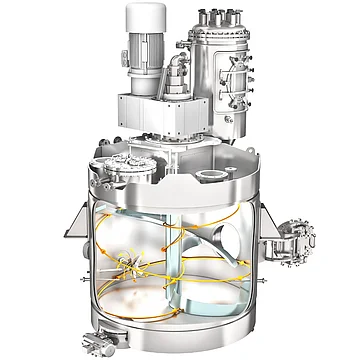
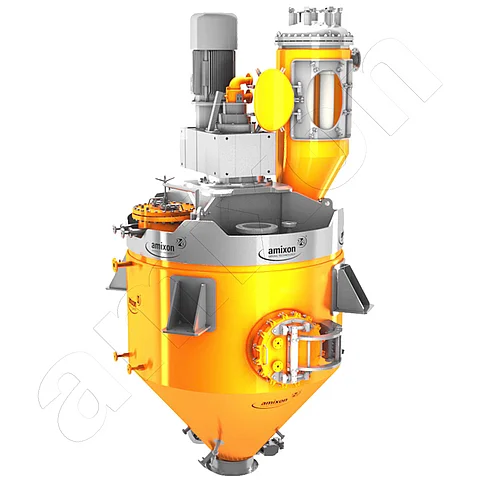
amixon® manufactures particularly powerful vacuum mixing dryers in various sizes and designs (cylindrical or conical). They operate at low speeds and are very gentle. These devices have extremely large heat transfer surfaces. They can be demonstrated and tested in the company's own technical centre. The blog post "amixon® helps with the dimensioning of large vacuum mixing dryer systems" also explains thermodynamic calculation methods for extrapolation.