Skip to main navigation Skip to main content Skip to page footer

Products of the tea and spice industry

Tea and spice blends are characterized by a wide variety of raw materials: dried leaves, herbs and plant parts, finely ground spices, botanical components, or complex seasoning powders. These components differ significantly in particle size, density, flow behavior, and surface.

In industrial processing, the aim is to combine these different bulk materials into homogeneous mixtures that perform uniformly for the end user—both sensorially and functionally. Dry bulk materials are processed, either filled directly as the final product or used as a premix in further process steps.

Typical dry products include: dried tea leaves and herbs, spice powders and herb blends, flavored seasonings, Seasonings, Premixes, botanical blends, as well as raw materials for spice and flavor components.

Requirements for mixing and refining

When blending tea and spice products, the particularly gentle handling of highly sensitive raw materials is paramount. Many components are sensitive to mechanical stress. The goal is to achieve a uniform distribution without unnecessarily altering structure, particle size, or aroma.

In addition to the uniform distribution of all components, aroma preservation plays a central role. Especially with high-quality herbs, teas, and spices, the characteristic flavor profile of the raw materials should be preserved and reproducibly reflected in the finished blend.

These requirements apply not only to small batches but also to large volumes and industrial throughputs. The mixing motion must act uniformly throughout the entire volume while still being gentle on the product. This ensures consistent sensory consistency even as production volumes increase.

In many applications, the controlled addition of liquid components such as flavors or extracts is also required. These must be incorporated evenly into the dry mixture without creating local overconcentrations or buildup. Dust avoidance, good cleanability, and frequent recipe or product changes also shape day-to-day production.

Depending on the product, additional steps such as drying or thermal treatment may be required, for example to achieve defined moisture levels or to meet microbiological requirements.

Typical process engineering requirements in the tea and spice industry are: homogeneous mixing of heterogeneous bulk solids, especially gentle product movement for delicate leaf and herb structures, reliable aroma retention, stable mixing quality even with large batch volumes, reproducible batch consistency, low-dust processing, and a hygienic, easy-to-clean equipment design.

amixon® solutions for the tea and spice industry

amixon® develops and builds mixers, dryers, and reactors for applications in which mixing quality, product preservation, and process safety are paramount. The selection of the appropriate mixer concept depends on raw material structure, batch size, and process engineering requirements.
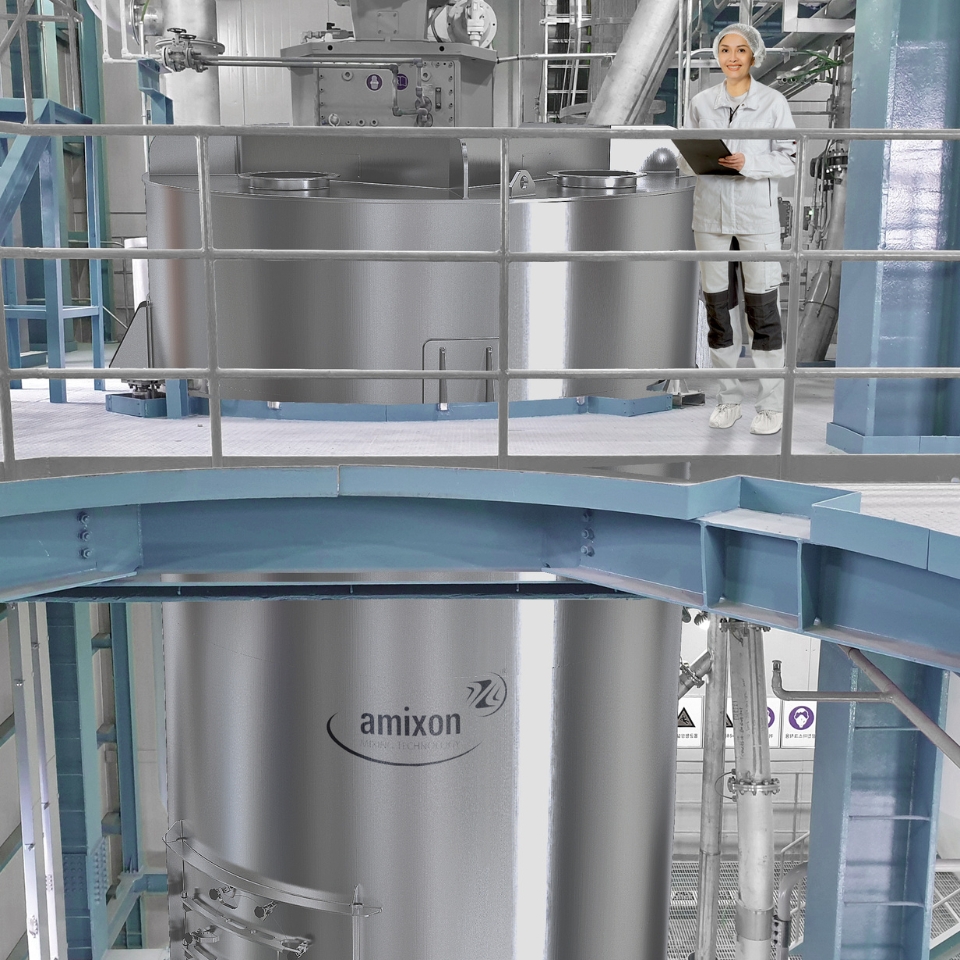
For large batches and volumes of sensitive tea and spice raw materials, amixon® Gyraton® Mixers (GM) are used. They are suitable for applications where particularly gentle mixing is required and uniform batch consistency should be ensured.
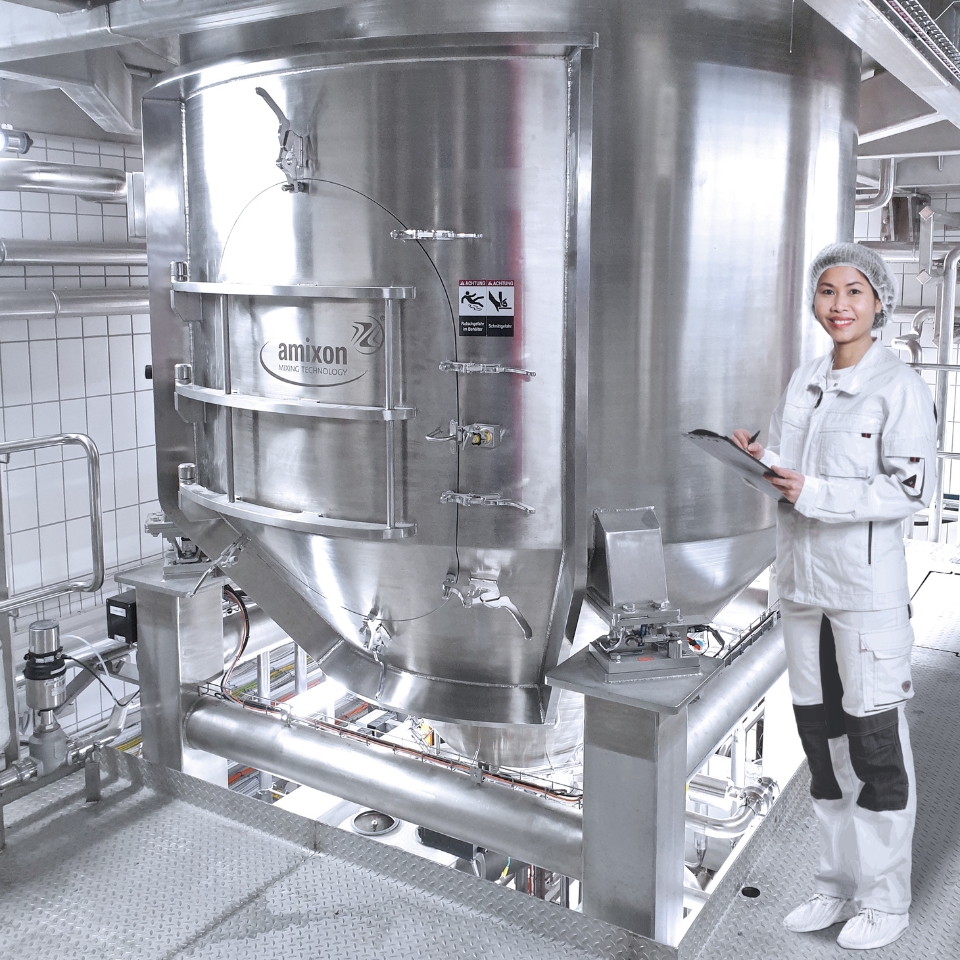
For flexible batch sizes and changing formulations, amixon® conical single-shaft mixers (AM) are available. They are used wherever reproducible mixing quality and effective discharge are required.
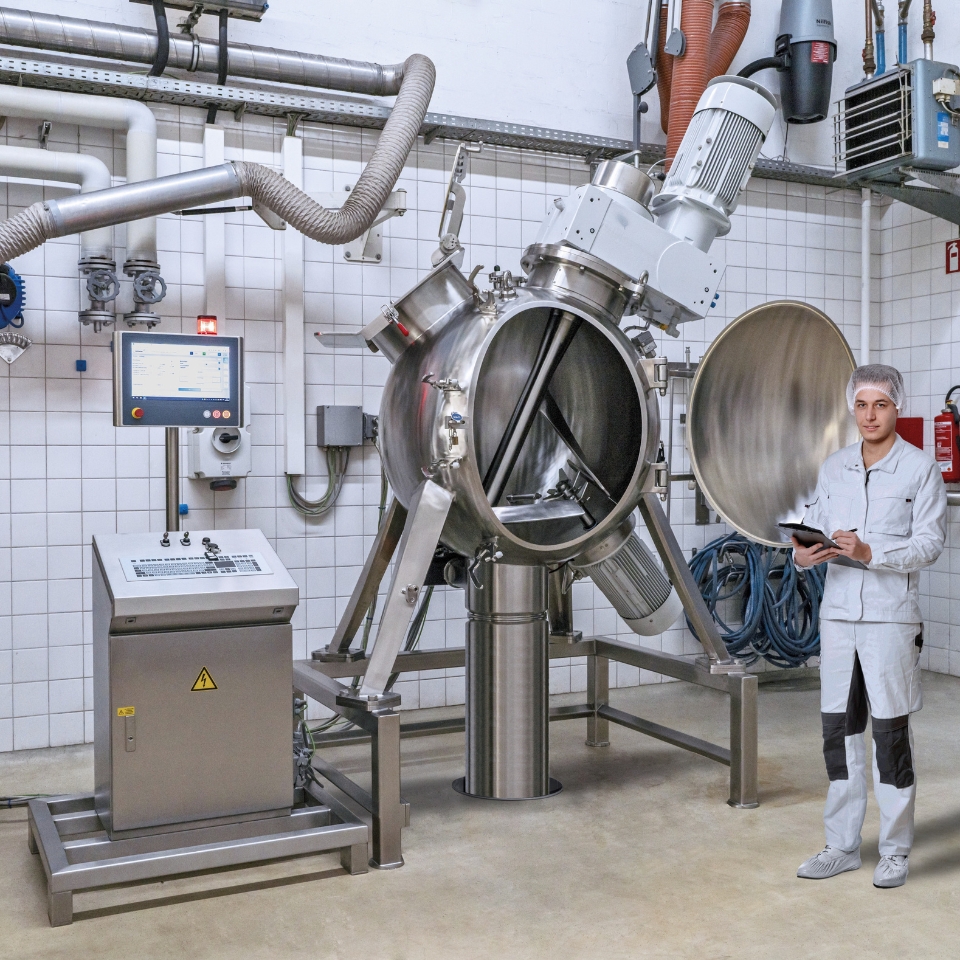
The amixon® SpherHelics® Hollow Sphere Mixer (SH) is the entry into the world of amixon® precision mixers. It supports uniform mixing with short mixing times and is suitable for products with high requirements for process stability and hygienic plant design.
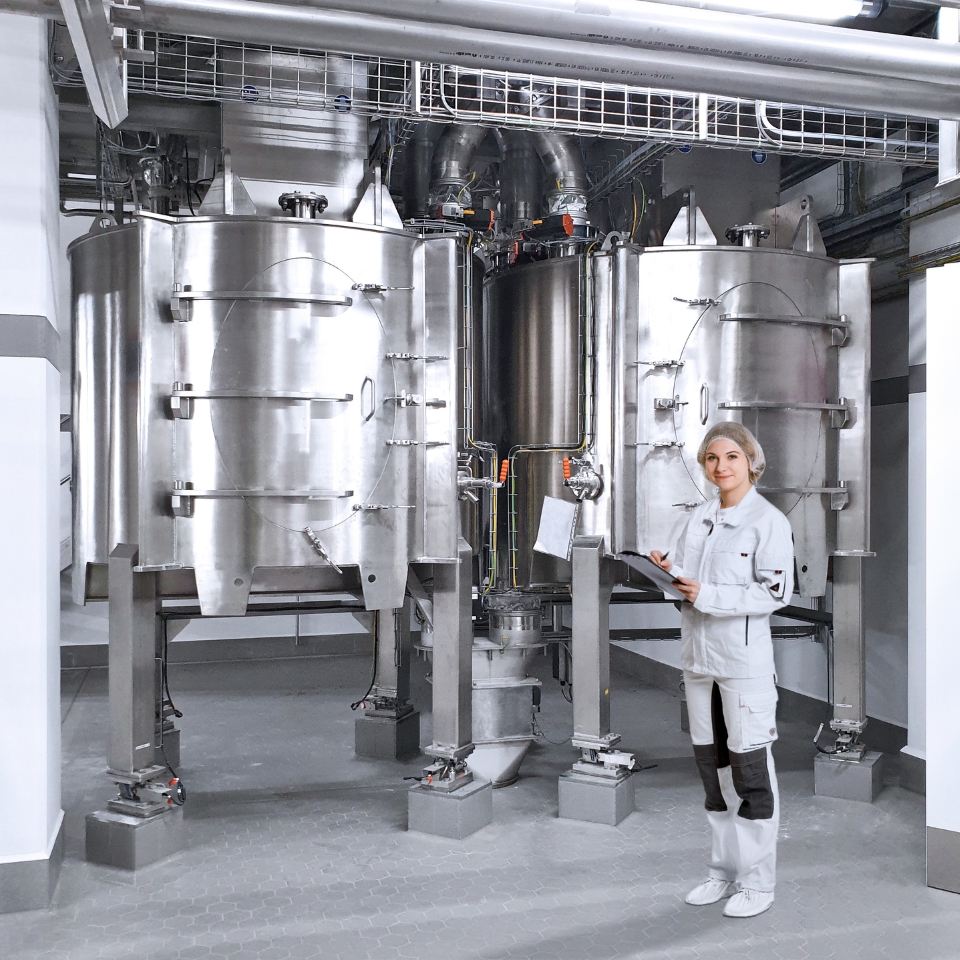
amixon® vertical single-shaft mixer (VM)The VM is a versatile industrial mixer for tea and spice products. Thanks to its vertical product flow, it achieves high mixing quality with short mixing times and is suitable for formulations with varying raw material properties and fill levels.

Additionally, amixon® offers vacuum dryers and mixing reactors that can be used for the thermal treatment and decontamination of tea and spice products.

Trials in the amixon® technical center support the design and validation of the processes.

amixon® offers the tea and spice industry individually designed industrial mixers, dryers, and reactors, as well as process engineering development and trials in the technical center.

If you are planning or further developing mixing or refinement processes for tea and spice blends, we support you with technical design and industrial implementation – from gentle homogenization to processing large batches with consistent sensory quality.

Talk to us about your application and your process engineering requirements.

amixon® – Process technology for high-quality spice and tea products.

Blog

FAQ: The ideal mixer for your needs?
The amixon® product range is uniquely comprehensive and particularly sophisticated. This means that amixon® meets the requirements of many different industries. amixon® experience is based on 40 years of tradition. Within the sectors, the processing stages of the bulk materials are more or less…

Read more

Aromatic, precise, reliable: Processing technology for tea and spice blends
For over 40 years, amixon® has been developing precision mixers for the gentle processing of tea, herbs, and spices. This article explores why mixing technology is crucial to aroma quality, product safety, and competitiveness in this industry—and which machine designs meet the specific requirements…

Read more

Blender for organic tea and fruit tea
A successful tea producer and trader answers questions about tea qualities.

Read more

amixon® mixing technology for professional tea preparation
The flavour of tea is influenced by numerous factors: from the region and location of the tea plantation, through the time of harvest and weather conditions at harvest time, to storage, fermentation, transport and packaging.

Read more

amixon® vertical mixers for spice preparation
The fascination of spices lies in the combination of essential oils, aromas, antioxidants, colorants, vitamins and minerals. They turn food into a sensory experience. A number of spices have been attributed with health benefits. Others have a preservative effect.

Read more

FAQ

Scaling up spice blends from laboratory or pilot-plant scale into production aims to ensure the mixing quality achieved, comparable mixing times and product protection at the larger scale, even though bulk quantity, plant size and process environment change considerably.

amixon® plans the trial programme together with the operator. In Paderborn alone, 35 test units are available, and further amixon® test mixers can be used in India, China, the USA, Thailand, Japan and Korea. Test blends are usually carried out with 400-litre batches.

Read more

Trial series for optimising a new spice recipe are ideally planned according to the principle of statistical design of experiments (DoE), combining a clearly defined objective with reproducible pilot-plant conditions.

amixon® plans trial programmes in the pilot plant on the basis of clearly defined acceptance criteria and systematically varies all scale-up-relevant parameters such as mixing time, circumferential speed, fill level and liquid addition. Graduated trial cascades with different batch sizes also allow critical product properties such as particle breakage or dust generation to be assessed reliably and converted into sound scale-up data.

Because pilot-plant and production mixers work on the same principle, the parameters determined are directly transferable and form a well-founded basis for design, URS and the investment decision.

Read more

A spice mixer for allergen-sensitive applications should be constructed hygienically, with low dead space and good dischargeability, so that product residues and allergenic deposits cannot lodge anywhere. Validatable cleanability, suitable seals and materials, and clear allergen, dust and batch management to avoid cross-contamination are equally important.

amixon® combines high residue-free discharge, a low-dead-space hygienic design and validatable CIP/WIP cleaning into a multi-stage protection concept against allergen contamination and cross-contamination. Depending on the application, various amixon® mixer categories and features such as ComDisc®, SinConvex®, SinConcave®, Mixtainer® and Washtainer® support a reliable, readily documentable process.

Read more

Selecting an industrial spice mixer with integrated liquid dosing requires a holistic view of process engineering, dosing technology, hygiene, safety and economic aspects. The most important criteria are summarised systematically below.

amixon® combines the SinConcave®/SinConvex® helical mixing tool with cutting rotors for this purpose: oil and fat are added via a lance or two-fluid nozzle directly into the action zone of the cutting rotor – giving microfine distribution without local over-wetting, and the mixing chamber remains free of build-up. Temperature-controlled liquid vessels keep fats reliably low in viscosity throughout the process.

Read more

Manufacturers with proven experience in processing tea and herbal blends containing sensitive leaves are typically plant engineering companies from the food, pharmaceutical technology and nutraceutical industries that specialise in low-shear mixing processes and gentle bulk solids handling.

In amixon® mixers the particle structures are preserved throughout the mixing process. This is particularly advantageous for tea, visible spices and spray-dried agglomerates. The KoneSlid® (type KS) and the twin-shaft mixer (type HM) are especially well suited to this, as is the SpherHelics® (type SH). As a rule, ideal mixing quality is reached after 10 to 30 seconds.

Read more

For spice blends with oil addition, hygienic precision mixers such as ploughshare mixers, helical and conical mixers and twin-shaft paddle mixers are particularly suitable, combined with fine spray nozzle technology, choppers and precise speed and dosing control, in order to distribute the oil evenly and avoid lump formation.

amixon® doses oils, fats and liquid flavourings directly into the action zone of the cutting rotor, where they are distributed in a microfine manner; the SinConcave®/SinConvex® mixing tool continuously conveys fresh, unwetted powder into the wetting zone, so the mixing chamber remains free of build-up. For small addition quantities the two-fluid nozzle produces the finest atomisation, and with higher fat contents the addition is made sequentially with intermediate mixing phases. Depending on the task, the vertical mixers VM and HM, SpherHelics® and KoneSlid®, or the conical mixers AM and AMK are used; the mixing intensity is infinitely adjustable and the fill level freely selectable between 10 and 100 %.

Read more

A relative standard deviation (RSD) below 5 % is regarded in spice blends as a practically relevant target value for a technically homogeneous distribution of all components.

amixon® precision mixers produce a technically ideal random mixture, so that coefficients of variation below 5 % are reliably achievable even with micro-dosages. Mixing quality remains largely independent of the fill level, while the gentle operating mode, an optional cutting rotor and hygienic design support product integrity, cleaning and validation.

Read more