Cross-Contamination
Cross-contamination is a form of contamination in which residues of one product or a previous batch enter another product. It is a central issue in industrial powder processing. Powder blenders play a key role here. They are used to produce complex mixed products for the food, animal nutrition, dietary supplement and convenience sectors.
A formulation can comprise more than 30 individual components. Liquids may also be included. These enter the mixer with precise dosing and in a defined sequence. Since sensitive, agglomerated or dusty raw materials have to be mixed in at different times, multi-step processes are common. Depending on the ingredient, mixing intensity, shear forces and mixing time vary. This produces agglomerates, coatings or homogeneous fine distributions. Fragile components are incorporated gently.
In highly automated powder plants, the entire logistics – transport, storage, weighing, dosing and discharge – runs automatically. This requires absolutely complete emptying of the pipes, diverters and dosing units. After all, any product residue from a previous batch carries the risk of cross-contamination. This also applies to the powder mixer. It must be designed so that it can be almost completely emptied at the end of the batch.
In practice, cross-contamination can be assessed quantitatively using MACO calculations. The MACO value describes the permissible residual quantity of an active ingredient on the contact surfaces after cleaning that could unintentionally be carried over into the subsequent product.
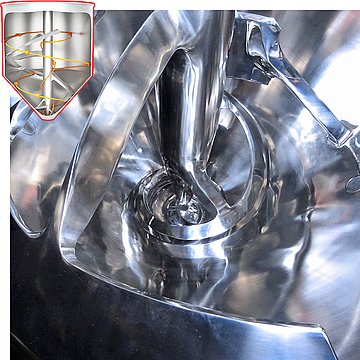
amixon® has developed special mixing tools for this purpose that significantly improve the residual discharge rate and the ease of cleaning. Tools such as SinConvex®, SinConcave®, ComDisc® or KoneSlid® enable targeted flow guidance in the mixer. They promote a homogeneous mixing result and minimise residues.
Powder production that delivers batch-pure products without manual cleaning represents a high technical standard. amixon® mixers can make a decisive contribution to this.
 FAQ - Cross-Contamination
 Blog
Blog

 Related pages