

Dimensionsanalysis
Dimensional analysis helps to develop calculation formulae on the basis of experiments.
Dimensional analysis is a method by which physical quantities are traced back to their base units (e.g. length, time, mass) and converted into unit-consistent equations - usually based on the International System of Units (SI). In experimental process engineering, it is often used to convert empirically observed phenomena into formulae that remain valid regardless of the system of units used.
Such equations enable a quantitative description of process engineering effects, e.g. during comminution, grinding, agglomeration or dispersion. Even if they appear formally physically correct, they are essentially based on observed relationships. The underlying physical laws have not yet been discovered. They are therefore referred to as dimensionally consistent approximations.
In practice, dimensional analysis is a valuable tool for modelling, scaling and transferring results from pilot plant tests to industrial processes.
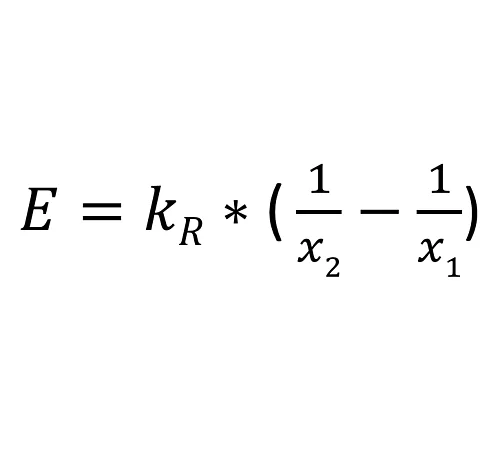
One example is the Rittinger law. This equation is based on the assumption that the energy required for comminution is proportional to the newly generated surface area, which applies relatively well to fine comminution.
- E: Specific energy requirement (e.g. kJ/kg)
- x1: Initial grain diameter (m)
- x2: End grain diameter (m)
- kR: Rittinger constant; material-dependent in the dimension: [m³/s²])
 FAQ - Dimensionsanalysis
Scaling up from a 20-litre mixer to a 2,000-litre mixer for infant formula involves considerable risks without sound empirical data.
A low-risk scale-up from 20 litres to 2,000 litres for infant formula is best achieved through pilot-plant trials with the original product, so that mixing quality, product protection and process stability are examined under realistic conditions. The amixon® pilot plant has 35 test mixers of up to 3 m³ available for this, offering the highest possible degree of process proximity and certainty for the later production scale.
Pilot trials are the decisive intermediate step between laboratory and production scale, allowing scaling risks in battery material mixtures to be identified and controlled at an early stage.
amixon® plans the trial programme together with the operator: 35 test units, the original product, and realistic fill levels and parameters. Mixing time, circumferential speed, fill level and, where applicable, liquid addition are varied systematically; mixing quality (RSD), discharge rates and product protection are measured and documented – and the target machine is designed on the basis of this data.
Securing scale-up tests from pilot plant to production in animal feed manufacturing requires a systematic combination of process characterisation, similarity analysis, statistical design of experiments, measurement technology and formal qualification.
amixon® plans scale-up tests in the pilot plant so that the operator's target parameters, realistic product quantities and an appropriate size scale are brought together early. Mixing time, circumferential speed, fill level, liquid addition and other relevant parameters are varied systematically and documented with the original product. A particular advantage is that amixon® can secure mixing quality even with very large recipe ratios, up to 1:100,000 and with a coefficient of variation below 5 %. The results therefore transfer soundly to production before any investment is made.
A secured scale-up rests on the combination of geometric similarity, the selection of process-relevant dimensionless numbers, and verification by measurement and modelling at intermediate and production scale.
amixon® turns scale-up into a secured transfer: pilot-plant and production mixers work with an identical mixing principle – the SinConvex® tool at the same circumferential speed of 0.8 to 3.5 m/s – mixing quality is independent of the fill level, and sizes can be selected in 100-litre increments up to 50,000 litres. The parameters are validated in advance in the pilot plant with the original product.
Scaling up spice blends from laboratory or pilot-plant scale into production aims to ensure the mixing quality achieved, comparable mixing times and product protection at the larger scale, even though bulk quantity, plant size and process environment change considerably.
amixon® plans the trial programme together with the operator. In Paderborn alone, 35 test units are available, and further amixon® test mixers can be used in India, China, the USA, Thailand, Japan and Korea. Test blends are usually carried out with 400-litre batches.
Transferring a recipe reproducibly from laboratory or pilot-plant scale to production scale in a vertical single-shaft mixer rests on the mixing principle remaining the same across all sizes and on the restratification covering the entire mixing chamber independently of the fill level; transferability is secured in a pilot-plant trial with the original product.
amixon® turns scale-up into a secured transfer: pilot-plant and production mixers work with an identical mixing principle – the SinConvex® tool at the same circumferential speed of 0.8 to 3.5 m/s – mixing quality is independent of the fill level, and sizes can be selected in 100-litre increments up to 50,000 litres. The parameters are validated in advance in the pilot plant with the original product.
Scaling up from laboratory to production scale in powder metallurgy is a demanding process engineering task, because mixing quality depends strongly on particle sizes, density differences, cohesive forces and the geometry of the mixer.
amixon® solves the scale-up problem by design: the mixing principle remains congruent from the pilot-plant mixer through to the production plant. This also applies to the geometry of the SinConvex®/SinConcave® helical ribbon tools and to the flow pattern. The mixing function is independent of the fill level. Sizes are adapted to the respective requirement in 100-litre increments, and batch sizes of up to 50,000 litres can be selected. On request, mixing quality is verified in advance in the pilot plant.
Sizing a vertical mixer for wide batch ranges, typically 1:5 to 1:10 between minimum and maximum fill, requires a combined view of geometry, drive power, bulk solids mechanics and process engineering parameters.
amixon® turns scale-up into a secured transfer: pilot-plant and production mixers work with the same mixing principle using the SinConcave®/SinConvex® tool, so that mixing quality is independent of the fill level. Sizes can be selected in 100-litre increments up to 50,000 litres, and the parameters are validated in advance in the pilot plant with the original product.
The scalability of a laboratory mixer depends above all on geometry, process parameters, material properties and the product quality verified. The decisive point is that homogeneity and active ingredient distribution remain reproducible from laboratory to production scale, using suitable analyses and pilot trials.
amixon® turns scale-up into a secured transfer: pilot-plant and production mixers work with an identical mixing principle – the SinConvex® tool at the same circumferential speed of 0.8 to 3.5 m/s – mixing quality is independent of the fill level, and sizes can be selected in 100-litre increments up to 50,000 litres. The parameters are validated in advance in the pilot plant with the original product.
The scale-up of instant food granules describes the proportional transfer of a process optimised in the laboratory or pilot plant to a large-scale production plant, with the aim of maintaining the product properties achieved.
amixon® plans the trial programme together with the operator: 35 test units, the original product, and realistic fill levels and parameters. Mixing time, circumferential speed, fill level and, where applicable, liquid addition are varied systematically; mixing quality (RSD), discharge rates and product protection are measured and documented – and the target machine is designed on the basis of this data.
Scaling a mixing process from laboratory or pilot-plant scale to production scale is a complex, interdisciplinary task in process engineering.
amixon® turns scale-up into a secured transfer: pilot-plant and production mixers work with an identical mixing principle – the SinConvex® tool at the same circumferential speed of 0.8 to 3.5 m/s – mixing quality is independent of the fill level, and sizes can be selected in 100-litre increments up to 50,000 litres. The parameters are validated in advance in the pilot plant with the original product.
Scaling up mixing processes from pilot plant to production scale requires the deliberate transfer of geometric, kinematic and dynamic similarity in order to ensure both mixing quality and particle integrity across all scales.
amixon® has proven scale-up procedures: pilot-plant and production mixers work with almost congruent mixing principles – SinConcave®/SinConvex® helical ribbons with mixing arms shaped as blades and a circumferential speed varying between 0.8 and 3.5 m/s – and varying fill levels are generally unproblematic. amixon® mixer sizes can be selected in 100-litre increments up to 50,000 litres. The parameters are validated in advance in the pilot plant with the original product. The Gyraton® mixing silo achieves ideal mixing quality up to 100 m³.
A mathematical scale-up of ring-layer mixing agglomerators is extremely difficult, because there is a lack of well-founded knowledge about which effects in the ring layer lead to agglomeration and which break up the agglomerates that have formed.
Scaling up ring-layer mixing agglomerators is extremely difficult. There is a lack of well-founded knowledge about which effects in the ring layer lead to agglomeration – and which effects break up the agglomerates that have formed.
The scale-up of mixing and agglomeration processes rests on geometric, kinematic and dynamic similarity, on dimensionless numbers such as the Froude, Reynolds, Newton and Weber numbers, on process and product data such as power consumption, specific energy input, particle size distribution and granule strength, and on empirical, mechanistic and population-balance models that are verified in trials with the original product.
amixon® scales via physical similarity rather than rules of thumb: a constant circumferential speed of 0.8 to 3.5 m/s instead of a constant rotational speed, an identical SinConvex® mixing principle across all sizes, and mixing quality independent of the fill level. Considerations based on dimensionless numbers such as Froude similarity are verified by pilot-plant trials with the original product – never replaced by them.
For the scale-up of vertical mixing technologies such as conical screw mixers and vertical paddle or helical mixers, several geometry-based, dimensionless-number-based and power-related approaches have become established in industrial practice.
amixon® scales via physical similarity rather than rules of thumb: a constant circumferential speed of 0.8 to 3.5 m/s instead of a constant rotational speed, an identical SinConvex® mixing principle across all sizes, and mixing quality independent of the fill level. Considerations based on dimensionless numbers such as Froude similarity are verified by pilot-plant trials with the original product – never replaced by them.
Converting mixing times during scale-up is based on geometric similarity between the laboratory and production vessel and on the deliberate selection of suitable similarity criteria, such as specific power input or circumferential speed.
amixon® scales from the laboratory mixer to the large-volume production plant via a defined restratification frequency, constant geometry and pilot-plant trials, thereby ensuring ideal mixing quality down to component ratios of 1:100,000.