

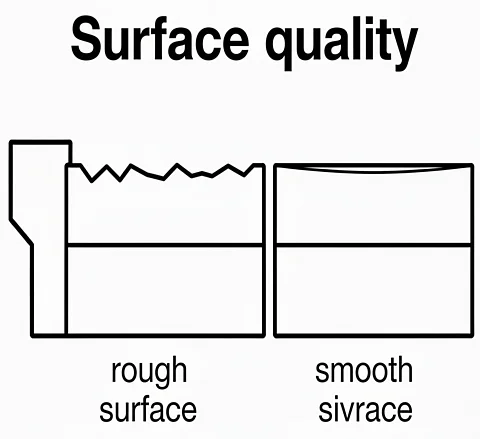
Surface quality
In mechanical engineering, surface quality describes the roughness, waviness and machining texture of a surface. It is closely related to the manufacturing process used.
Please refer to this glossary for the topic ‘Surface’.
 FAQ - Surface quality
Smooth surfaces and a dead-space-free design are central elements of hygienic design in milk powder plants. They directly influence product safety, cleaning efficiency and the microbiological stability of the entire process.
For hygienic powder processes, amixon® relies on a dead-space-free design, joint-free and readily accessible mixing chambers, and validatable cleaning. This includes Clever-Cut® inspection doors, OmgaSeal® seals, top-mounted mixing tools, and freely programmable target-jet cleaning nozzles and washing lances for reproducible CIP and WIP cycles. ComDisc® and the SinConcave®/SinConvex® mixing helix additionally ensure particularly good residual discharge and a low risk of cross-contamination. In dairy and infant formula production this improves hygiene, cleanability and product protection, and is secured in advance in the pilot plant with the original product.
Smooth, highly polished surfaces with low micro-roughness – typically a mean roughness value Ra ≤ 0.8 µm, and in hygiene-critical applications down to approximately ≤ 0.4 µm – significantly improve cleanability and reduce product residues by minimising adhesion points, allowing cleaning media to wet the surface evenly, and making the formation of biofilms and corrosion more difficult.
For hygienic powder processes, amixon® relies on surfaces welded free of joints, ground and, depending on the application, highly polished; the roughness depth can be selected on a project-specific basis, typically with Ra values of 0.8 µm, 0.6 µm, 0.4 µm or 0.2 µm, and beyond that lapped to a mirror finish or electropolished. Complemented by a wide range of materials, freedom from dead space, high residual discharge and qualifiable manufacture in Paderborn, the result is a hygienic overall system with very good cleanability and high process reliability.
Surface finish, typically described by the arithmetic mean roughness value Ra, is a key hygiene engineering parameter for all product-contact surfaces in food mixers.
amixon® manufactures all product-contact surfaces welded and ground free of joints – on request up to highly polished, GMP-compliant surface finishes. The range of materials extends from austenitic stainless steels (1.4301 to 1.4539) through duplex steels to Alloy 59, Hastelloy-C22 and nickel for corrosive products.
For milk powder applications, hygienic design is regarded as state of the art: plants should be constructed so that product residues do not accumulate wherever possible, can be removed easily, and no unnecessary contamination risks arise.
amixon® implements hygienic design by construction: the mixing chamber and the mixing tool are welded and ground free of joints, and the mixing tool is supported at the top only. Large Clever-Cut® inspection doors with OmgaSeal® sealing and dead-space-free discharge fittings are standard, and the target-jet washing lances are programmable.
In hygienic powder processes, corrosion-resistant, easily cleanable materials and smooth, hygienically designed surfaces are the most important levers for minimising build-up, bridging and cross-contamination.
amixon® manufactures all product-contact surfaces welded and ground free of joints – on request up to highly polished, GMP-compliant surface finishes. The range of materials extends from austenitic stainless steels (1.4301 to 1.4539) through duplex steels to Alloy 59, Hastelloy-C22 and nickel for corrosive products.
Milk powder production places high requirements on the surface roughness of product-contact components, because only sufficiently smooth, defect-free surfaces allow reliable cleaning (CIP/SIP), the avoidance of product residues and the minimisation of microbial contamination.
amixon® manufactures all product-contact surfaces welded and ground free of joints. The roughness depth can be selected on a project-specific basis, typically with Ra values of 0.8 µm, 0.6 µm, 0.4 µm or 0.2 µm; beyond that, amixon® can lap to a mirror finish and electropolish. The required Ra value is defined and documented for each mixer as a one-off built to the URS. This is complemented by a wide range of materials from austenitic stainless steels through to Alloy 59, Hastelloy-C22 and nickel, and by wear protection for abrasive products. Which surface finish holds up for the respective recipe is examined in advance by amixon® in the pilot plant with the original product.