

Sterilize
Sterilization is used to make products, equipment, or packaging germ-free. In the process, bacteria, spores, viruses, and fungi are destroyed or inactivated. The goal is to create a microbiologically safe product.
Sterilization can be carried out thermally, chemically, or physically. Frequently used methods include steam sterilization, hot-air sterilization, irradiation, and sterilization with gases or plasma. Which method is used depends on the product, the material, and the process.
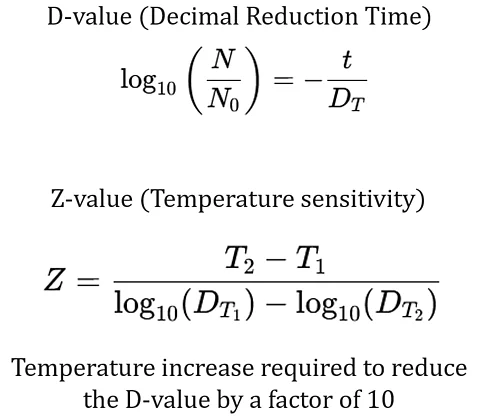
The killing of microorganisms follows logarithmic kinetics. It can be described with the following equation:
log₁₀(N/N₀) = −t/DT
- N0 is the initial microbial count
- N is the remaining microbial count
- t is the time
- DT is the D-value at temperature T. The D-value describes the time required to reduce the microbial count by 90%.
An example of a D-value: D121 °C= 1 min.
- This means that
- after one minute at 121 °C, 90% of the germs are killed.
- after two minutes, 99% are killed.
- after six minutes, 99.9999% of the germs are killed.
Sterilization is used in the pharmaceutical, food, and medical technology industries. It is important for product safety, shelf life, and regulatory compliance. Process parameters include temperature, time, pressure, and active ingredient concentration.
amixon® process equipment can be automatically steam-sterilized and dried.
Z = (T2−T1) / [log10(DT1) – log10(DT2)]
- T₁ is the first temperature (e.g., 111 °C)
- T₂ is the second, higher temperature (e.g., 121 °C)
- D₍T₁₎ is the D-value at T₁
- D₍T₂₎ is the D-value at T₂
T₁ and T₂ are measuring points from laboratory tests. They define how sensitive a microorganism reacts to temperature. The Z-value is material- and germ-specific.
 Blog
Blog