

Shear stress
Shear stress refers to the mechanical stress exerted on particles or particle aggregates by tangential forces. This results from relative movements between the particles or between the particles and the surfaces of the equipment. In powder technology, shear stress arises in particular during mixing, conveying, agglomeration, comminution or dosing.
It has a significant influence on the structure and properties of powders and granulates. Possible consequences include deagglomeration, particle destruction, changes in particle shape, dust formation or even the activation of surfaces. Products such as crystals, brittle granulates or coated particles are particularly sensitive to high shear forces. Instant agglomerates, cereals or muesli flakes are similarly sensitive.
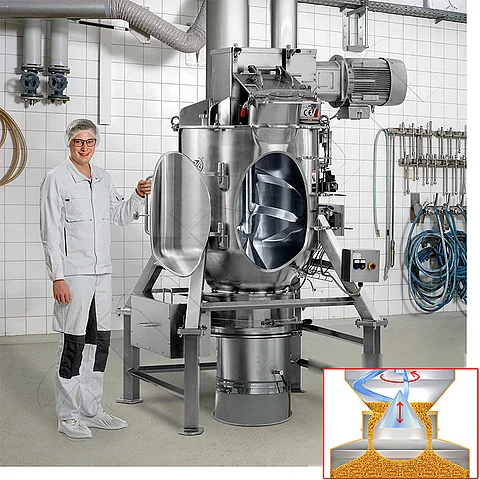
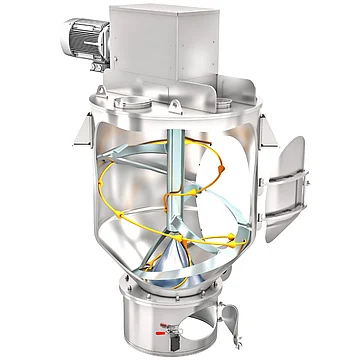
In process engineering, the controlled adjustment of shear stress is therefore an important design criterion for mixers, conveyors and reactors. The aim is to achieve sufficient mixing and reaction without unduly altering the product structure. With the KoneSlid® mixer, ideal mixing qualities can be achieved with minimal shear stress. It is therefore ideally suited for spray-dried agglomerates, flakes and cereals.

 Related pages