

Rotational frequency
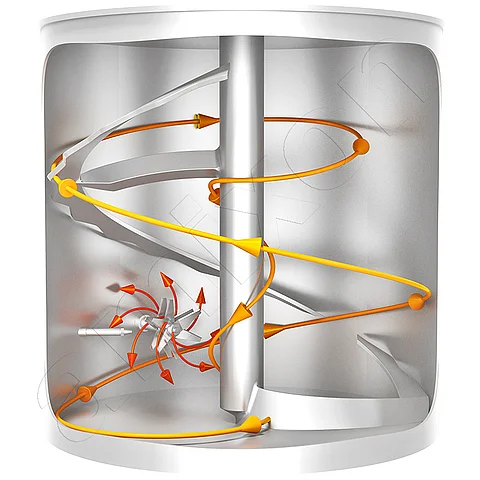
The rotational frequency is the number of revolutions of a rotating component per unit time. It describes the rotational speed of shafts, mixing tools, or rotors. The rotational frequency influences flow, mixing intensity, shear forces, and energy input.
In process engineering, the rotational frequency is used for the design of mixers, agitators, crushers, and conveyors. A high rotational frequency generates strong swirling and high turbulence intensity. A low rotational frequency leads to gentle shear flow and low particle abrasion.
The rotational frequency is given in hertz or as rotational speed in revolutions per minute. The relationship is
f = 60 · n
- f is the rotational frequency in s⁻¹
- n is the rotational speed in revolutions per minute
The corresponding angular velocity is given by
ω = 2 · π ˙ f
- ω is the angular velocity in rad/s.
Circumferential speed
The circumferential speed describes the linear velocity of a point at the rotor circumference. For further details see in this glossary „Circumferential speed“.