
cellulose ether
This is a group of cellulose derivatives in which the hydroxyl groups of cellulose have been partially or completely replaced by ether groups (for example, methyl, ethyl, hydroxyethyl, or hydroxypropyl groups). Through this etherification, the originally water-insoluble cellulose in many cases becomes water-swellable or water-soluble and acquires thickening, gelling, and film-forming properties.
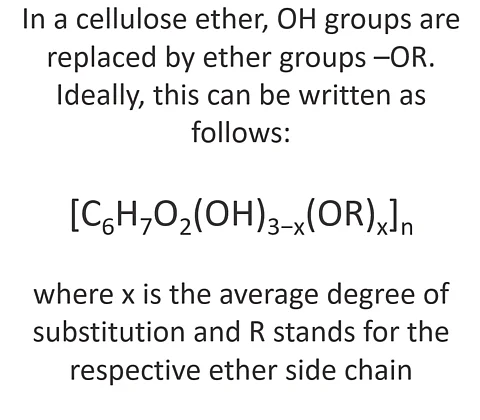
In a cellulose ether, OH groups are replaced by ether groups –OR. Ideally, this can be written, for example, as:
[C6H7O2(OH)3−x(OR)x]n
where x is the average degree of substitution and R denotes the respective ether side chain.
Typical representatives include methylcellulose (MC), ethylcellulose (EC), hydroxyethylcellulose (HEC), hydroxypropylcellulose (HPC), and carboxymethylcellulose (CMC). Depending on the substituent and the degree of substitution, they are soluble in water and/or organic solvents. In practice, cellulose ethers are used, among other things, as thickeners, gelling agents, stabilizers, and film formers, for example in foods, pharmaceuticals, construction chemicals, paints, and personal care products.
 Blog
Blog