

beta-glycosidic bond
A β-glycosidic bond is a glycosidic bond in which the anomeric carbon atom of the sugar involved is in the β-configuration. In the Haworth projection, this means that in D-sugars, the hydroxyl group at the anomeric centre – and thus the bonding oxygen atom – points upwards, i.e. cis to the CH₂OH group.
For example, a β-1,4-glycosidic bond is said to exist when the anomeric C-1 of one sugar is linked to the C-4 of a second sugar in the β-configuration. An important example is cellulose, in which the glucose building blocks are linked by β-1,4-glycosidic bonds to form long, extended chains. This β-linkage results in a rigid, hydrogen-bond-rich structure and thus high strength, but poor solubility compared to α-linked polysaccharides such as starch.
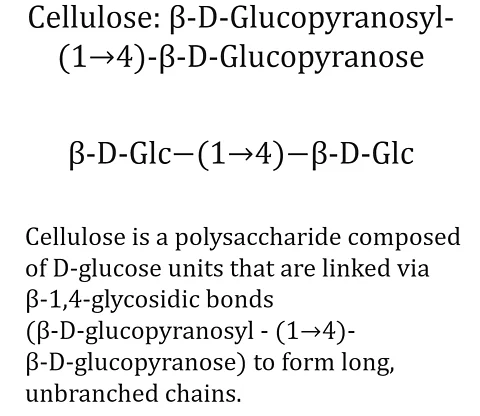
Cellulose is a polysaccharide composed of D-glucose units linked via β-1,4-glycosidic bonds (β-D-glucopyranosyl-(1→4)-β-D-glucopyranose) to form long, unbranched chains.