

Aroma
Aroma refers to the overall sensory impression of a product’s smell and taste. It is produced by volatile and non-volatile chemical compounds. Many of these flavouring substances are organic molecules such as esters, terpenes, aldehydes, ketones or lactones. In food technology, the term ‘flavourings’ is used when substances or preparations are added to food to enhance or alter its smell or taste. These flavourings can be obtained naturally, produced through defined reactions, or manufactured synthetically. A distinction is made, for example, between flavouring substances (individual defined compounds), natural flavourings, reaction flavourings and smoke flavourings. Flavourings are of great importance for production, cleaning and containment in mixing and bulk material processes, as they are often very intensely perceptible and can lead to sensory cross-contamination even in minute traces.
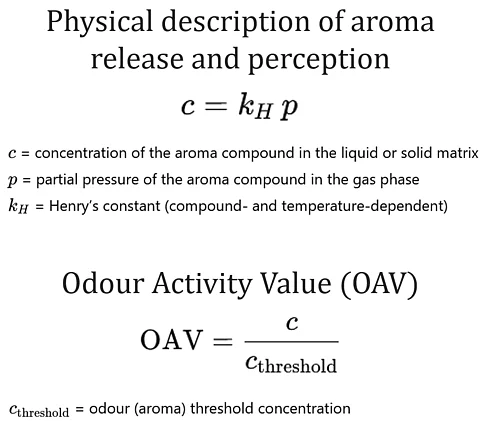
The release of volatile aroma compounds into the gas phase can be described approximately using Henry’s law. The smaller the Henry’s constant, the more strongly an aroma compound remains bound within the matrix; the larger it is, the more readily it passes into the headspace phase and is perceived
c = kH · p
- c: Concentration of the flavouring agent in the liquid
- p: partial pressure of the aroma compound in the gas phase
- kH: Henry's constant (substance- and temperature-dependent)
The Odour Activity Value (OAV) can be used to assess whether a flavouring compound has a sensory effect: values greater than 1 indicate that the compound contributes to the aroma; the higher the value, the more dominant its influence.
OAV = c/cSchwelle
- c: Concentration of the flavouring in the product
- Threshold: Odour or aroma threshold concentration