
amyloidosis
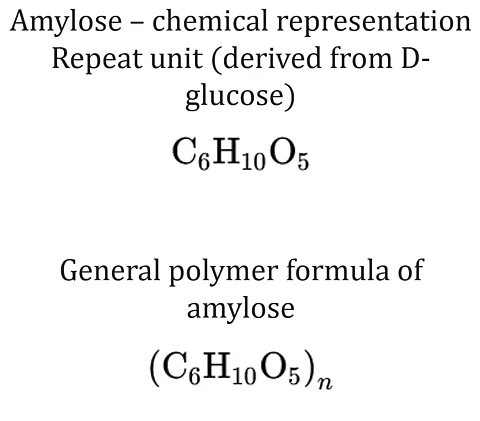
Amylose is a naturally occurring polysaccharide. Alongside amylopectin, it is one of the main components of plant starch. Typical sources include potatoes, cereals and maize. Amylose molecules consist of many D-glucose units. These are linked together via α-1,4-glycosidic bonds. This results in a largely unbranched, long-chain structure. The chains coil into a helical shape. Small molecules such as iodine can be incorporated into these helices. This explains the characteristic blue colouration observed in the iodine-starch test. Amylose is less soluble in water than amylopectin.
When heated in water, it forms viscous solutions and gels. It is prone to retrogradation; that is, as it cools, ordered regions may form, which can lead to solidification or syneresis. In foodstuffs and industrial starches, the amylose content influences, amongst other things, the texture, gel strength and gelatinisation behaviour.
 Related pages