Organic solvents
Organic solvents are carbon-based chemical compounds that can dissolve other substances physically or chemically. They are among the most important auxiliary materials in industrial process engineering. Their importance ranges from extraction and active ingredient breakdown to chemical synthesis. In many processes, they enable access to valuable ingredients or control reactions. Organic solvents are therefore indispensable in the pharmaceutical industry, fine chemicals, food technology and the cosmetics industry.
One key area of application is extraction. Organic solvents allow certain components to be selectively dissolved from complex mixtures of substances. By specifically selecting the polarity, active ingredients, flavours or oils can be efficiently extracted. Solvents also play a crucial role in the chemical breakdown of substances. They make substances that are difficult to access reactive or transportable. In chemical synthesis, they serve as a reaction medium, heat transfer medium and transport phase for reactants and products. In doing so, they influence the reaction rate, selectivity and quality of the products.
Solvents are particularly important in the process of liquid application to solids. In this process, a solid is first dissolved in a solvent. This solution is then sprayed evenly onto another solid, often in a mixer. After the solvent has evaporated, the dissolved substance remains finely distributed on the surface of the particles. This allows extremely high mixing qualities to be achieved. The distribution can be almost homogeneous down to the nanometre range. This process is used to dope active ingredients, introduce additives evenly or modify products functionally.
The same principle can also be used to carry out coating and encapsulation processes. To do this, polymers, waxes or functional substances are dissolved and applied to solids. After the solvent has evaporated, a uniform shell forms around the particles. This protects products, controls release profiles or improves flow properties. Solvents thus enable not only mixing, but also the targeted functionalisation of powders and granulates.
Inorganic solvents
Solvents are not exclusively organic. Water is also a solvent and is classified as an inorganic solvent. A well-known example is the solution of carbon dioxide in water, as found in beverages or in technical gas absorption processes. In addition to water, liquid ammonia and mineral acids are also classified as inorganic solvents. They are mainly used in aqueous reactions, in electrochemistry or in gas scrubbing.
There are also other classes of solvents. These include ionic liquids, supercritical fluids such as supercritical carbon dioxide and so-called deep eutectic solvents. These are mainly used when high selectivity, low residues or improved environmental compatibility are required. They are becoming increasingly important in research and specialised industrial applications.
After almost every solvent-based process, the question of solvent removal and recovery arises. Complete and gentle drying is particularly important for coated or extracted solids. Residues are undesirable. At the same time, sensitive particles must not be damaged.
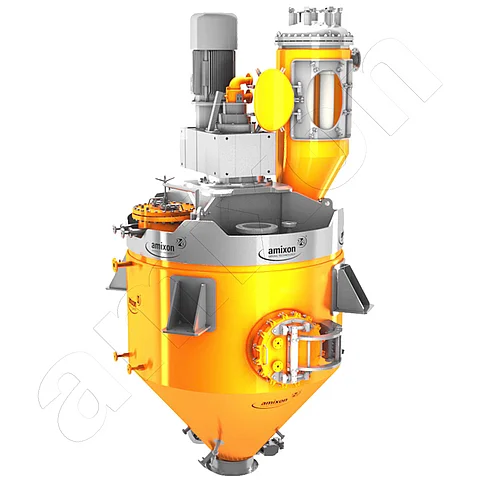
This is where vacuum contact dryers such as those from amixon® come into play. These devices are capable of expelling almost all types of solvents from dispersed solids. Drying is particularly gentle. On the one hand, this is due to the gentle mixing process. On the other hand, exceptionally large heat transfer surfaces ensure efficient energy input at low temperatures. amixon® is happy to demonstrate these processes in its technical centre. There is an interesting blog post on this website: ‘amixon® helps with the dimensioning of large vacuum mixing dryer systems’.
Another important aspect is the chemical resistance of the devices. Some solvents are highly corrosive. In such cases, the dryers and mixers are therefore made of nickel-based materials.
 Related pages