
mixing accelerator
In process engineering, the term "mixing accelerator" is rarely used unambiguously. However, it describes two different operating principles. On the one hand, it refers to supplementary mechanical tools that intensify the mixing process. On the other hand, it encompasses chemical or physical additives that improve the miscibility of components.
During storage, powders can become compacted, clumped or agglomerated due to their own weight and the stacking of the bags. Such agglomerates dissolve again in a mixer. The more deagglomeration power is applied to the powder, the better this works.
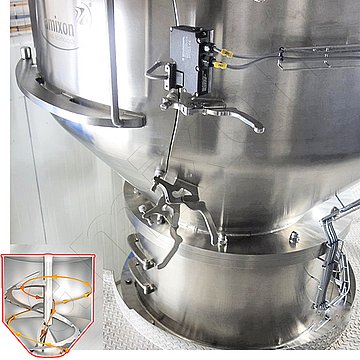
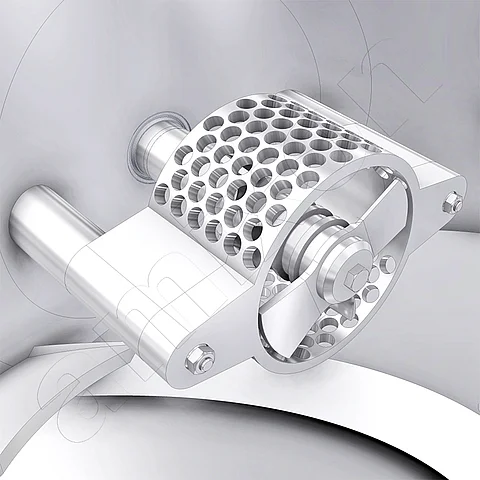
High-speed tools such as cutting rotors, shear dispersers, rotor-stator systems or knife heads also protrude into the mixing chamber and generate intense shearing, impact and collision effects. These tools increase the local power density in the product, thereby accelerating the breaking up of agglomerates and the homogenisation of the mixture. In this sense, they are therefore considered mechanical mixing accelerators.
In addition to mechanical influences, material properties determine miscibility. Differences in density, surface tension, particle shape, moisture content, hydrophobicity or hydrophilicity can make dispersion difficult. Electrostatic charges, van der Waals forces, chemical repulsion or magnetic properties also influence the behaviour of particle systems in the mixing process.
In such cases, small additives are sometimes sufficient to improve wetting, flowability or discharge and enable stable mixing. Typical examples of this are flow aids, surfactants, dispersing aids or antistatic agents. These substances change the particle interaction structure and can be regarded as chemical or physical mixing accelerators.
The aim is to reduce mixing time, increase homogeneity and make the mixing process more reproducible. amixon® mixers are ideal for this purpose. Despite effective deagglomeration, the particle structures remain largely intact. For demonstrations with original products, amixon® has technical centres in Germany, China, India, Japan, Korea, Thailand and the USA.
 Blog
Blog