mixer weight
The mixer weight refers to the mass of an industrial mixer in its complete structural design. It includes the dead weight of the mixing vessel, the mixing tools, the drive and bearing technology, and the support structures. Operating materials such as gear oils, hydraulic media, or thermal fluids in double jackets must also be added to the mixer weight.
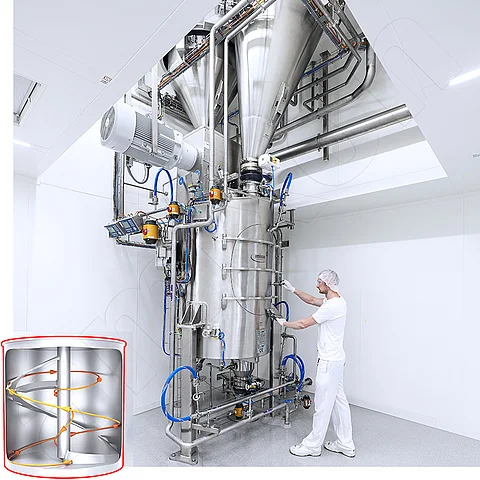
Industrial mixing machines can reach considerable dimensions and masses. This applies regardless of whether they are free-fall mixers with rotating or shaking containers or stationary compulsory mixers with dynamically driven mixing tools. The total weight of the mixer is an essential planning parameter in plant statics.
In Europe, the main set of rules for structural analysis ("statics") of buildings – including industrial facilities – is the Eurocode series of standards (EN 1990–EN 1999).
For the static design of the building, all static loads must first be determined. These include the mixer's own weight, the mass of the operating materials and the load of the maximum possible mixing batch. The basis for this is the gross volume of the mixer, which is multiplied by the highest expected specific density or bulk density of the mixture. Since industrial mixers must not be overfilled, this calculation represents a conservative design parameter. Under certain circumstances, there may be access to water or other liquids. In this case, the gross volume of the mixer must be multiplied by the density of the corresponding liquid. This consideration must always be taken into account if the mixed materials are lighter than water.
Environmental and operational loads must also be taken into account. These include the effects of forklift trucks, hoists, driverless transport systems or other conveyor equipment located in the immediate vicinity of the mixer during filling or emptying. The loads caused by equipment used for maintenance, inspection and repair work must also be taken into account.
In addition to static loads, additional dynamic loads occur. These are caused by the movement of the mixing container or by rotating mixing tools and their drives. These dynamic forces can significantly exceed the static loads. It is particularly important to carefully consider the rotational frequencies in order to avoid resonance effects between the mixer, the frame and the building structure. Operation in the vicinity of resonance frequencies can cause damage to the supporting structure.
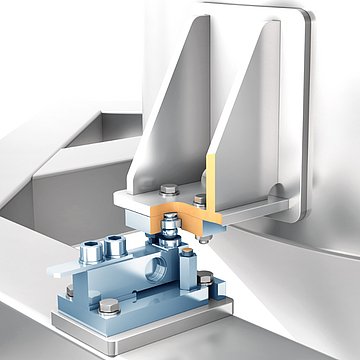
In the case of mixers that also function as synthesis reactors, vacuum mixing dryers or thermally controlled process apparatus, additional consideration must be given to thermally induced expansion and contraction of the apparatus. The mounting and fastening points must be designed in such a way that they can accommodate temperature-related changes in length without causing unacceptable stresses in the building or in the process apparatus. This is based on the material-specific thermal expansion coefficients.
The mixer weight and the loads derived from it are important parameters for planning and plant safety. amixon® devices are usually designed as vertical mixers. The main mixing tools operate at comparatively low rotational frequencies. Due to the vertical arrangement of the shafts, there are typically lower vertical vibrations than in mixers with horizontally mounted mixing shafts. A practical indicator of the strength of any vertical or torsional vibrations that may occur is the size of the installed drive power.
The blog post on the amixon® website explains the terms excitation frequency, unbalance force, theoretical spring stiffness and natural frequency using examples.
 Blog
Blog