

Dry, fast, long-lasting: The blending technology behind instant food
amixon’s multi-step dry mixing process “instantizes” powders by first intensively deagglomerating base components and then briefly, gently homogenizing fragile add-ins, producing instant foods that wet, disperse, and dissolve quickly while preserving taste, texture, and particle integrity. The low-energy, no-temperature-rise approach enables microfine distribution of minute ingredients such as preservatives, supporting long shelf life without refrigeration and protecting delicate pieces, with both steps done in one vessel to avoid transfer losses. amixon offers HM twin-shaft mixers for combined intensive/gentle regimes, AM single-shaft mixers for versatile premixes and small fill levels, and AMT cone mixer-dryers for in-vessel thermal treatment or sterilization to fine-tune moisture, solubility, and flowability.
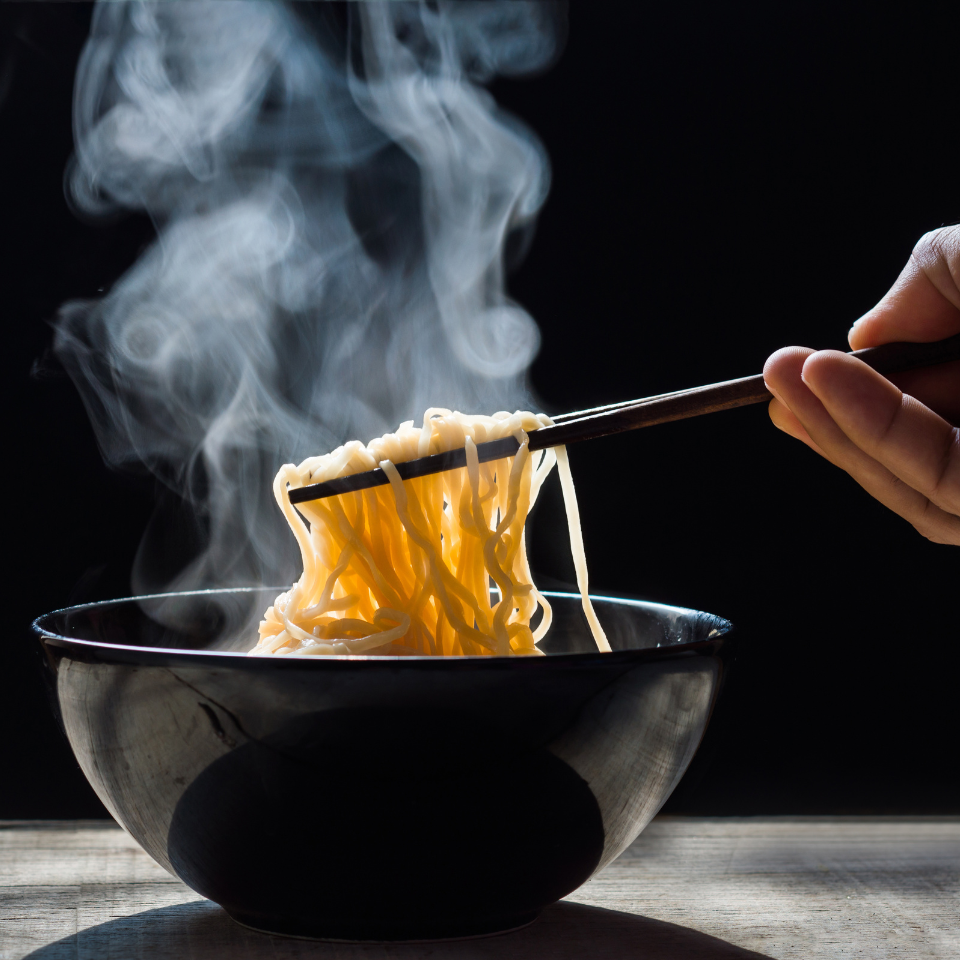
With its multi-step mixing method, amixon® solves the key challenge in instant food production: a long shelf life without refrigeration, combined with reliable solubility during preparation. The dry mixing process is the key factor here, as it takes place immediately before filling and sealing and determines the taste, particle size distribution, appearance, and mouthfeel of the finished instant product. In the amixon® mixer, two steps are carried out in a single unit: intensive deagglomeration of the robust base components, followed by gentle homogenization of the fragile ingredients.
Instantization: Powder is instantly transformed into a ready-to-eat product
Instantisation refers to the deliberate modification of powders so that they can be stirred into liquids quickly, completely and without forming lumps. The aim is to produce a dry product that disperses, wets and dissolves immediately upon contact with water or milk. Examples of instant food include baby food, instant coffee, instant teas, drinking chocolate, herbal tea blends, potato flakes, dried soups and dessert mixes.
Achieving this is technically challenging. Many ingredients in the formulation are hydrophobic and do not wet easily. Emulsifiers such as lecithin modify the water-repellent surface of such powder particles. Fine powders are agglomerated to prevent them from floating to the surface and clumping together. This results in porous granules that readily absorb liquid, disintegrate quickly and sink to the bottom.
A good instant powder meets seven criteria simultaneously:
- Long shelf life
- Good flow properties
- Good dosing properties
- Dust-free
- Good settling behaviour
- Good solubility
- Good dispersibility for the insoluble components
Powders have a long shelf life and are easy to store and transport. Compared to liquid preparations, they save on volume, weight and packaging material.
Instantisation refers to the deliberate modification of powders so that they can be stirred into liquids quickly, completely and without forming lumps. The aim is to produce a dry product that disperses, wets and dissolves immediately upon contact with water or milk. Examples of instant food include baby food, instant coffee, instant teas, drinking chocolate, herbal tea blends, potato flakes, dried soups and dessert mixes.
Achieving this is technically challenging. Many ingredients in the formulation are hydrophobic and do not wet easily. Emulsifiers such as lecithin modify the water-repellent surface of such powder particles. Fine powders are agglomerated to prevent them from floating to the surface and clumping together. This results in porous granules that readily absorb liquid, disintegrate quickly and sink to the bottom.
A good instant powder meets seven criteria simultaneously:
- Long shelf life
- Good flow properties
- Good dosing properties
- Dust-free
- Good settling behaviour
- Good solubility
- Good dispersibility for the insoluble components
Powders have a long shelf life and are easy to store and transport. Compared to liquid preparations, they save on volume, weight and packaging material.
Gentle Mixing: The Key to Shelf Life
With amixon®, the dry mixing process takes place with minimal energy input and without any measurable rise in temperature. This is important when preservatives such as sorbates or benzoates are used: even the smallest quantities can determine the microbiological stability of the entire batch. amixon® mixers distribute such minute quantities – whether powdery or liquid – in a microfine manner throughout large batches, regardless of whether the recipe is processed at room temperature or at very low temperatures in cold stores, for example in the case of pizza toppings, grated cheese or ham strips.
With amixon®, the dry mixing process takes place with minimal energy input and without any measurable rise in temperature. This is important when preservatives such as sorbates or benzoates are used: even the smallest quantities can determine the microbiological stability of the entire batch. amixon® mixers distribute such minute quantities – whether powdery or liquid – in a microfine manner throughout large batches, regardless of whether the recipe is processed at room temperature or at very low temperatures in cold stores, for example in the case of pizza toppings, grated cheese or ham strips.
Two mixing regimes, one system: The multi-step mixing method
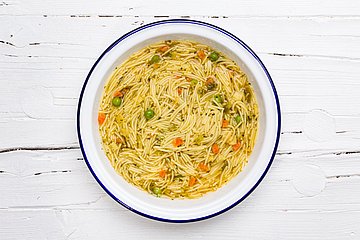
Instant soups and sauces consist of many different particle forms: dried vegetables, ground spices, natural flavors, liquid extracts, stabilizers, and enzymes. The vertical twin-shaft mixer (HM) is ideal for this very task: Two screw-conveyor mixing units rotating in the same direction create an upward spiral at the periphery and a downward flow at the center. This allows the same mixer to intensively deagglomerate the powders one after another or homogenize them extremely gently without changing the vessel.
- Deagglomeration: Dextrose, maltodextrin, salts, spices, starch, oleoresins, fats, oils, and flavorings are mixed with high energy input, aided by swirlers, choppers, cutting rotors, or high-shear blades. The conical single-shaft mixer (AM) also performs this step: It is universally applicable, operates at fill levels of approximately 5 to 100 percent, and achieves ideal mixing quality in very short mixing times. During this process, the powdered components are intensively wetted with liquid additives such as oil, fat, seasoning extract, or lecithin.
- Homogenization: The mixer stops, and fragile ingredients such as freeze-dried dill tips, onion rings, pieces of bell pepper and cauliflower, or pasta pieces are added. The mixer then runs for only about 30 seconds at a slow rotation speed to prevent the coarse particles from breaking apart.
The result: Coarse components are preserved, the mixture is not heated during the mixing process, and the batch is discharged without segregation. Because both steps take place in the same machine, there are no transfer losses and no additional cleaning required.
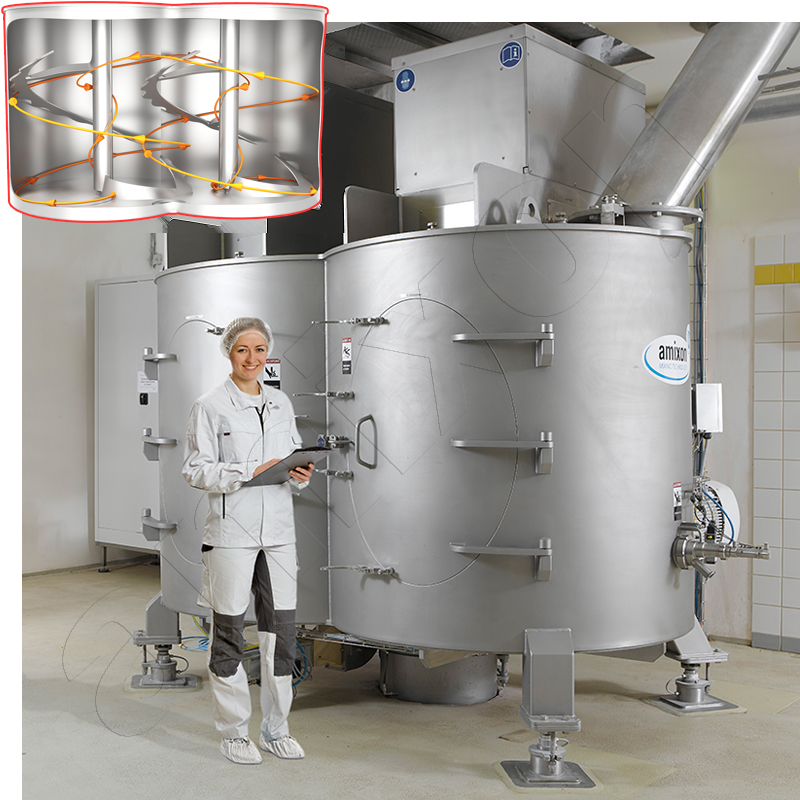
amixon® HM Twin-Shaft Mixer
Instant soups and sauces consist of many different particle forms: dried vegetables, ground spices, natural flavors, liquid extracts, stabilizers, and enzymes. The vertical twin-shaft mixer (HM) is ideal for this very task: Two screw-conveyor mixing units rotating in the same direction create an upward spiral at the periphery and a downward flow at the center. This allows the same mixer to intensively deagglomerate the powders one after another or homogenize them extremely gently without changing the vessel.
- Deagglomeration: Dextrose, maltodextrin, salts, spices, starch, oleoresins, fats, oils, and flavorings are mixed with high energy input, aided by swirlers, choppers, cutting rotors, or high-shear blades. The conical single-shaft mixer (AM) also performs this step: It is universally applicable, operates at fill levels of approximately 5 to 100 percent, and achieves ideal mixing quality in very short mixing times. During this process, the powdered components are intensively wetted with liquid additives such as oil, fat, seasoning extract, or lecithin.
- Homogenization: The mixer stops, and fragile ingredients such as freeze-dried dill tips, onion rings, pieces of bell pepper and cauliflower, or pasta pieces are added. The mixer then runs for only about 30 seconds at a slow rotation speed to prevent the coarse particles from breaking apart.
The result: Coarse components are preserved, the mixture is not heated during the mixing process, and the batch is discharged without segregation. Because both steps take place in the same machine, there are no transfer losses and no additional cleaning required.
amixon® HM Twin-Shaft Mixer
When the Mixer Becomes a Sterile Reactor
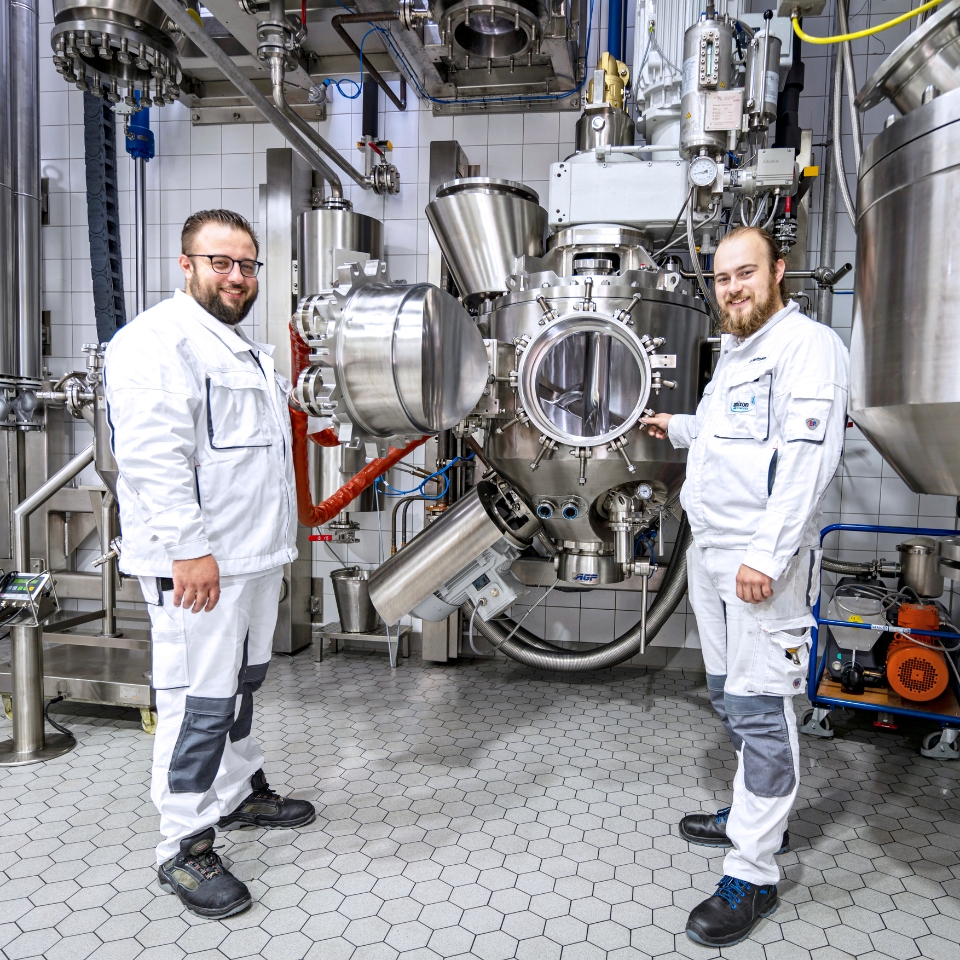
amixon® AMT Cone Mixer-Dryer
Some instant formulations require thermal treatment before final blending—for example, to specifically reduce residual moisture or to adjust solubility and flowability to the desired levels. The conical mixing dryer and reactor (AMT) is well-suited for this purpose, as it is temperature-controlled and designed to be pressure- and vacuum-tight, and it performs both mixing and thermal treatment in the same vessel. Spices, vegetables, or fruits are first mixed slowly and gently without altering their particle size distribution. The advantage: The product does not need to be transferred between the mixing and thermal treatment stages, which prevents transfer losses and ensures the reproducibility of the specified functionality from batch to batch.
amixon® AMT Cone Mixer-Dryer
Some instant formulations require thermal treatment before final blending—for example, to specifically reduce residual moisture or to adjust solubility and flowability to the desired levels. The conical mixing dryer and reactor (AMT) is well-suited for this purpose, as it is temperature-controlled and designed to be pressure- and vacuum-tight, and it performs both mixing and thermal treatment in the same vessel. Spices, vegetables, or fruits are first mixed slowly and gently without altering their particle size distribution. The advantage: The product does not need to be transferred between the mixing and thermal treatment stages, which prevents transfer losses and ensures the reproducibility of the specified functionality from batch to batch.
Which mixer is right for my recipe?
The choice between HM, AM, and AMT depends on two properties of the formulation: the brittleness of the coarse particles and the need for thermal post-treatment. The following questions can help with the preliminary selection before a mixing trial at the amixon® Technical Center confirms the final process design.
- Does the formulation need to be thermally treated before final blending—for example, to reduce residual moisture or to specifically adjust solubility and flowability? If so, the AMT is a suitable option, as it is temperature-controlled and designed to be pressure- and vacuum-tight, allowing both mixing and thermal treatment to take place in the same vessel.
- Does the formulation contain particularly fragile coarse particles, such as freeze-dried vegetables or herbs? In that case, the HM is suitable, as deagglomeration and gentle homogenization take place in the same vessel, and the fragile components are added only in a gentle second step.
- Do you need to prepare a premix before mixing, which will then be incorporated into the main mixture? In that case, the AM is often the best choice, as it operates at fill levels as low as 5 percent, thereby enabling both processes to take place in the same mixer.
These questions are no substitute for a mixing trial with the actual product, but they do provide an initial guide as to which mixer type is even relevant for the planned formulation.
The choice between HM, AM, and AMT depends on two properties of the formulation: the brittleness of the coarse particles and the need for thermal post-treatment. The following questions can help with the preliminary selection before a mixing trial at the amixon® Technical Center confirms the final process design.
- Does the formulation need to be thermally treated before final blending—for example, to reduce residual moisture or to specifically adjust solubility and flowability? If so, the AMT is a suitable option, as it is temperature-controlled and designed to be pressure- and vacuum-tight, allowing both mixing and thermal treatment to take place in the same vessel.
- Does the formulation contain particularly fragile coarse particles, such as freeze-dried vegetables or herbs? In that case, the HM is suitable, as deagglomeration and gentle homogenization take place in the same vessel, and the fragile components are added only in a gentle second step.
- Do you need to prepare a premix before mixing, which will then be incorporated into the main mixture? In that case, the AM is often the best choice, as it operates at fill levels as low as 5 percent, thereby enabling both processes to take place in the same mixer.
These questions are no substitute for a mixing trial with the actual product, but they do provide an initial guide as to which mixer type is even relevant for the planned formulation.
Frequently Asked Questions
Why must the dry mixing process for instant products not cause a measurable increase in temperature?
A rise in temperature during mixing can affect the distribution of moisture in the product and compromise the effectiveness of preservatives such as sorbates or benzoates, whose minute quantities alone determine the microbiological stability of the entire batch. amixon® prevents this by using a short, controlled mixing time as part of the multi-step method.
Why does the second mixing step with fragile ingredients last only about 30 seconds?
After adding fragile ingredients such as vegetable flakes or herbs, the amixon® mixer continues to run only briefly and at a slow rotational speed. This minimizes the breakage of coarse particles without compromising the homogeneity of the base mixture that was previously achieved.
Can an amixon® mixer also perform sterilization tasks?
Yes, when configured as a mixer-reactor: temperature-controlled, pressure- and vacuum-tight, with sterile steam injection followed by vacuum. This is used, for example, for culture media in gourmet mushroom cultivation; for simple dry mixtures without microbiological requirements, it is not necessary.
Learn more in our Fact Sheet!
Why must the dry mixing process for instant products not cause a measurable increase in temperature?
A rise in temperature during mixing can affect the distribution of moisture in the product and compromise the effectiveness of preservatives such as sorbates or benzoates, whose minute quantities alone determine the microbiological stability of the entire batch. amixon® prevents this by using a short, controlled mixing time as part of the multi-step method.
Why does the second mixing step with fragile ingredients last only about 30 seconds?
After adding fragile ingredients such as vegetable flakes or herbs, the amixon® mixer continues to run only briefly and at a slow rotational speed. This minimizes the breakage of coarse particles without compromising the homogeneity of the base mixture that was previously achieved.
Can an amixon® mixer also perform sterilization tasks?
Yes, when configured as a mixer-reactor: temperature-controlled, pressure- and vacuum-tight, with sterile steam injection followed by vacuum. This is used, for example, for culture media in gourmet mushroom cultivation; for simple dry mixtures without microbiological requirements, it is not necessary.
Learn more in our Fact Sheet!
 Related News
© Copyright by amixon GmbH