Vacuum operation
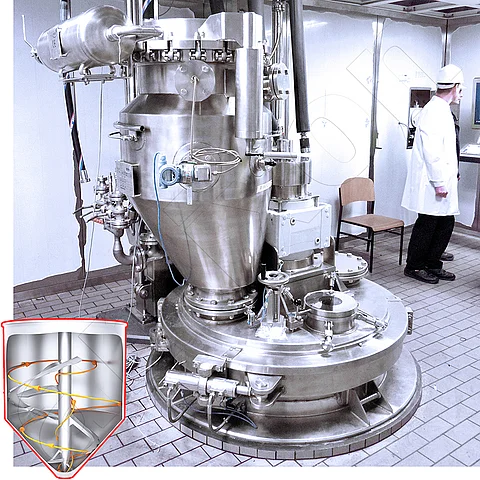
On the left you can see an amixon® vacuum dryer/reactor for 600-liter batches in pharmaceutical manufacturing. In vacuum operation, a process apparatus is operated at a pressure below atmospheric pressure. The pressure is actively lowered and controlled with vacuum pumps. The aim is to lower the boiling point of liquids, remove oxygen, and influence mass transfer processes.
In vacuum operation, the boiling point of a liquid decreases as the pressure drops. This enables drying at low temperatures and protects temperature-sensitive products. At the same time, oxidation is reduced.
The relationship between pressure and boiling point can be qualitatively described as follows:
p↓ ⇒Tboil↓
The heat requirement for evaporation in vacuum operation is described by
Q˙ = m˙⋅ Δhvap
- Q˙ is the supplied heat rate
- m˙ is the mass flow rate of the evaporating water or solvent
- Δhvap is the enthalpy of vaporization of the liquid
In vacuum operation, heat transfer often occurs through contact with heated wall surfaces or mixing tools. The specific heat transfer area of the apparatus is therefore of great importance.
 Blog
Blog