
turbulence
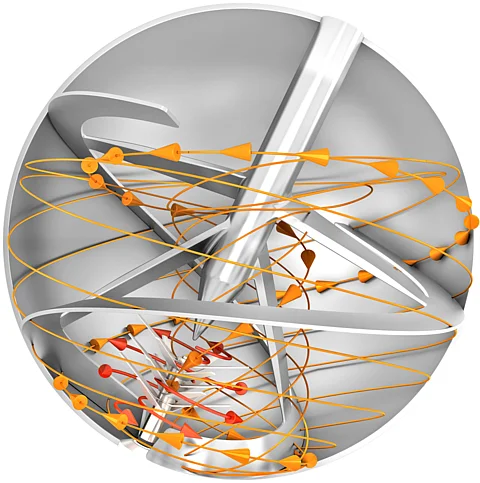
The SpherHelics® mixer shown on the left is a product from amixon®. Turbulence prevails in the lower part of the sphere, where a high-speed cutting rotor is in operation. In the upper part of the mixing chamber, a gentle shear flow is generated by the slowly rotating mixing helix.
In process engineering, turbulence frequently occurs at high relative velocities, for example due to rapidly rotating mixing tools, nozzles or cutting rotors. It leads to intensive mass and heat transfer. At the same time, the mechanical stress on the particles increases. In powder mixing, turbulence can be desirable or undesirable. It is useful when agglomerates need to be broken up or materials need to be dispersed very quickly. In other cases, it can lead to dust generation, segregation, abrasion or product damage.
Turbulence is the opposite of laminar flow. Whilst laminar flow enables gentle, low-dust mixing, turbulence creates high levels of turbulence and requires a high energy input. The choice of flow pattern depends on the product, the process objective and the specific requirements.