

Bulk Solid Theory
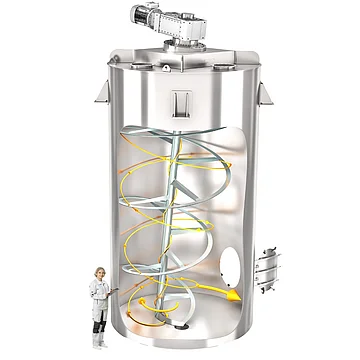
Image on the left: Gyraton silo mixers consistently achieve high mixing quality – regardless of the properties of the bulk solids.
Bulk solids theory (also known as bulk solids technology) is a sub-field of process engineering and mechanics. It deals with the physical behaviour of bulk solids. It describes how powders, granulates and other particulate solids flow, compact, segregate or adhere to one another under the influence of forces.
Unlike liquids and solids, bulk materials exhibit complex, non-linear behaviour determined by particle contact, friction, cohesion and compaction.
Bulk solids theory employs models from continuum mechanics, soil mechanics and granular physics, such as the Mohr–Coulomb model, the Janssen equations for silo pressure or modern approaches to granular rheology.
For the design of cylindrical silos, the Janssen equation describes the vertical stress in the direction of filling as a function of depth z:
Vertical stress σ_v(z) in the direction of filling at depth z in a cylindrical silo:
σ_v(z) = ρ_b·g·λ·(1 - e^(-z/λ))
where
- ρ_b = bulk density,
- g = acceleration due to gravity,
- λ = R / (2·μ_w·K) = characteristic equilibrium length,
- R = silo radius,
- μ_w = coefficient of friction between the wall and the bulk material,
- K = lateral pressure coefficient (horizontal/vertical ratio).
The horizontal wall stress is given by:
σ_h(z) = K·σ_v(z)
K = σ_h/σ_v
- σ_h = horizontal stress
- σ_v = vertical stress
This relationship is used to design silo walls. The formula also illustrates the typical ‘saturation’ of the stress as the fill height increases; unlike liquids, the pressure does not rise linearly in a hydrostatic manner, but approaches a limit value.
In process engineering, bulk solids theory forms the basis for the design of silos, hoppers, discharge devices, conveyors, mixers and dosing systems. It is crucial for process reliability, flow behaviour, product quality and the prevention of operational disruptions such as bridging, channeling or segregation.