

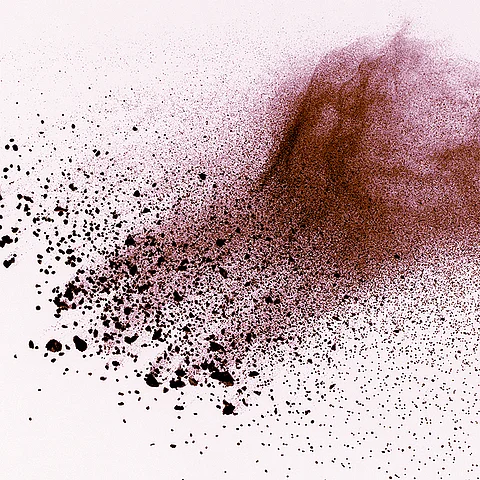
Tendency to attract dust
Dustiness refers to the tendency of a bulk material to generate dust during handling. Dust can be produced by abrasion, fragmentation or the stirring up of fine particles. Dust is released particularly during pouring, transfer, dosing, conveying and mixing. This also applies to the final stage of powder drying.
A high tendency to generate dust is exacerbated by fine particles and a wide particle size distribution. Angular particles are more prone to breaking than round ones. As such, they form fine dust particles when disturbed. Dry and light materials are more prone to generating dust than damp ones. Agglomerates can bind fine particles, thereby reducing the tendency to generate dust.
A high tendency to generate dust can lead to product losses, emissions and explosion risks. It also affects dosing accuracy and reproducibility. Possible technical measures include enclosure, extraction, humidification and agglomeration in the mixer. As a general rule, the handling of dusty materials should take place in closed systems.