

solubility
Solids, such as powders, can dissolve in liquids if their chemical structure allows them to interact with the solvent. Gases can also be dissolved in liquids, for example carbon dioxide in water.
Solubility describes the maximum amount of a substance that can be dissolved in a solvent at a given temperature and pressure. It is a fundamental parameter in treatment and process engineering.
The dissolution process is determined by diffusion. The material dissolves at the surface of the solid and the dissolved molecules diffuse into the surrounding liquid. The speed of mixing or the flow of the solvent significantly influence this transport process.
In contrast to a solution is a suspension. Here, the solid particles are not soluble, but finely distributed in the liquid. The solid and liquid phases exist side by side. Depending on their density and particle size, the solids may sediment or float.
Solutions can be broken down or separated in a targeted manner. One example of this is crystallisation, in which dissolved substances crystallise through cooling or evaporation of the solvent. Another process is flotation. Here, solids are bound to gas bubbles by the addition of flocculants or flotation agents and transported to the surface. Such separation processes are used in wastewater treatment and in the chemical industry.
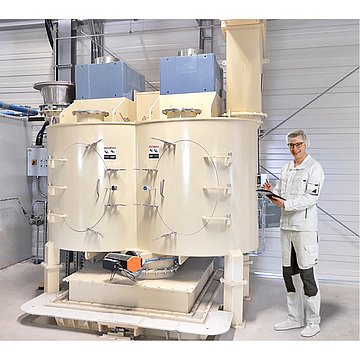
amixon® process equipment can produce solutions or suspensions and keep them stable. In addition, they can also carry out chemical precipitation and crystallisation processes.
 Blog
Blog